AI is overkill.
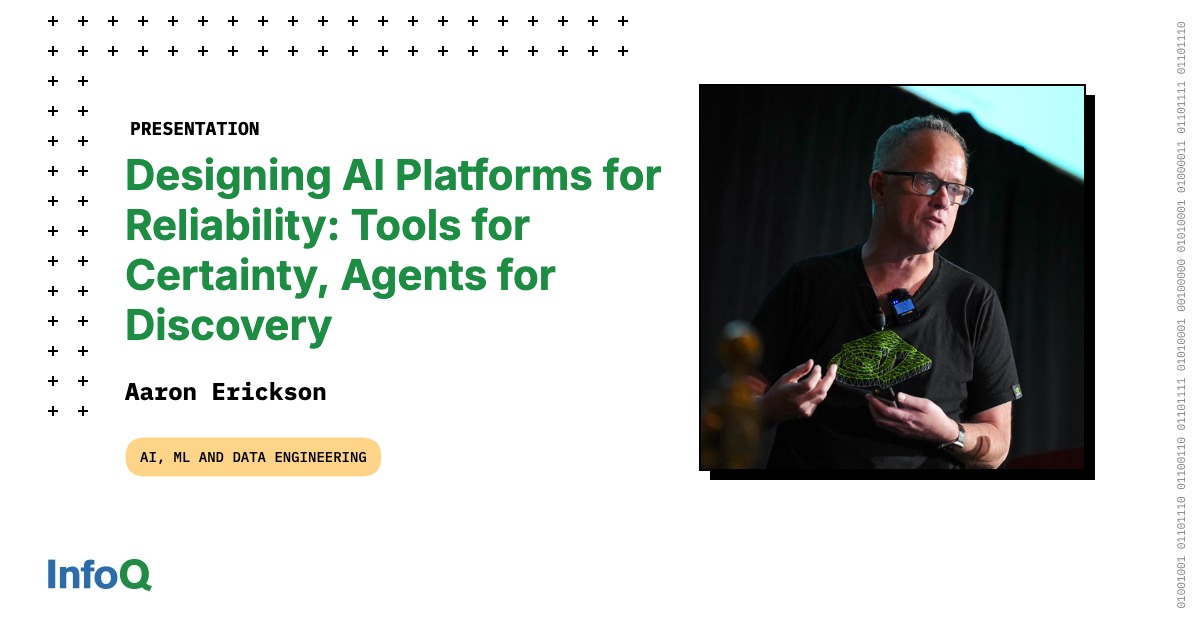
It’s a phrase that should be tattooed on the foreheads of every MBA who’s ever declared their entire business model “AI-first” overnight. Aaron Erickson, now at NVIDIA, but formerly of Orgspace, knows this all too well. He stood on stage, a lone voice of weary realism, dissecting the frenzy that consumed 2023. The mandate was simple: If you didn’t slap an AI sticker on your startup, you wouldn’t get funding. Not even a coffee shop. It’s enough to make you miss the days when the worst corporate buzzword was “synergy.”
His previous gig at Orgspace involved building software for… reorgs. Yes, reorgs. A concept universally loathed, even by the people doing the reorganizing. It’s the corporate equivalent of rearranging deck chairs on the Titanic, but with more spreadsheets and existential dread. And in the AI gold rush, the bright idea was to ask ChatGPT to handle the heavy lifting. Think of it like using a chatbot to perform surgery. Desperation breeds… interesting ideas.
What emerged was a system that, given a prompt like “people are flattening orgs, help me,” would churn out a reorganization plan. It pulled data, spewed out recommendations – the kind of bland, consultant-approved output that’s “most mid.” You could then execute the plan, flatten your precious hierarchy, and even get your reorg email drafted in iambic pentameter. Because nothing says genuine corporate restructuring like poetry written by a language model.
This was like the thing you would do in 2023.
It’s a perfect encapsulation of the era. Innovation wasn’t about solving problems; it was about appearing to solve problems with the hottest new tech. The org chart flattened, the emails were sent, and presumably, the existential angst remained unchanged. This isn’t discovery; it’s a very expensive, very digital form of busywork.
The Hard Truth About GPU Governance
But Erickson landed on his feet. Not in HR tech, thankfully. He’s now at NVIDIA, a place that actually does AI, in a way that involves actual chips. His first assignment? Not building another chatbot to fire people, but managing GPU fleets. This is where the rubber meets the road for serious AI development. These aren’t your grandma’s spreadsheets we’re talking about. We’re talking about multimillion-dollar GPU clusters, essential for training gargantuan models like Nemotron and BioNeMo.
He draws a parallel between managing human resources and managing computational resources. It’s surprisingly apt. Open positions in HR become idle GPU clusters. Headcount requests morph into requests for thousands of H100s. Complex organizational hierarchies find their echo in the cloud provider regions and blocks. Performance management? That’s the GP.
It’s a stark reminder that the shiny AI applications we see are built on a foundation of immense, carefully managed infrastructure. The ‘discovery’ part of AI might be exciting, but the ‘certainty’ part – reliably allocating and managing these power-hungry resources – is what keeps the lights on. And it’s far less glamorous.
Why Does This Matter for Developers?
For developers, especially those in the open-source space, this distinction is vital. We’re often building the tools that sit on top of these behemoths, or perhaps even contributing to the underlying infrastructure itself. The idea of an “agent for discovery” is compelling – an AI that can explore, experiment, and find novel solutions. But without the “tools for certainty” – reliable deployment, resource management, predictable performance – these agents are just digital pipe dreams.
Erickson’s journey from chatbot-generated reorgs to GPU fleet management highlights the practicalities. The hype cycle moves fast. What’s cutting-edge today is tomorrow’s corporate folly. The real work, the work that sustains innovation, often lies in the unsexy but essential infrastructure that enables it. This means understanding how to provision, monitor, and manage complex systems, whether they’re composed of humans or silicon.
My own unique insight here, and bear with me, is that the narrative around AI is so heavily skewed towards the output, the dazzling capability, that we often forget the sheer engineering effort required to even get there. We see the AI drawing a picture or writing code and think it’s magic. It’s not. It’s math, meticulously managed infrastructure, and a whole lot of expensive hardware running at peak efficiency. The brilliance of an AI agent for discovery is directly proportional to the robustness of the certainty tools that underpin it.
Look, the promise of AI is enormous. But the path from a ChatGPT plugin to a reliable, scalable AI platform is paved with more than just good intentions. It’s paved with solid engineering, pragmatic resource management, and a healthy dose of skepticism towards anything that sounds too good to be true. Especially if it involves automating reorgs.
🧬 Related Insights
- Read more: AI Gateways: Taming the Model Zoo
- Read more: Kubernetes GPU Waste: The Invisible Cost
Frequently Asked Questions
What are AI agents for discovery? These are AI systems designed to explore unknown data, experiment with hypotheses, and uncover new insights or solutions, often in complex or uncertain environments.
What are tools for certainty in AI platforms? These are the infrastructure, management, and governance tools that ensure AI systems operate reliably, predictably, and efficiently. Think resource allocation, monitoring, and deployment systems.
Will AI replace HR and consultants? While AI can automate aspects of HR and consulting work, it’s unlikely to fully replace human judgment, empathy, and strategic decision-making in the near future. The focus is more on augmentation.