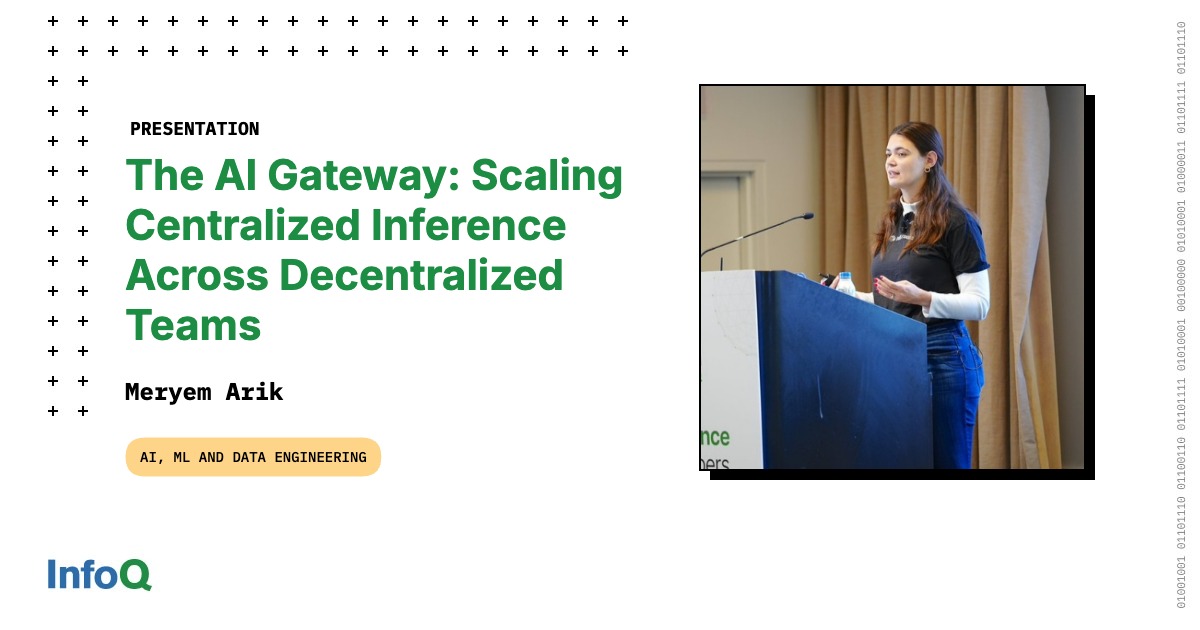
They’re wrangling spreadsheets, then suddenly they need to integrate the latest LLM. That’s the scene playing out in countless tech departments right now, a frantic scramble for inference — the actual running of AI models. And according to Meryem Arik, CEO of Doubleword and a former Oxford physicist, it’s a mess.
Arik recently took the stage, not to pitch her company’s commercial wares, but to champion something far more fundamental: AI model gateways. Her company, four years into tackling inference problems for clients, found itself staring at a familiar disaster. Companies weren’t just using one or two AI providers; they were juggling OpenAI, Mistral, and a hodgepodge of self-hosted, fine-tuned models. Chaos. Pure, unadulterated, expensive chaos.
This is precisely where AI model gateways, like the open-source one Doubleword built (though they don’t sell it), come in. Arik’s message is simple, yet potent: everyone needs one, even for small-scale deployments.
The Hunting Analogy: Why One Model Won’t Do
It’s easy to scoff at the need for complexity. “Can’t we just pick the best model?” the uninitiated might ask. Arik dismantles this notion with a surprisingly apt analogy: a posh English hunt. You don’t just have one dog for the entire affair. You need pointers to locate the game, spaniels to flush it out, and retrievers to bring it back. Each breed, much like each AI model, has a specialized role.
Every single application will have a different requirement for inference. There’s no one model that rules them all.
This extends to the practicalities of model selection. It’s not just about raw intelligence. You’ve got application quality – does it actually solve the problem? Then there are non-performance factors: regulatory compliance, data residency requirements (everything must be in AWS because of credits, or in the EU because of GDPR). Finally, you have inference performance trade-offs. A brilliant model that costs $25 per run isn’t going to cut it for most use cases.
Dimensions of Inference Demand
- Application Quality: Does the model actually perform the task correctly?
- Non-Performance Constraints: Location (AWS, EU, Mexico), regulatory needs, data residency.
- Performance Trade-offs: Cost, latency, throughput vs. accuracy.
- Modality: Embeddings, images, voice, text generation.
- Task Specificity: Does it excel at labeling cancer screens or general conversation?
This is the thorny landscape your use-case teams have to navigate. Empowering them means giving them access not just to a model, but to a curated, accessible array of models suited to these diverse demands.
The Centralization Conundrum
But here’s the rub. If every team is out there independently sniffing around for models, you’re back to square one: anarchy. This is where the idea of centralizing inference infrastructure, or at least the management of it, becomes compelling. The tension is between the decentralized nature of use-case development (teams wanting to pick their own tools) and the efficiency gains of centralized management.
A model gateway acts as the indispensable intermediary. It’s the maître d’ at the chaotic AI restaurant, taking your order and ensuring the right dish (model) is prepared by the right chef (provider) in the right kitchen (environment).
Why Does Centralized Inference Matter?
From my own twenty years watching Silicon Valley flail and then eventually succeed, I’ve seen this pattern before. The initial surge of innovation is always messy. Everyone invents their own wheel. Then, the infrastructure builders arrive, providing standardization and efficiency. Think of how cloud platforms consolidated server management. Think of how package managers like npm or pip brought order to software dependencies.
AI model gateways are the next logical step. They promise to tame the wild west of LLM providers, offering a single point of access, standardized APIs, and a dashboard for monitoring usage, cost, and performance. This isn’t just about convenience; it’s about control and cost-efficiency. Without it, companies risk paying through the nose for redundant services and struggling with security and governance across a sprawling, unmanaged AI landscape.
Who’s Actually Making Money Here?
Let’s not pretend this is all about altruism. While Arik is pushing an open-source gateway and emphasizes its importance for everyone, the underlying need represents a massive market. Companies will build commercial products around this problem. Think of companies like LiteLLM or OpenRouter that Arik mentioned – they’re already playing in this space. The value isn’t just in providing access to models, but in abstracting away the complexity, managing costs, and ensuring reliability and security. Those who can effectively solve the inference chaos for enterprises stand to make a killing. It’s the infrastructure play, the plumbing beneath the shiny AI applications. And right now, that plumbing is a tangled mess.
The Open-Source Argument
Arik’s advocacy for an open-source gateway is shrewd. It democratizes the solution, preventing a single vendor from locking everyone in. It encourages adoption by making the barrier to entry low. This aligns perfectly with the spirit of Open Source Beat, where transparency and community-driven solutions are paramount. It’s a pragmatic approach: if the problem is widespread, the solution should be accessible.
The goal? To bring order to the inference storm, to let development teams focus on building innovative use cases rather than fighting with APIs and managing vendor sprawl. It’s a vision of a more efficient, manageable, and ultimately more productive AI future. And it starts with a gateway.
🧬 Related Insights
- Read more: Cloudflare’s MCP: Is This the Future of Agent APIs?
- Read more: CrowdStrike’s $5.4 Billion Blackout: The Monitoring Flaw That Doomed Recovery
Frequently Asked Questions
What does an AI model gateway do? An AI model gateway acts as a central point of access for various AI models. It simplifies how applications interact with different model providers, abstracting away complexities like API differences, authentication, and cost management.
Will an AI model gateway replace my current AI models? No, an AI model gateway doesn’t replace your existing AI models. Instead, it provides a unified interface for calling them, allowing you to use multiple models from different providers (like OpenAI, Mistral, or self-hosted ones) through a single, consistent API.
Is an AI model gateway suitable for small teams? Yes, the presentation argues that AI model gateways are beneficial even for small-scale deployments. They help manage complexity and costs from the outset, preventing future chaos as the team’s AI usage grows.