A developer stares at a screen, the cursor blinking expectantly, a universe of possibilities contained within a few lines of AI-generated code.
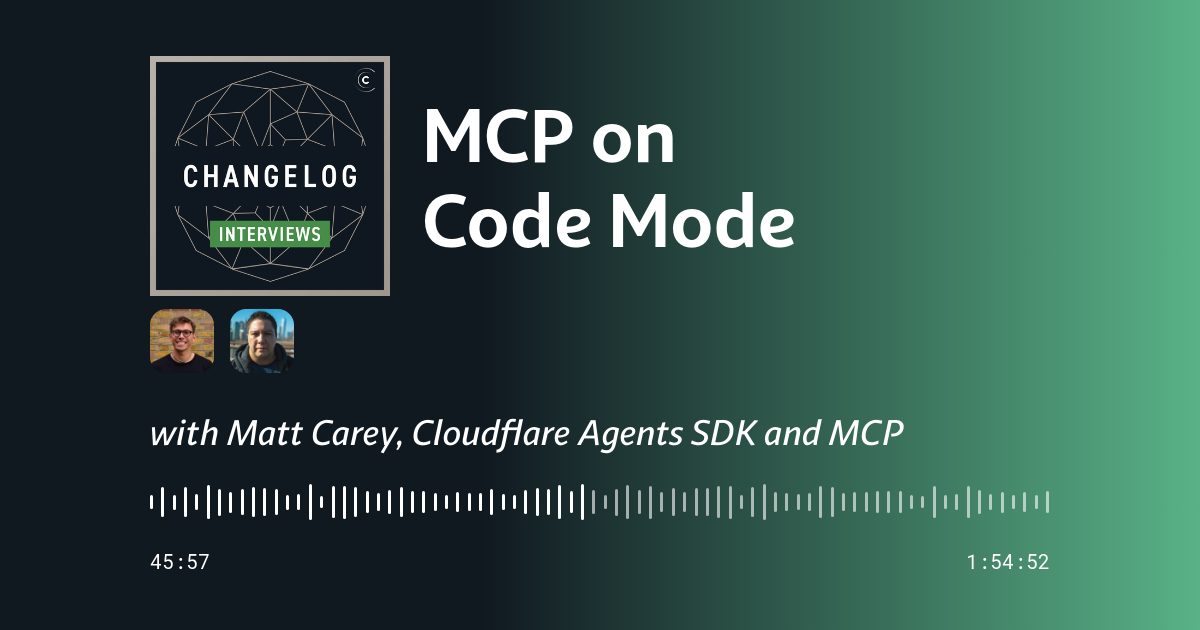
That moment, so familiar yet increasingly alien, is precisely what Cloudflare is trying to reinvent with its Model Context Protocol (MCP) and, more recently, its “Code Mode.” For too long, the dream of truly useful AI agents has been hobbled by a fundamental architectural friction: how do you give a language model access to a sprawling, complex API surface without overwhelming its limited context window? The answer, it turns out, might be a lot more elegant than we thought, and Matt Carey, a key figure on Cloudflare’s Agents SDK team, is here to explain why most of us have been thinking about MCP all wrong.
The core issue is scale. Imagine an AI agent needing to interact with, say, Cloudflare’s entire API. That’s roughly 2,500 distinct endpoints, each with its own parameters, authentication requirements, and potential side effects. Feeding even a fraction of that documentation into a typical LLM’s prompt would instantly blow past its token limit, rendering it effectively blind and useless for anything beyond the most trivial tasks. This is where the traditional approach of “tool calling” or exposing individual functions falters; it’s like asking someone to navigate a city with only a street map for one block.
Cloudflare’s breakthrough, discussed extensively by Carey, is to treat the entire API surface not as a collection of discrete tools, but as a unified, searchable, and dynamically loadable knowledge base. This is the essence of MCP Code Mode. Instead of listing every API call the agent might use, Code Mode lets a single MCP server expose these ~2,500 endpoints within a remarkably tight context window—around 1,000 tokens. This is a seismic shift, moving from explicit enumeration to implicit discovery and execution.
Why is Cloudflare’s MCP Approach a Game-Changer?
Think of it this way: Instead of a chef having a giant recipe book with thousands of individual recipes, they have a single, incredibly detailed menu that describes every dish. The chef (the AI agent) can then ask for specifics about any dish, and the waiter (the MCP server) can retrieve that information and even orchestrate its creation without the chef needing to memorize every step of every recipe beforehand. This dynamic loading and on-demand information retrieval is what makes Code Mode so powerful. It’s less about what the agent knows and more about how the agent can find out what it needs to do, precisely when it needs to do it.
The magic happens through a dynamic Worker loader that runs model-written code safely within a V8 isolate. This means the AI-generated code—code that might even be partially written by another AI—is executed in a sandboxed environment, preventing it from wreaking havoc on your production systems. It’s a crucial layer of security that has been conspicuously absent in many earlier agent experiments. Carey emphasizes this point, noting the inherent risks involved when agents have significant programmatic control over critical infrastructure.
Carey’s own workflow with Claude offers a human-scale glimpse into this future. He’s not just using AI to write code; he’s using it to manage and augment his development process. Tools like his Zaggy git wrapper, designed to prevent agents from force-pushing into his repositories, highlight the pragmatic challenges and solutions emerging in this space. It’s a clear signal that the “AI revolution” isn’t just about generation; it’s about integration, control, and trust.
We’re talking about giving agents an entire API in 1,000 tokens.
This quote from the Cloudflare blog succinctly captures the audacious nature of Code Mode. It’s not an incremental improvement; it’s a fundamental re-architecture of how AI agents interface with software systems. The implications for developers are profound. No longer will agents be limited to a handful of pre-defined, brittle functions. They can, in theory, orchestrate complex workflows across vast services by simply understanding the intent and letting the MCP layer handle the mechanics.
Where Does Memory Fit into All This?
The discussion inevitably turns to memory. How do these agents retain context across multiple interactions? How do they learn from past successes and failures? Carey hints that memory is a critical, yet still somewhat nascent, area of focus. The current architectural shifts are laying the groundwork for more sophisticated memory systems, moving beyond simple session history to more persistent, contextual understanding. Imagine an agent that not only knows how to access the Cloudflare API but also remembers your past interactions with it, proactively suggesting relevant actions or anticipating your needs.
This entire paradigm shift resonates with historical parallels. Early operating systems treated hardware as monolithic blocks. Then came abstraction layers, virtual machines, and containers, each offering greater flexibility and isolation. Cloudflare’s MCP and Code Mode feel like the next evolution for AI interaction—a sophisticated abstraction that allows for powerful, yet controlled, access to complex systems. The skepticism surrounding AI agents often stems from their perceived fragility and limited scope. Code Mode directly tackles this by providing a strong, scalable, and secure foundation.
For developers, this isn’t just about faster code generation. It’s about a future where AI agents are not just assistants but collaborators, capable of understanding and navigating the complex web of modern software infrastructure. It’s about moving from explicitly telling the AI how to do something, to simply telling it what you want to achieve, and trusting it to find the most efficient path through the available tools and APIs. Cloudflare’s approach, grounded in practical engineering and a clear understanding of the limitations of current LLMs, might just be the blueprint we’ve been waiting for.
🧬 Related Insights
- Read more: Phone-to-PC Jukebox Quest: Pikaraoke and Open-Source Rivals That Actually Work
- Read more: Hello World in 0s and 1s: Why Binary and ASCII Unlock Developer Superpowers
Frequently Asked Questions
What is Cloudflare’s MCP? MCP, or Model Context Protocol, is a Cloudflare initiative to standardize how AI models interact with external tools and data. Its Code Mode specifically allows agents to access thousands of API endpoints within a very small context window.
Will Code Mode replace traditional API documentation? No, but it dramatically changes how developers and AI agents will interact with APIs. Instead of developers needing to parse and feed extensive documentation into an AI, Code Mode provides a dynamic, discoverable interface that AI can query on demand.
Is Cloudflare’s Code Mode secure for agents to use? Yes, Cloudflare’s implementation uses V8 isolates to run model-written code in a sandboxed environment, providing a critical security layer against malicious or erroneous code execution.