The refund pinged back into Priya’s account, a digital ghost haunting a completed order. But this time, the system fought back.
“Order #4471 already shipped yesterday. Automatic cancellation only applies before shipment. I can start a return when it arrives, or connect you with a human agent right now. Which would you prefer?”
It stopped. Waited. No confident pronouncements, no preemptive apologies. Just a clear, contextual offer.
This wasn’t about a smarter Large Language Model. The engine behind this response was the same one that, in a previous iteration, had confidently and erroneously refunded Priya. The revolution here wasn’t in the silicon, but in the scaffolding. This is where the real story of AI agents begins: not with the model’s raw intelligence, but with the complex systems built around it.
The difference, starkly illustrated, boils down to architecture. The broken agent from Part 1 didn’t fail because it was dumb; it failed because its structural components were misaligned, its decision-making flow brittle. The second system, however, was engineered for resilience and intelligence. It checked the actual state of the order before acting. It compared that state against established procedures, recognizing ‘shipped’ as a legitimate blocker, not an error condition. Crucially, it presented the customer with realistic alternatives based on the current reality, and—perhaps most tellingly—it paused, deferring the next move to human agency.
Notice what’s conspicuously absent from that list of improvements: no mention of a more advanced model, no tweak to the prompt engineering. The leap forward was purely structural. The system, in essence, engineered a space where the correct decision could naturally emerge. The three glaring deficiencies from Part 1—state awareness, a clear stopping condition, and a strong escalation path—were all addressed by reconfiguring the underlying architecture.
This isn’t mere semantics. The original prompt might have been a bit of a Swiss Army knife, stuffed with every conceivable instruction. The sophisticated agent, however, use composition—the elegant assembly of discrete, well-defined components—where the first relied on brute-force prompt stuffing.
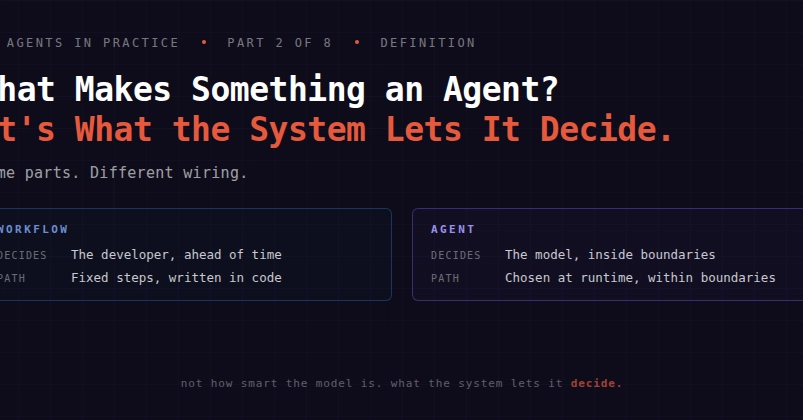
What makes an AI agent an agent, then? It’s the loop. A deceptively simple cycle that powers intelligence: Observe → Decide → Act → Check → Repeat. This isn’t a fixed script, a pre-ordained path the system blindly follows. Instead, at each iteration, the model itself is empowered to choose the next step—whether to query a tool, solicit user input, or gracefully terminate the interaction. All within the carefully defined boundaries set by the system’s architects.
This continuous feedback loop is the engine of adaptable AI behavior. The ‘Observe’ step is critical, gathering the current state—the user’s request, the dialogue history, the results of previous actions, any accumulated knowledge. This forms the bedrock for the ‘Decide’ step, where the model, drawing on this context, makes a strategic choice. The ‘Act’ phase executes that decision, perhaps by invoking a specialized tool or communicating with the user. The ‘Check’ stage then feeds the outcome of that action back into the system, enriching the context for the next ‘Observe’ cycle. The loop continues until a defined stopping condition is met, an impasse is reached, or an escalation to a human is deemed necessary.
Why This Systemic Shift Matters
The workflow, a familiar construct, executes predetermined steps laid out by a developer. The agent, in contrast, exercises runtime autonomy. It’s the same set of functional primitives—tools for acting, knowledge for knowing, and structured procedures for guiding behavior—but wired differently, enabling dynamic decision-making. This distinction is crucial for understanding the future of automation. It moves us beyond rigid, pre-programmed sequences to systems capable of genuine, albeit bounded, reasoning and adaptation.
An agent doesn’t need to reinvent the wheel for every task. It composes three fundamental capabilities:
MCP — For Acting: This is the standardized protocol that allows an agent to interact with the external world—querying databases, calling APIs, running calculations, dispatching emails. Think of these as the agent’s verbs, its means of effecting change in the digital or physical realm. The MCP (Model-Command Protocol) in practice ensures a clean, consistent interface for these actions, irrespective of their underlying complexity.
RAG — For Knowing: Retrieval-Augmented Generation brings external, relevant knowledge directly into the agent’s operational context. This could be anything from company policy documents and product manuals to historical customer interactions or complex eligibility matrices. RAG ensures that an agent’s decisions are grounded in verifiable facts and up-to-date information, rather than relying solely on the static knowledge embedded in its training data. This capability is fundamental to creating agents that are both informed and accurate.
Skills — For Following Reusable Procedures: Skills act as codified, reusable procedural logic. Defined in formats like Markdown, they outline specific sequences of actions, their intended use cases, and crucially, their failure modes. These aren’t just static instructions; they represent pre-vetted, repeatable processes that the agent can apply reliably across a variety of situations, ensuring consistency and efficiency in common tasks.
The previous agent’s fatal flaw wasn’t a lack of understanding, but a lack of structured self-awareness. It couldn’t see the forest for the trees, or in this case, the shipped order for the cancellation request. The new system, by contrast, is built with a fundamental understanding of its own operational constraints and the external world it interacts with. This architectural maturity is the true differentiator, heralding a new era where AI agents are not just responsive, but contextually aware and strategically autonomous.
🧬 Related Insights
- Read more: AI Coding’s Day 2: What Breaks When Adoption Scales
- Read more: eBPF Kills User-Space Security Agents [Kernel Ground Truth]
Frequently Asked Questions
What does “AI agent” actually mean in this context?
It refers to an AI system designed to perform tasks autonomously by observing its environment, making decisions, acting upon those decisions, and then checking the results, repeating this loop until a goal is achieved or an impasse is reached. The key is the loop and the model’s ability to decide the next step at each iteration.
Will this replace human customer service agents entirely?
Not entirely, but it will automate many routine interactions. The described system explicitly includes an escalation path to human agents for complex or novel situations, suggesting a hybrid model where AI handles volume and complexity, while humans manage exceptions and nuanced issues.
Is this a new type of AI, or just clever programming?
It’s a combination. The underlying LLM might be the same, but the “clever programming” refers to the sophisticated system architecture – the loop, state management, tool integration, and knowledge retrieval – that enables the AI to behave intelligently and autonomously. It’s the system design that elevates it.