“Which commit broke everything?”
Every developer who’s ever inherited a sprawling, ancient codebase has stared at their screen, muttering that same desperate plea into the void. Usually, the answer remains tantalizingly out of reach, buried under thousands of commit messages that range from the cryptic to the downright useless. Then, you’re left playing whack-a-mole with workarounds for workarounds. That’s precisely the scenario that sparked CodeDNA, a new tool leveraging Google’s Gemma 4 LLM to do what human eyes—or even seasoned Git wizards—struggle to: connect the dots across vast swathes of project history to understand not just what changed, but why it mattered, and when quality began to fray.
This isn’t just another code search tool. The problem, as the creator of CodeDNA, a developer who found themselves drowning in a production issue from a forgotten era, puts it, is that standard Git commands show velocity and attribution, but they utterly fail to capture the narrative. You see the commits, you see who made them, but you’re blind to the causal chains. A seismic API shift in March could be silently incubating a cluster of critical bugs by June, and you’d only ever see them as isolated incidents unless you possessed some kind of temporal omniscience. Or, apparently, a 128K context window LLM.
The LLM as Historian
The magic, apparently, lies in Gemma 4’s “Thinking Mode.” Unlike standard instruction-tuned models that might summarize or count keywords, Gemma 4, when pushed, appears to engage in a form of historical reasoning. It doesn’t just note that a flurry of bug fixes followed a feature release; it attempts to trace the why. The live, streaming analysis in CodeDNA’s UI isn’t just for show; it’s the engine at work, building that causal chain in real-time. This is a crucial distinction from models that simply churn out a polished summary after the fact.
But the LLM alone isn’t enough. The 128,000-token context window of models like Gemma 4 is the other essential piece of the puzzle. To connect a March pivot to a June bug storm, the entire span—all 180 commits in the React test case, for instance—needs to be present in the model’s working memory. Chunking historical data, a common workaround for smaller context windows, inevitably breaks these vital connections.
Privacy, too, is baked in. The creator stresses that CodeDNA runs under your own API key with zero data retention. Given the sensitive nature of private repositories—proprietary module names, security patch details, unreleased features—this isn’t a nice-to-have; it’s a fundamental requirement for any practical adoption in professional environments.
React’s Hooks Transition: A Test Case for Truth
The choice of React’s 2018-2019 Hooks transition as the primary testbed is brilliant. It’s an architecturally significant period familiar to a vast number of developers, offering immediate, human-verifiable results. It sidesteps the domain-specific knowledge required for financial analysis or the potential for fuzzy logic in image recognition.
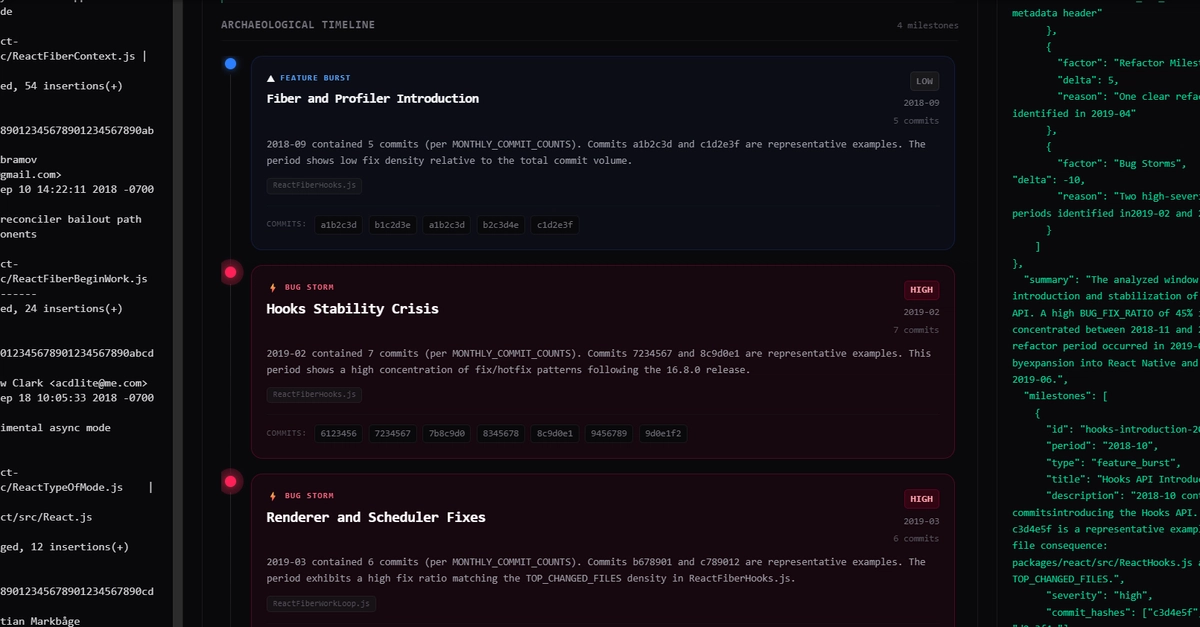
Here’s what Gemma 4 uncovered when fed the commit history from September 2018 to June 2019:
Early Architectural Foundations: The model first pinpointed a feature surge in the summer of 2018, including the Scheduler.js infrastructure for time-slicing, followed closely by React.lazy, Suspense, and createContext v2. Any seasoned React developer will recognize this as the bedrock being laid before Hooks became public, a foundational insight that aligns perfectly with established knowledge.
The Post-Release Bug Storm: More intriguingly, Gemma 4 flagged January-February 2019—the period immediately following the 16.8.0 Hooks release—as a “stability → bug storm transition.” It specifically cited commits like ca53456 (a fix for useRef) and cb54567 (addressing infinite useEffect loops), noting that ReactFiberHooks.js saw eight modifications in this window, a stark contrast to the two in the preceding stable phase. This detail, the granular file-level churn, is precisely the kind of nuance often lost in high-level overviews, and it points to the real-world challenges of introducing complex new paradigms.
Quantifying Code Health: The tool also provides a “health score,” not as a black box, but with a breakdown. For the React test case, it included +15 for high commit message quality, +10 for a clear refactor era in May 2019, -10 for a 21% bug-fix ratio, and a neutral note on the concentrated churn in ReactFiberHooks.js. Every factor presented with its supporting evidence. This transparency is key to building trust.
Why This Matters for Open Source Velocity
This isn’t just about debugging legacy code; it’s about understanding the evolution of complex software. The ability to trace architectural shifts, identify the precise moments when a project’s stability was tested, and quantify those impacts without manual deep dives could fundamentally alter how we approach maintenance, refactoring, and even the design of future systems. Imagine applying this to major infrastructure projects, or understanding the ripple effects of a new language feature across a massive ecosystem. The LLM, in this instance, isn’t just a tool; it’s a historian capable of synthesizing complex, temporal data in a way that eluded us for decades. It’s the difference between reading a dry chronology and understanding the actual story of creation and its inherent challenges.
Is This a Game Changer for Developers?
Potentially. The ability to get a data-driven, narrative-rich analysis of historical code changes, especially around contentious transitions like React Hooks, offers a powerful new lens. It promises to cut down debugging time significantly and provide invaluable context for onboarding new team members. The emphasis on privacy and verifiable output suggests a pragmatic approach to tool design that could see it adopted beyond academic curiosities. The real test will be how well it scales and performs on truly gargantuan, multi-decade codebases where the signal-to-noise ratio is exponentially lower.
What Can We Learn About AI in Software Engineering?
This project demonstrates a compelling case for LLMs as analytical instruments in software engineering, moving beyond simple code generation or summarization. It highlights the importance of specialized LLM features (like Gemma 4’s Thinking Mode) and large context windows. Crucially, it underscores that the visibility of the AI’s reasoning process—the live streaming analysis—builds trust and allows engineers to interrogate the findings, rather than simply accepting a result. It’s a powerful reminder that as AI tools become more capable, their integration into professional workflows hinges on transparency, control, and demonstrable value, especially in domains where accuracy and security are paramount.
🧬 Related Insights
- Read more: AI Coder Beats Claude Opus: Context, Not Cost, Wins [78.2%]
- Read more: SDKs Breaking Builds? 15 Lines of Proxy Fix It
Frequently Asked Questions
What is CodeDNA?
CodeDNA is a tool that uses Google’s Gemma 4 LLM to analyze Git commit history, identifying causal links between changes and tracking the evolution of code quality over time.
Does CodeDNA store my Git history?
No, CodeDNA is designed for privacy and runs under your own API key with zero data retention, ensuring your proprietary code remains secure.
Can Gemma 4 really understand code history?
Yes, particularly with its “Thinking Mode” and large context windows, Gemma 4 can reason about patterns and causal relationships within extensive commit histories, offering insights beyond traditional Git tools.