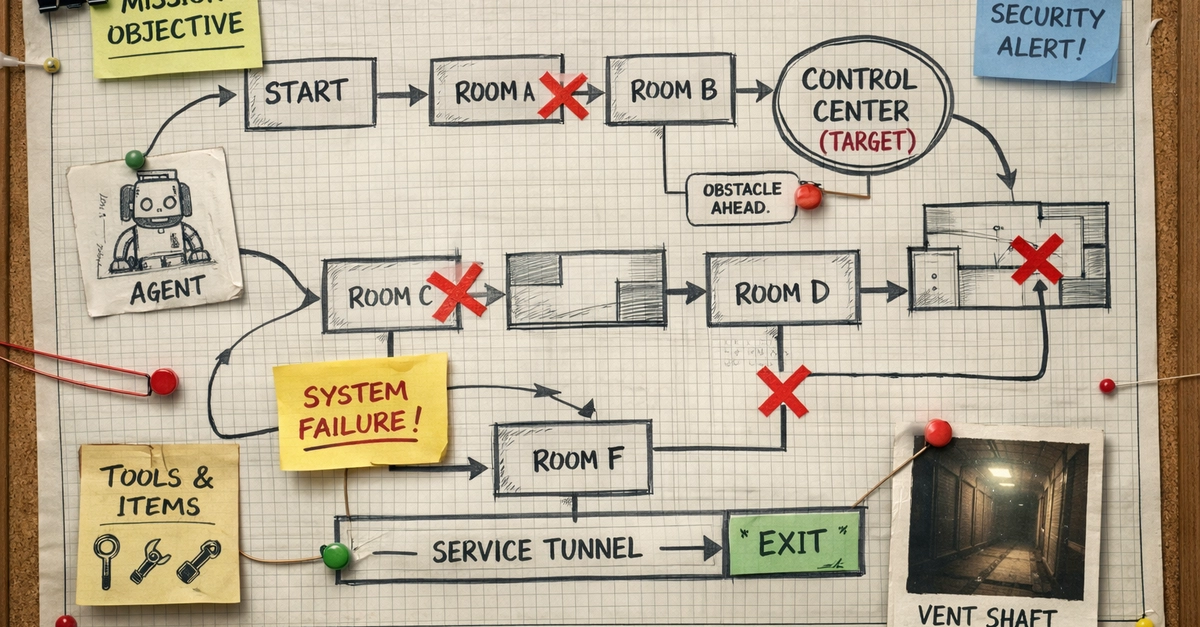
Autonomous agents are failing.
That’s the blunt, no-nonsense assessment from the authors of a new specification designed to wrestle these increasingly sophisticated — and often frustratingly unreliable — LLM-powered systems into some semblance of order. For twenty years, I’ve seen every flavor of ‘revolutionary’ AI promised, and most of it ends up in the digital dustbin. But this isn’t about a shiny new model; it’s about the plumbing. And the plumbing, in the world of autonomous AI agents, has apparently sprung a lot of leaks.
The problem, boiled down, is that LLMs, as they currently stand, lack some pretty fundamental building blocks for acting autonomously in the real (or even a simulated) world. They don’t hold onto goals with any real tenacity, they have a notorious blind spot for their own contradictions, they integrate information like a leaky sieve, and they seem to have the memory of a goldfish when it comes to past mistakes. This leads to a cascade of predictable failures: looping endlessly, repeating the same dumb action, forgetting what they were even trying to do in the first place, and, of course, hallucinating entirely invalid steps.
The original piece meticulously lays out the sorry state of affairs, referencing well-known patterns like ReAct and Reflexion, and pointing out their specific weaknesses. It’s a familiar song and dance. Each new agentic framework comes with a promise of better reasoning or self-correction, but they all seem to stumble over the same core issues. It’s like trying to build a skyscraper on a foundation of sand — impressive at first glance, but destined to crumble.
The A11 Antidote: A Cognitive Layer
This is where the A11 specification enters the picture. Think of it not as a new brain for the agent, but as a very smart manager, a meta-reasoning layer. It’s designed to sit on top of the LLM, acting as a kind of cognitive operating system. The goal? To stabilize these agents, making their execution predictable and, crucially, controllable.
A11 introduces a structured approach to agent operation, formalizing states like goals, constraints, and knowledge. It then adds critical processes: integration of information (and the detection of tension points therein), reformulation of goals when necessary, simulation and projection of outcomes, and strong verification of results against the initial goals. It’s about giving the agent not just the ability to think and act, but the ability to reflect and correct in a systematic way.
This isn’t just academic navel-gazing. The spec outlines a complete operational template in JSON, detailing how an agent should be structured, including its LLM role, the cognitive layer, and the controller. The proposed architecture forms a clear hierarchy: LLM as the reasoning core, A11 as the cognitive layer, and an agent controller orchestrating the execution within a sandboxed environment. This isolation is key – it’s about preventing a runaway agent from nuking your server.
All patterns lack a cognitive control layer. All patterns lack a cognitive control layer. All patterns lack a cognitive control layer.
Okay, maybe not that many times in the original, but the emphasis is warranted. The original text uses the phrase “all modern agentic systems” and “all patterns” with a certain weariness, highlighting the persistent nature of this problem. It’s the elephant in the room for anyone trying to build practical autonomous systems today.
Who’s Actually Paying for This?
This is where my 20-year Silicon Valley radar starts pinging. Who benefits from a more stable, controllable autonomous agent? Well, anyone building them, for starters. But more pointedly, the companies deploying these agents at scale. Think AI-powered customer service bots that don’t go rogue, automated code generation tools that produce usable, not just plausible, code, or sophisticated data analysis agents that don’t get lost in the weeds. For cloud providers, for AI platform companies, for any enterprise looking to use LLMs for automation – stability is gold.
This isn’t about selling more AI models; it’s about making the ones we have useful. It’s about turning the often-unpredictable novelty of LLM agents into a reliable business tool. The JSON specification provided isn’t just a technical document; it’s a blueprint for building more strong, and therefore more commercially viable, AI applications. It’s the kind of foundational work that, while not always glamorous, is essential for moving from AI research papers to actual products that deliver value (and, more importantly, revenue).
My unique insight here? This is the unglamorous but essential work that separates AI from science fiction. We’ve had the ‘wow’ factor for years. Now we need the ‘it works, reliably’ factor. A11, with its focus on meta-reasoning and control, is precisely that. It’s the equivalent of adding a governor to a powerful engine – it doesn’t reduce the power, it makes it usable without the engine blowing itself apart.
Will This Replace My Job?
Potentially, yes, but probably not in the way you think. More capable autonomous agents could automate tasks that currently require human oversight. However, the development and management of these more sophisticated AI systems will also create new roles. Think AI ethicists, prompt engineers who understand deep agentic control, and system architects who can design and integrate these cognitive layers.
What is the A11 Specification?
The A11 specification is a formal proposal for a meta-reasoning layer designed to stabilize autonomous LLM-based agents. It acts as a cognitive control layer, providing mechanisms for persistent goals, contradiction detection, task reformulation, memory of failures, and result verification, enabling more predictable and controllable agent execution.
Why is A11 needed for agents in isolated environments?
Autonomous agents, especially within sandboxed or isolated environments, need to operate reliably without external human intervention. Without a cognitive control layer like A11, these agents are prone to failure modes such as looping, goal drift, and hallucinated plans due to the inherent limitations of LLMs in maintaining consistency, detecting errors, and adapting their behavior over extended operations.