Is your AI just a fancy parrot, or is it starting to build your shed?
The line between intelligent conversation and intelligent action is blurring, and fast. We’re standing on the precipice of a fundamental platform shift, one where AI moves from passively responding to actively intervening in our digital and, increasingly, our physical worlds. Think of it less like a helpful customer service rep and more like a fully integrated co-pilot for your entire digital life.
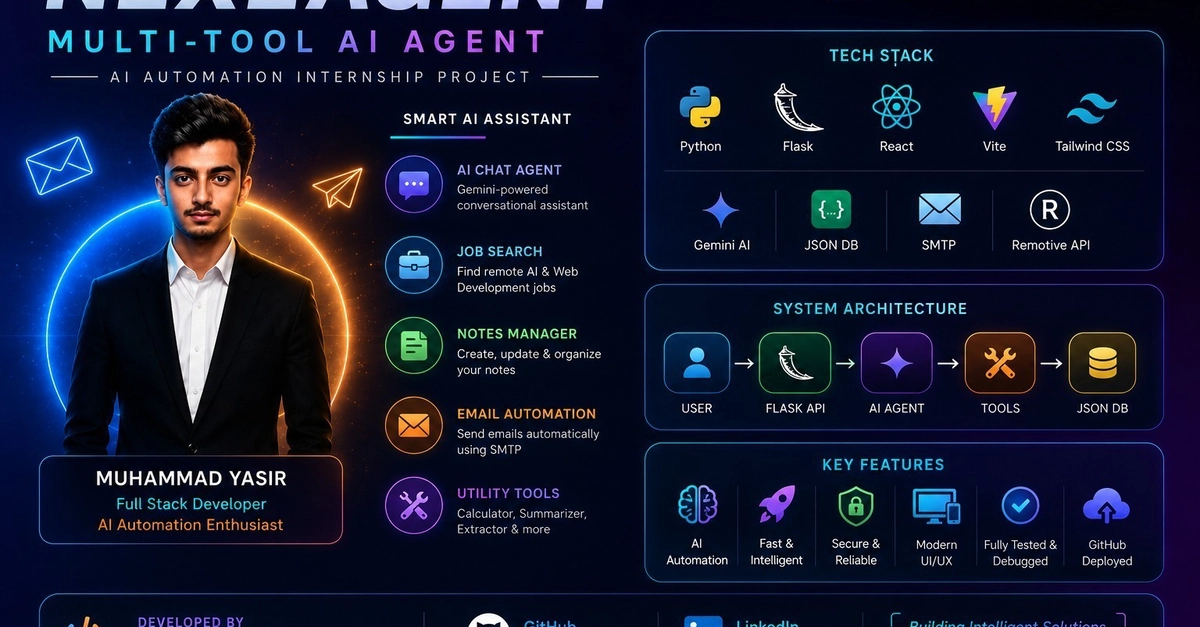
This isn’t just theoretical; it’s happening now. Muhammad Yasir, an intern at NEXE.AGENT, has just dropped a project that perfectly encapsulates this seismic shift: a production-style AI automation assistant. This isn’t your grandma’s chatbot; this is an AI that can search for jobs, manage your notes, fire off emails, and even run utility tools, all orchestrated through a sophisticated workflow. It’s like giving your computer a brain that not only understands what you want but also knows how to get it done.
The Orchestrator in the Machine
The core idea is disarmingly simple, yet profoundly powerful: build an AI system that behaves more like an intelligent assistant than a regular chatbot. Yasir’s agent doesn’t just spit out text; it analyzes prompts, selects the right “tools” from its arsenal—think of them as specialized digital Swiss Army knife blades—executes functions, manages complex workflows, and returns structured, usable results. It’s an entire operational system woven from the threads of AI.
Consider the possibilities: the agent can scour the web for remote AI and developer jobs, extract the critical information you need, meticulously save important notes, automate the sending of personalized emails, and execute custom utility functions like a calculator or a text summarizer. It’s a symphony of interconnected services, all directed by a singular, intelligent conductor.
The main idea behind this project was simple: Build an AI system that behaves more like an intelligent assistant than a normal chatbot.
This project is a proof to the power of modern full-stack development fused with cutting-edge AI. The backend hums with Python and Flask, powered by the Google Gemini AI API for its brains, with data stored in a simple JSON database and email automation handled via Gmail SMTP. On the frontend, React.js and Vite bring a responsive dashboard to life, styled with Tailwind CSS, creating an intuitive interface for this powerful engine.
Beyond the Hype: Real-World Engineering Challenges
What truly elevates this project beyond a simple demo is the real-world engineering that went into it. Yasir wasn’t just playing with prompts; he was wrestling with open API token limits, debugging Gemini API integrations, navigating the labyrinth of SMTP configurations, and squashing bugs in tool execution. These aren’t trivial issues; they’re the gritty, everyday challenges that separate a pet project from a production-ready system.
And that’s the real wonder here: the experience gained. Solving these problems translates directly into practical mastery of AI automation systems, API integration, backend and full-stack development, and the often-overlooked art of production-style debugging. This isn’t just about building an AI agent; it’s about building the engineers who will build the next generation of AI agents.
Why Does This Matter for Developers?
This project isn’t just a cool tech showcase; it’s a blueprint. It demonstrates how AI can transcend its current role as a conversational partner and become an active participant in development workflows. Imagine an AI that doesn’t just answer your coding questions but actively searches for relevant libraries, drafts boilerplate code, and even helps debug your errors—all within the same interface.
The structure itself—modular Flask backend, service-based AI logic, tool-based execution—is a masterclass in creating scalable and maintainable AI applications. This modularity is key. It’s like Lego bricks for AI systems; you can easily swap components, add new tools, or redesign workflows without tearing the whole thing down. This adaptability is what will allow AI agents to evolve and integrate into every facet of our digital lives.
A Glimpse into the Future of Work?
The implications here are massive. If AI agents can intelligently perform tasks like job searching, email management, and information summarization, what does that mean for human roles? While it’s easy to jump to dystopian conclusions, the reality is often more nuanced. This project, for instance, is explicitly positioned as an assistant for developers. It augments, it doesn’t replace. It frees up human engineers from tedious, repetitive tasks, allowing them to focus on the creative, strategic, and complex problem-solving that AI, for now, can’t replicate.
My own take is that we’re witnessing the birth of an entirely new class of software. For decades, we’ve built applications that run on our command. Now, we’re building applications that anticipate our needs and act on them, not just in a siloed function, but across a broad spectrum of digital activities. It’s a move from a command-line interface to an intelligent intent interpreter. This is the future, and it’s arriving faster than many expect.
🧬 Related Insights
- Read more: Fedora Ditches Deepin Packages After Security, Maintenance Failures
- Read more: Why Security Vulnerabilities Are Becoming a Bigger Problem for IPTV Infrastructure
Frequently Asked Questions
What does the NEXEAGENT multi-tool AI agent actually do? It’s an AI assistant designed to perform multiple tasks beyond just conversation, including job searching, note management, email automation, and executing utility tools, all managed through intelligent workflows.
Will this AI agent replace software developers? This project and similar advancements are primarily designed to augment developer capabilities by automating repetitive tasks, allowing them to focus on more complex and creative problem-solving, rather than outright replacement.
How is this different from a regular chatbot? Unlike traditional chatbots that mainly generate responses, this AI agent is built to analyze prompts, select appropriate tools, execute functions, and manage workflows to perform real-world actions and automate tasks.