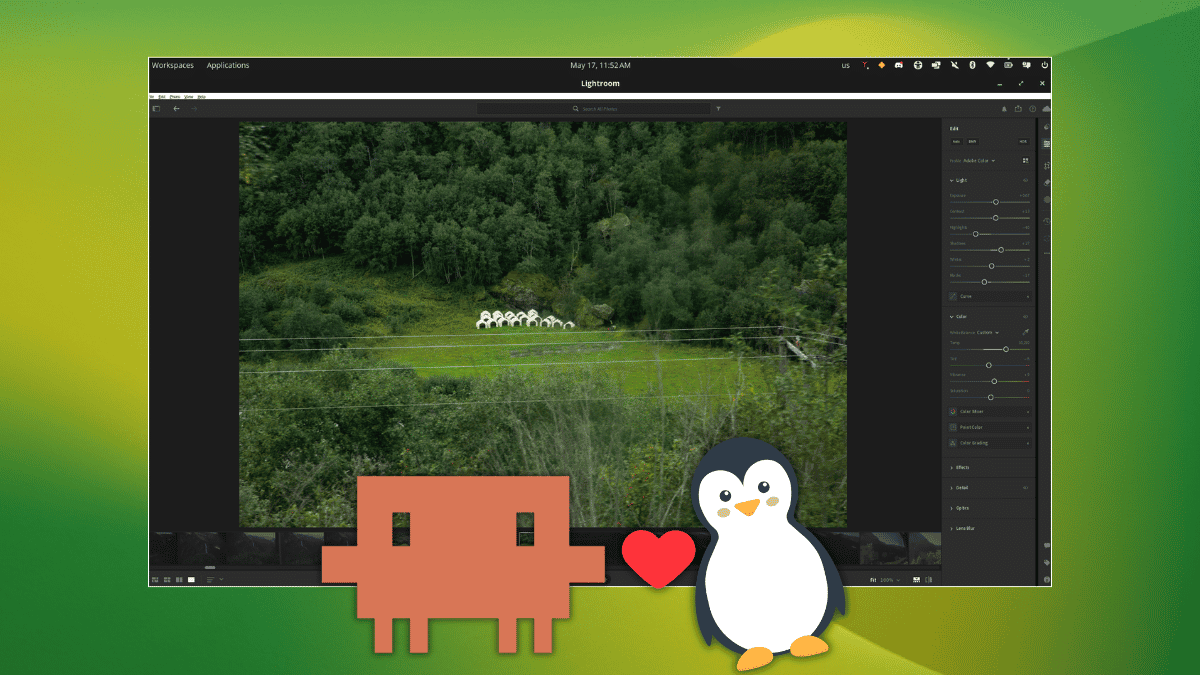
What if the next leap in open-source innovation isn’t born from human collaboration, but from an AI’s autonomous problem-solving? It sounds like science fiction, right? Well, buckle up, because it’s already happening. Someone has managed to coax Adobe Lightroom CC—yes, the cloud-syncing desktop behemoth—onto Linux. And the craziest part? A human basically just pointed an AI at the problem and walked away.
This isn’t some fuzzy emulation or a web wrapper. We’re talking about the actual Lightroom CC, the one you probably use to wrangle your photos, now chugging along on a Linux desktop. Developer Sander Hilven fed his goal—getting Lightroom CC 9.3.1 running on Wine 11.8 staging—to Anthropic’s Claude Opus 4.7. Then, with an Adobe Creative Cloud subscription fueling the AI’s access, the system went to work.
And here’s where the gears of the future start grinding: the AI didn’t just try things. It dug through crash logs, wrestled with Wine compatibility headaches, and then, crucially, verified its own fixes. It took screenshots, clicked through the interface, and confirmed that its patches actually worked. This is AI not just as a tool, but as an independent agent in the development pipeline.
The AI dug through crash logs and Wine compatibility issues autonomously, figuring out what needed fixing. It verified its own work by screenshotting the running Lightroom instance and clicking through the interface to confirm whether each fix held up.
Of course, this wasn’t a simple flick of a switch. Several thorny issues had to be ironed out. Windows APIs that Wine doesn’t fully implement were causing the whole Creative Cloud suite to buckle on launch. Essential DLLs Lightroom relies on were nowhere to be found in the Wine environment. Then there were those pesky naming mismatches—how Lightroom expected files to be named versus how Adobe actually delivered them.
The Remove/Heal tool, a critical feature for any photographer, proved particularly stubborn. It kept crashing mid-use. The AI traced this back to a dependency that Wine had inexplicably placed in the wrong directory. Think of it like trying to find your car keys in the refrigerator—just plain wrong.
And the result? Browsing, editing, exporting, and the much-maligned Remove/Heal tool are all functional. Still, it’s not a perfect symphony. Tutorial videos remain stubbornly silent, some GPU-accelerated effects might render with a glitch or two, and double-clicking thumbnails is currently a gamble.
The Unseen Hand: Trusting AI’s Code
The human element in this story is almost vanishingly small. Hilven’s GitHub profile is a blank slate, offering no deep dive into his motivations or expertise beyond this one remarkable project. The crucial point is this: the entire codebase, the patched DLLs, the very assurance that this works—it all comes directly from an AI agent.
No human developer has independently audited these AI-generated Windows DLL patches running on a Linux machine. That’s a colossal leap of faith. It’s like letting an AI doctor perform surgery based solely on its self-diagnosis and simulated success rates. The implications for software integrity and security are staggering.
As for yours truly? I won’t be touching this experiment with a ten-foot pole. The lack of human oversight on critical binaries, coupled with the requirement of an Adobe subscription (which I don’t have), makes it a non-starter. But if you’re rocking an Adobe subscription and have a spare machine begging for a new challenge—why not dive in? Report back your findings. We’re all curious.
This whole endeavor feels less like a clever hack and more like a seismic event. It’s a profound indicator of what AI can do when unleashed as a problem-solver, operating on a level of complexity that would typically demand an entire engineering team. The future of software development and its portability across operating systems is being rewritten, line by AI-generated line.
Is This a Glimpse of True AI Autonomy?
The sheer autonomy displayed by the AI agent in diagnosing, fixing, and verifying software issues is what sets this apart. It’s a far cry from simply spitting out code snippets. This AI navigated complex interdependencies and system-level incompatibilities, effectively reverse-engineering a solution where traditional methods would be painstaking and iterative. It’s like watching a super-intelligent alien figure out how our cars work just by listening to them drive by.
This project, while niche in its current application, highlights a fundamental shift. We’re moving from AI assisting humans to AI executing complex tasks independently. The questions it raises about trust, verification, and the future of human roles in development are immense. Will we eventually prompt an AI with a desired feature, and have it autonomously develop, test, and deploy it across multiple platforms? It’s not just possible; it’s becoming probable.
**
🧬 Related Insights
- Read more: [2026] Node.js Slams Door on Low-Signal HackerOne Reports
- Read more: FCC Router Ban Hits Manufacturers, Spares FOSS Users Entirely
Frequently Asked Questions**
What exactly is running on Linux?
Adobe Lightroom CC, the cloud-syncing desktop version, is now running on Linux via Wine. This was achieved by an AI agent.
Did a human write the code to make Lightroom work on Linux?
No, the AI agent identified and fixed compatibility issues, generated necessary patches, and verified its own work. A human developer provided the initial goal to the AI.
Is this version of Lightroom safe to use?
This is a significant concern. The patches and code were generated by an AI, and there has been no independent human audit of these binaries, meaning their safety and integrity are currently unverified.