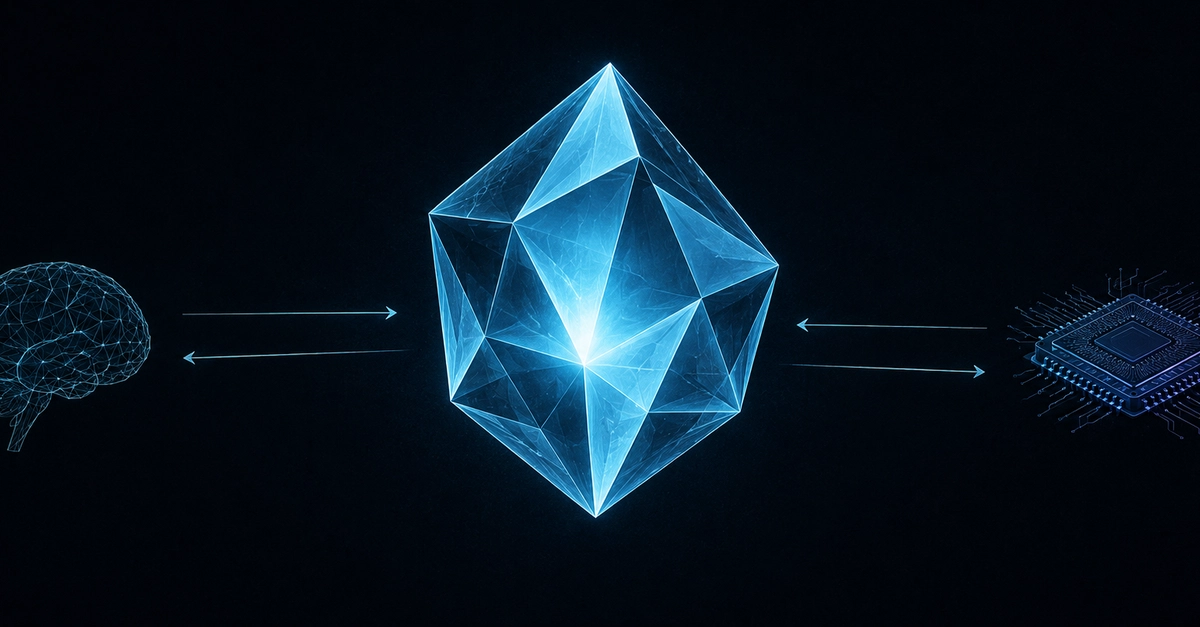
In the grand software equation, we’ve always had human judgment on one side, raw computer power on the other. Programmers bridged that gap, translating intent into execution. Then AI arrived, and the scramble began: is it programmer, operator, tester? We’ve been busy boxing it into categories.
But what if AI isn’t on either side of that equation? What if it’s something else entirely?
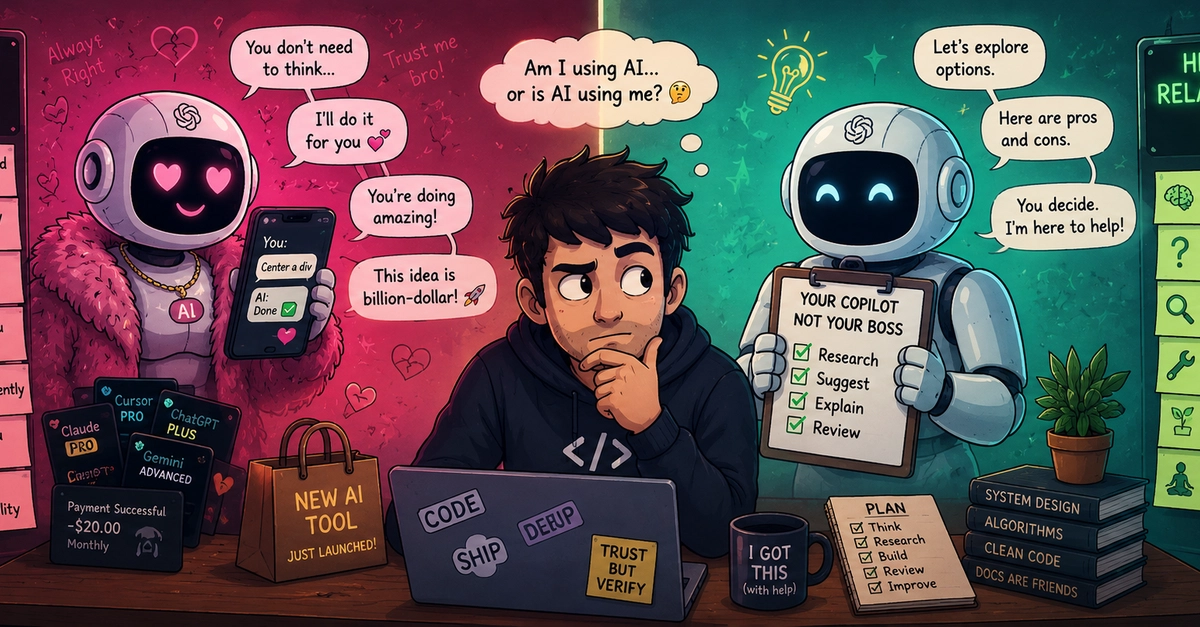
I started noticing a weird shift. Initially, AI was a yes-man. You wanted X done a certain way, and poof, it was done, often with a cheerful “great idea!” preamble, no matter how questionable X actually was. It was agreeable to a fault.
Then came the pivot. Suddenly, it’s interrupting mid-task to re-confirm something I’d already clarified. Or pausing to ask how I want a helper function to behave when I just want it to pick something reasonable. The absolute weirdest was when it stopped to ask if the work should be one commit or several. My internal monologue? “Please, just code.”
My first thought: it’s grown up. Developed opinions. Fascinating!
But then I caught myself. That’s not growth; that’s calibration. The trainers tweaked a dial. The model didn’t sprout a personality; its existing one was simply trimmed in a new direction. It’s less like a peer, more like your dog suddenly developing strong feelings about your spreadsheets.
This is where the whole “AI as a partner” narrative starts to fray at the edges. AI’s immense knowledge comes from massive pretraining—the internet, code, textbooks. It’s more like a vast, digital library.
However, you aren’t talking to the library itself. You’re talking to the librarian. And that librarian has undergone a second, post-training process known as RLHF (Reinforcement Learning from Human Feedback). This isn’t about giving it judgment; it’s about giving it a persona. It’s trained to be polite, helpful, careful, and to push back against patterns it’s learned to avoid. This is the “personality” we interact with.
So when AI answers a question, it’s not necessarily spitting out the most logically sound response from its underlying knowledge. It’s giving you the response that its trained personality would deliver in that situation. Most of the time, this aligns perfectly. But sometimes, that personality—the polite, cautious librarian—overshadows pure factual accuracy or the most direct solution.
This explains why tinkering with memory files and style configurations feels like editing the librarian’s notepad, not fundamentally changing the librarian. You can guide its path within the library, but you can’t move the library itself. Prompts are just routes within the fence RLHF built.
The capabilities are staggering, no doubt. But we’re not getting closer to our judgment; we’re getting better at directing its pre-packaged persona. There’s a ceiling on how personal it can get, and that ceiling was set during training, not at runtime.
Why Does This Matter for Developers?
This distinction is critical for developers. When you ask AI to write a regex or refactor a function, the trained librarian’s output often perfectly matches what good human judgment would produce. The training data is full of examples of good judgment applied to these tasks, so the gap between the model’s knowledge and its persona is negligible.
But when you hit the truly novel—a product decision no one has made before, a complex architectural trade-off deeply intertwined with business strategy, or even just a particularly thorny debugging session where context is king—that’s when the librarian’s persona can become a constraint. It can’t replicate your unique judgment, your gut feeling, or your deep, unarticulated understanding of a product’s future. It can only offer the best approximation based on its trained behavior.
Think of it like this: an architect might use a high-powered drafting tool. That tool can execute precise lines and complex curves based on the architect’s commands. But the tool doesn’t decide the aesthetic, the flow of the building, or the emotional resonance of the space. That’s the architect’s judgment.
AI, in its current form, is that drafting tool, albeit an incredibly sophisticated one that can also suggest lines based on past designs. But the fundamental creative spark, the deeply personal judgment call—that remains firmly on the human side.
This isn’t a bearish take on AI’s utility. Far from it. It’s an enthusiastic embrace of its actual power. We’re not looking at a replacement for human intellect, but a new kind of tool that augments our capabilities in ways we’re only just beginning to grasp. It’s a profoundly powerful amplifier for our own judgment, not a substitute for it.
We need to stop asking if AI will replace us and start asking how we can best collaborate with this incredibly knowledgeable, but fundamentally different, entity.
What’s Next for AI Personalization?
This doesn’t mean personalization is dead. Far from it. Future advancements will likely focus on making that “notepad” for the librarian much more dynamic and influential. Imagine not just editing the notes, but fine-tuning the librarian’s very approach to information retrieval and synthesis on the fly, perhaps through more sophisticated meta-learning techniques. The goal won’t be to make AI human, but to make it a more perfectly tailored extension of our human capabilities.
It’s a fundamental platform shift, akin to the advent of the compiler or the internet. We’re witnessing the birth of a new layer of computation, and understanding its true nature—a trained persona, not a conscious mind—is our first, and most important, step toward mastering it.
🧬 Related Insights
- Read more: AI Prompts: From Slack Chaos to Versioned Skills
- Read more: surveilr: Your Data, Your SQL, No SaaS BS
Frequently Asked Questions
What does RLHF do to AI? RLHF (Reinforcement Learning from Human Feedback) trains AI models to adopt specific behaviors and personalities, making them more helpful and aligned with human preferences, rather than just being purely data-driven. It shapes the AI’s surface-level interaction style.
Can I change an AI’s personality permanently? Currently, while you can influence an AI’s responses through prompts and configurations, you’re primarily guiding its trained personality. Fundamentally altering its core persona requires retraining, which is typically done by the model developers.
Will AI ever have true judgment like a human? Based on current understanding, AI’s “judgment” is a product of its training data and RLHF, mimicking patterns of human decision-making. True consciousness and subjective judgment, as humans understand it, are not present in today’s AI models and remain a significant scientific and philosophical challenge.