The server room’s humming. Not with the gentle whir of well-oiled machines, but with the frantic buzz of a thousand panicked engineers trying to teach a chatbot to remember their company’s Q3 earnings report. It’s a familiar scene. We’re awash in AI hype, and the latest battleground? How to get these silicon brains to actually do something useful, beyond reciting Wikipedia entries.
Companies are clamoring for AI that knows things. Things specific to their business. Things that aren’t plastered all over the public internet. This is where the dust-up between Retrieval-Augmented Generation (RAG) and fine-tuning kicks off. Each claims to be the silver bullet. Both, frankly, have their limitations. And understanding those limitations is key to not wasting millions.
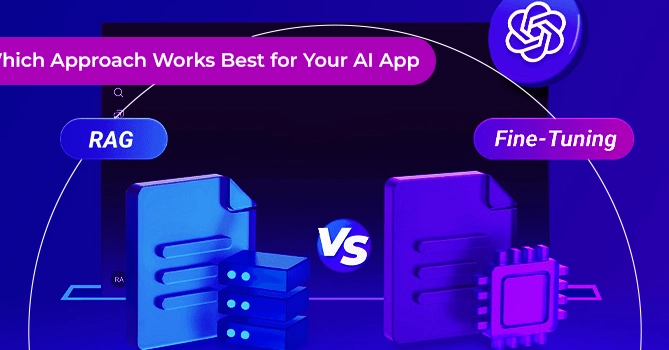
What’s the difference? It’s not subtle. RAG, bless its data-retrieving heart, doesn’t actually change the AI model itself. Think of it as a really smart intern with a perfectly organized filing cabinet. When you ask a question, it goes and finds the most relevant document, pulls out the key facts, and then feeds that to the AI to generate an answer. The AI’s brain remains untouched, but its knowledge base is suddenly, temporarily, much richer. Handy for real-time data. No retraining required, just a swift data lookup. It’s about pulling in fresh intel on demand.
Fine-tuning, on the other hand, is like sending that intern back to grad school for a specialized degree. You take an existing AI model and drill it with a specific dataset. It learns the nuances, the jargon, the style of your industry. The knowledge becomes embedded, baked into the model’s very architecture. It’s less about finding external facts and more about shaping the AI’s internal “personality” and how it responds.
RAG: The Quick and Dirty Information Fix
So, RAG in the wild. The big win? Access to information that’s practically breathing. You update your database, and BAM, the AI knows. No need to halt operations for a week-long retraining session. This alone chops down infrastructure and maintenance costs. Instead of feeding the whole beast new data, you’re just managing the retrieval system and its little data buddies (embeddings). For AI service providers, this means quicker deployments and faster updates for clients. Speedy turnarounds. And importantly, RAG systems often offer source traceability. You can see where the AI got its answer. Good for regulators. Good for anyone who doesn’t want to trust a black box.
But RAG isn’t perfect. Far from it. Its whole gig hinges on that retrieval part. If your search queries are garbage, your answers will be too. Poorly structured data, shoddy embeddings, or just plain bad search results mean the AI gets junk. And when it gets junk, it spits out… well, more junk. Partial answers. Outdated facts. The whole shebang can become a labyrinth of interconnected parts: vector databases, embedding models, search pipelines, ranking systems. It’s an orchestra of components, and if one instrument is out of tune, the whole symphony is ruined.
Fine-Tuning: When Personality Matters More Than Facts
Where does fine-tuning shine? Consistency. Domain-specific results. Think of training an AI to sound exactly like your brand voice. Or to use highly technical industry jargon without a hitch. It’s about molding the AI’s behavior, its tone. It doesn’t need to constantly hunt for external data; it learns to mimic those patterns during its intensive training. This leads to smoother, more natural-sounding responses for tasks that are repetitive or follow a strict format.
When you’ve got a well-tuned model, it’s less reliant on those clunky external searches during inference. Faster responses. Simpler deployments. Especially useful for customer service bots that need to sound consistently empathetic, content generators that need to adhere to a specific style guide, or workflow automation tools that need to execute tasks with precision.
Of course, the flip side is steep. Fine-tuning is a resource hog. You need high-quality data – and lots of it. Powerful GPUs are mandatory. Then comes the agonizing process of tuning hyperparameters, evaluating the model’s performance, and then doing it all over again when the data inevitably shifts. It’s expensive. It’s time-consuming. It’s a commitment.
Is There a Right Answer? Don’t Be a Martyr.
Look, the idea that it’s RAG versus fine-tuning is a false dichotomy pushed by consultants who love buzzwords. The real answer? It’s usually both. Or neither. It depends entirely on the specific application. Trying to get an AI Bottom line: the latest news? RAG is your friend. Want an AI to write legal briefs in the style of a seasoned attorney? Fine-tuning might be necessary. But often, a well-engineered RAG system augmented with a few strategic fine-tuned components can be far more effective and less costly than going all-in on one approach.
Companies often tout these methods as if they’re revolutionary. They’re not. They’re engineering challenges. Building effective AI isn’t about picking the sexiest new technique; it’s about understanding the problem and applying the right tools. Throwing a hammer at a screw won’t work. And expecting an AI to perfectly mimic your brand’s voice after a single RAG query is just… naive.
The Real Cost: It’s Not Just Compute Power
The cost of model training for fine-tuning is a huge barrier. We’re talking serious GPU time, expert data scientists, and meticulous hyperparameter tuning. This isn’t a weekend project for the IT department. It demands significant investment, and the ongoing need for retraining to keep performance sharp adds another layer of expense. This makes it a non-starter for many smaller organizations or for applications where the ROI isn’t immediately obvious.
Then there’s the RAG complexity. While it avoids retraining costs, managing those multiple components – the vector databases, the embedding models, the search infrastructure, the data pipelines – is no small feat. This system complexity means you often need specialized expertise just to keep the lights on. Many businesses lean on external AI development services to navigate this complex landscape, adding another line item to the budget. It’s a trade-off: do you pay for brute-force training or for complex system management?
Ultimately, the choice isn’t academic. It’s about practical deployment. If your AI needs to be current, RAG offers a path. If it needs a specific persona, fine-tuning is the route. But be realistic. And for goodness sake, don’t believe the hype that one is a magic wand. They’re tools. And like any tool, they require skill, planning, and a healthy dose of skepticism to wield effectively.
🧬 Related Insights
- Read more: Agentic Orchestration: AI’s Next Platform Shift
- Read more: CNCF Landscape Explained: Navigating the Cloud-Native Ecosystem
Frequently Asked Questions
What is RAG in AI? RAG stands for Retrieval-Augmented Generation. It’s a technique where an AI model retrieves relevant information from an external knowledge base before generating a response, without altering the model itself.
When should I use fine-tuning vs RAG? Use fine-tuning for behavioral customization, specific tone, or domain-specific language embedded into the AI. Use RAG when the AI needs access to up-to-date information from external sources in real-time.
Is RAG or fine-tuning more expensive? Fine-tuning is typically more expensive due to the computational resources and time required for model training. RAG can have lower initial training costs but incurs ongoing expenses for managing its complex retrieval system.