The glow of the monitor was the only light in the room, another late night spent wrestling with a seemingly simple UI component. It’s a familiar scene for many developers. The data grid. A necessary evil. A black box of props and callbacks that often feels more like arcane ritual than efficient tool building.
Every developer has been there. You crack open the documentation, brace yourself for the inevitable descent into prop-name purgatory. Hundreds of flat, undifferentiated options. You pick one, it breaks. You Google it. You eventually jam it into submission, only to forget the solution by the time the next project rolls around. The author of EliteGrid, fed up with this cycle, decided enough was enough. Hence, EliteGrid.
The pitch? A TypeScript data grid whose configuration reads like plain English. No more memorizing obscure prop names or deciphering cryptic acronyms. Instead, you get a structured, namespaced API. Think sorting={{ multi: true }} instead of some enableMultiColumnSortFlag. It’s a small change, but it’s the kind of thing that signals a different philosophy.
<EliteGrid
  data={rows}
  columns={columns}
  sorting={{ multi: true }}
  filtering={{ debounce: 300 }}
  pagination={{ pageSize: 25 }}
  selection={{ mode: 'multi' }}
  editing={{ trigger: 'doubleClick' }}
  appearance={{ theme: 'dark', density: 'compact' }}
/>
Here’s the thing: developer experience is king. Especially in the open-source world. If your tool is a headache to use, no matter how powerful it is under the hood, it’s going to gather dust. This namespaced approach, coupled with TypeScript autocompletion, aims to eliminate that friction. You’re not guessing; you’re being guided.
Under the Hood: A Microkernel Approach
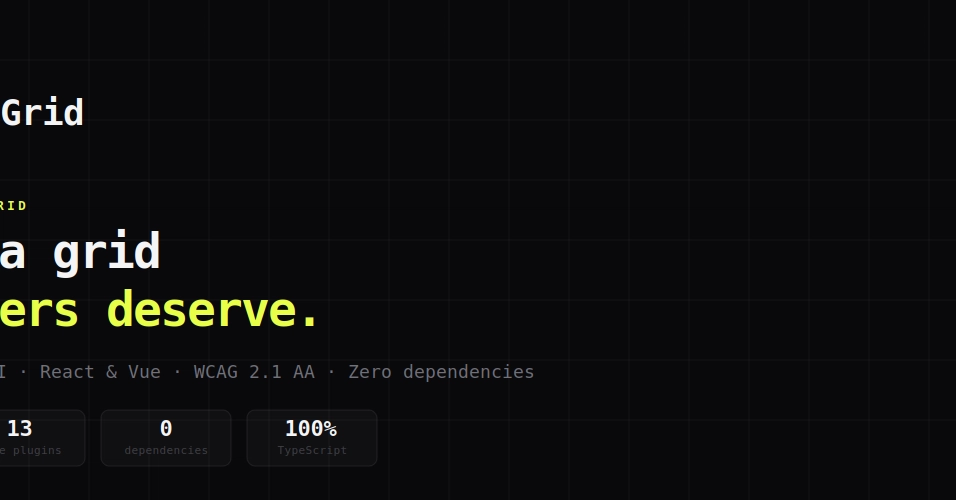
What’s really interesting is the architecture. EliteGrid isn’t just a monolithic block of code. It’s built on a microkernel with thirteen independent plugins. These plugins communicate via a shared event bus and data store. This modularity is a good sign. It means cleaner code, fewer hidden dependencies, and potentially easier maintenance or contribution.
- DataSource: Handles raw data. Basic, but essential.
- RowModel: Manages row lifecycles. Gets complex quickly.
- ColumnModel: Controls column definitions. Think visibility, pinning, width.
- Sort: Single and multi-column sorting. Custom comparators are key here.
- Filter: Per-column filtering for various data types.
- Pagination: Client-side and server-side options. Crucial for large datasets.
- Selection: Single or multi-select. Keyboard support is a must.
- Edit: Inline editing with validation. The devil is always in the details here.
- Viewport: Calculates visible rows. Performance optimization.
- Export: CSV export. Needs to be flexible.
This design promises no circular dependencies. No hidden coupling. Zero runtime dependencies on the core. That’s a strong claim. And with 662 passing tests already, it suggests a level of rigor that’s often missing in early-stage projects.
Accessibility Isn’t Optional
But the real kicker? EliteGrid is shipping with full WCAG 2.1 AA compliance out of the box. Zero configuration required. This isn’t an afterthought; it’s a product requirement. Full ARIA Grid Pattern implementation, screen reader announcements, complete keyboard navigation, roving tabindex, respect for prefers-reduced-motion, and Windows High Contrast mode support. In an industry where accessibility is too often treated as a polite suggestion rather than a fundamental right, this is a bold and welcome stance. Every user deserves a great grid, not just the ones wielding a mouse.
This commitment to accessibility, combined with the developer-friendly configuration, hints at a mature product vision. It’s not just about building another component; it’s about building a better one, for everyone.
Why This Matters for Developers?
Look, the open-source data grid market is crowded. We’ve got AG Grid, TanStack Table, and a host of others. So, what makes EliteGrid’s entry into this space noteworthy? It’s the explicit focus on a low barrier to entry. The goal isn’t just to be powerful; it’s to be approachable. A junior developer should be able to pick it up, read the docs, and get it working without needing an AI assistant or a deep dive into Stack Overflow rabbit holes. That’s a lofty aspiration.
This isn’t just about convenience; it’s about productivity. When developers aren’t bogged down by complex configurations or fighting with poorly documented APIs, they can actually build things. They can innovate. And when a tool is built with accessibility in mind from the ground up, it elevates the entire ecosystem. It pushes other projects to do better. It’s a positive feedback loop we need more of.
It reminds me a bit of the early days of React. The promise wasn’t just a new way to build UIs; it was a commitment to a more declarative, understandable programming model. EliteGrid seems to be chasing a similar high ground for data grids. A promise of clarity in a sea of complexity.
The Road Ahead
The project is still under active development. The core engine is built, and adapters for React and Vue are in progress. An interactive sandbox is also coming soon. The public npm launch is on the horizon. The community version will be free and open source. If this sounds like the grid you’ve been waiting for, the waitlist is open at elitegrid.dev.
What matters most in a data grid, really? Is it speed? Flexibility? Ease of use? Or perhaps it’s the quiet confidence that comes from knowing it’s built with everyone in mind.
🧬 Related Insights
- Read more: NextDNS, Tailscale Conflict Resolved [DNS Fix]
- Read more: Gemma 4: AI Grader for Indian Schoolkids? [Analysis]
Frequently Asked Questions
What does EliteGrid actually do? EliteGrid is a new TypeScript data grid component designed to be easy to configure and highly accessible. It aims to provide an English-like syntax for its configuration options and includes full WCAG 2.1 AA compliance by default.
Is EliteGrid open source? Yes, the community version of EliteGrid will be free and open source, making it accessible to a wide range of developers and projects.
Will this replace my current data grid? EliteGrid aims to offer a superior developer experience and accessibility features. Developers may find it a compelling alternative or replacement for existing data grids, especially if they struggle with complex configurations or accessibility requirements.