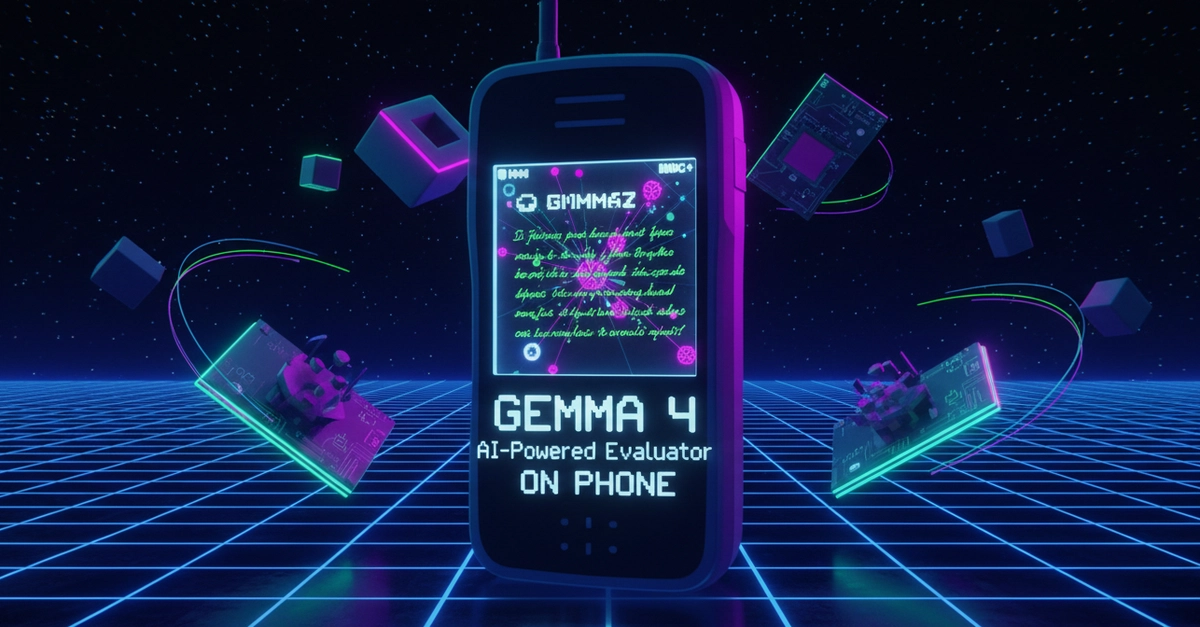
So, the big question everyone should be asking isn’t ‘Can AI grade essays?’ but rather, ‘Who’s actually going to profit from this latest AI tinkering?’
Look, I’ve been wading through Silicon Valley’s perpetual “innovation” cycle for two decades, and it’s always the same dance: a shiny new toy, a torrent of breathless PR, and a vague promise of changing the world. This time, it’s an AI-powered handwritten answer evaluator for Indian students, dubbed UttarCheck, built on Google’s Gemma 4. The pitch? Personalized feedback, instant scoring, and a way to bridge the educational divide for millions. Sounds noble, right? Let’s peel back the layers.
The Grand Vision (and the Fine Print)
UttarCheck, a submission for the Gemma 4 Challenge, aims to solve a real problem: the agonizing wait for teachers to grade handwritten exams. We’re talking about 250 million school students in India, many in remote areas, who can’t afford premium education or timely, personalized feedback. The creator, drawing from personal experience, envisions an app where students snap a pic of their answer, and poof—instant AI evaluation in Hindi and English. It’s designed to detect mistakes, suggest improvements, and boost confidence. Pretty slick.
And the technology? It’s touting Gemma 4’s native multimodal capability. The claim is that Gemma 4 can directly read handwriting from an image, bypass the need for a separate OCR step, and evaluate content. This is the part that, frankly, has my eyebrows raised.
The intent to choose Gemma 4 API for UttarCheck is its native multimodal capability. It is not a normal text model where we add OCR step to read content from the handwritten text while Gemma 4 does read directly from the text
See, here’s the thing about AI hype. Every new model is touted as a “breakthrough.” Multimodal? Naturally. Bilingual? Of course. Efficient? You betcha, especially the MoE (Mixture-of-Experts) variant that supposedly only activates a fraction of its parameters. The developer even bragged about how Gemma 4 doesn’t always return clean JSON, wrapping its prose and markdown fences in a bit of human-like (or AI-like?) inconsistency. It’s almost as if they’re proud of the added complexity needed to parse the output. Makes you wonder about the stability and scalability, doesn’t it?
Who’s Actually Making Money Here?
Let’s cut to the chase. While the altruistic underpinnings are laudable, the real question for any tech journalist worth their salt is the monetization. Is Google AI Studio giving away Gemma 4 API access for free to all these challenge participants? Doubtful. The model itself, even the supposedly efficient MoE variant, isn’t exactly cheap to run at scale. So, who foots the bill? Are these students paying per evaluation? Is there a freemium model with ads? Or is this just another proof-of-concept destined to gather digital dust once the challenge ends?
My bet? It’s a showcase for Google’s AI prowess. The real money will be made by Google, selling API access to educational institutions, ed-tech startups, or governments who want to look like they’re adopting cutting-edge tech. UttarCheck itself might be a noble effort, but it’s likely just a stepping stone. The underlying technology – a multimodal LLM that can read and analyze handwritten text in multiple languages – is the valuable commodity here.
And what about the “edge deployment” mentioned? They point to Gemma 4 E4B. This hints at future ambitions, perhaps offline evaluation capabilities. But for now, it seems like a localhost setup exposed via ngrok. Not exactly enterprise-grade, is it?
The Multimodal Payload: More Than Just a Pretty Picture?
Okay, let’s humor the idea that Gemma 4 is some kind of educational savant. The multimodal payload, where an image and a prompt are sent in one go, is indeed a neat trick. The developers claim it reads handwriting, identifies the subject, and evaluates content all in one inference. This is where my skepticism really kicks in. Handwriting recognition, especially across diverse styles and languages, is notoriously difficult. AI models have struggled with this for years, often requiring specialized OCR engines. For Gemma 4 to do it flawlessly, natively, alongside content evaluation, without any translation layer… well, color me surprised.
And the bilingual reasoning is interesting. Thinking in Hindi but studying in English is a common scenario in India. Providing feedback in both languages is a genuine benefit, no doubt. But does it justify the complex integration and potential inaccuracies of a new, unproven multimodal system? That’s the million-dollar question.
Ultimately, UttarCheck represents a fascinating application of Gemma 4’s capabilities. It highlights the potential for AI to democratize education. But as always, we need to look beyond the shiny veneer. The true impact, the sustainability, and who truly benefits financially are the stories that remain largely untold amidst the buzz.
🧬 Related Insights
- Read more: Phone-to-PC Jukebox Quest: Pikaraoke and Open-Source Rivals That Actually Work
- Read more: Vercel AI SDK in Production: Unseen Pitfalls
Frequently Asked Questions
What does UttarCheck actually do? UttarCheck is an AI-powered system that uses Google’s Gemma 4 model to evaluate handwritten student answers. Students can take a picture of their exam response, and the AI provides a score, identifies mistakes, and offers improvement tips in both Hindi and English.
Is this tool available for general use? Currently, UttarCheck appears to be a project developed for a challenge. While the underlying technology and code might be shared, the full, deployed application’s availability for widespread public or school use is not explicitly stated in the provided information.
How does UttarCheck handle different handwriting styles? UttarCheck use Gemma 4’s multimodal capabilities, which are described as being able to read handwriting directly from an image. The specific effectiveness across a wide range of handwriting styles and legibility levels would require extensive testing and validation. The claim is that Gemma 4 performs this function natively, without a separate OCR step.