The hum of servers in a dimly lit data center is the sound of infrastructure being rebuilt, one line of code at a time. Now, Cloudflare is aiming to rebuild a titan of the web.
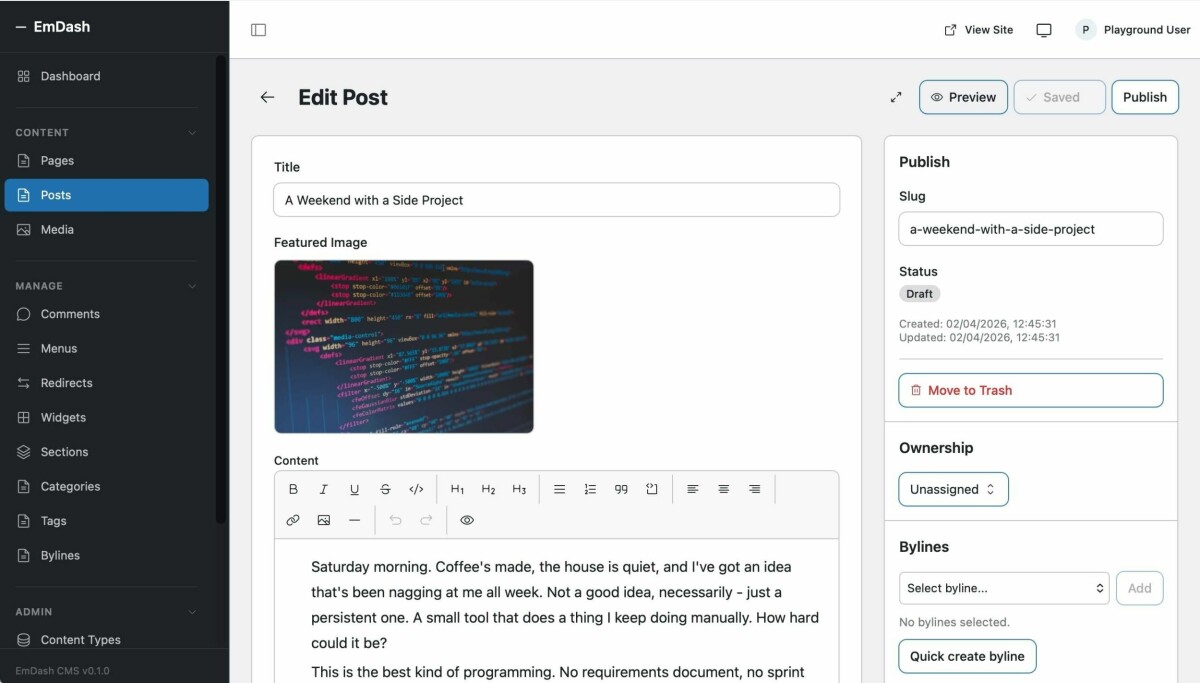
Cloudflare, a company that has made a name for itself by making the internet faster and more secure, has just previewed ‘EmDash’ – an AI-driven, ground-up rewrite of WordPress. The catch? It’s being built entirely in TypeScript. This isn’t just a minor update; it’s a wholesale reimagining of a system that powers over 40% of the internet. The implications for the open-source world, and indeed for the entire digital infrastructure that relies on WordPress, are significant. The question isn’t if this will have an impact, but rather, what kind of impact.
Why TypeScript for WordPress?
This move immediately raises eyebrows for anyone familiar with WordPress’s PHP heritage. For years, PHP has been the workhorse, powering countless websites. Its ubiquity, though often criticized for its quirks, is undeniable. So why the pivot to TypeScript? Cloudflare cites several reasons, primarily centered around developer productivity and modern tooling. TypeScript, with its static typing, promises to catch errors at compile time rather than runtime, a significant advantage for a project of WordPress’s scale and complexity. It also aligns with the trend of web development leaning more heavily into JavaScript-based ecosystems, even on the server-side.
“Our goal is to use AI to produce exceptionally high-quality, modern code that is performant, secure, and maintainable,” Cloudflare stated in their announcement. This isn’t just about a language switch; it’s about a fundamental shift in development methodology.
But let’s be clear: this is a massive undertaking. Migrating a system like WordPress, with its vast plugin ecosystem and decades of accumulated code, is not for the faint of heart. The market dynamics here are fascinating. Cloudflare isn’t just building a better WordPress for its own services; it’s ostensibly aiming to offer a superior platform that could, over time, chip away at the dominance of traditional WordPress hosting and even self-hosted installations. The promise of AI-generated, TypeScript-native code is compelling on paper, offering potential gains in speed and reliability.
The AI Angle: A Boon or a Bottleneck?
The most striking aspect of EmDash is its AI-driven development process. Cloudflare claims that AI is not just assisting, but actively rebuilding WordPress. This is where the skepticism — a healthy dose of it, if you ask me — needs to kick in. AI can be a powerful tool for code generation, suggesting snippets, refactoring code, and even writing entire functions. However, replacing the nuanced, often intuitive, decision-making of experienced developers with algorithmic output for a system as critical as WordPress is a bold claim. The history of software development is littered with projects that underestimated the complexity of their chosen domain.
Will AI be able to fully grasp the complex interdependencies of the WordPress ecosystem? Can it intelligently handle the sheer volume of plugins and themes, many of which are not exactly paragons of modern coding practices? The potential for AI to introduce subtle, hard-to-debug errors is very real. We’ve seen AI assistants generate code that looks plausible but fails under specific, edge-case conditions. For a platform like WordPress, where stability is paramount, these kinds of slip-ups could be catastrophic. It smells a bit like trying to put a high-performance engine into a classic car without reinforcing the chassis first.
Market Momentum and Future Implications
Cloudflare’s move isn’t happening in a vacuum. The broader trend towards AI in software development is undeniable. Companies are racing to integrate AI into their workflows, and the allure of accelerated development cycles and reduced costs is potent. For WordPress, this could represent a much-needed modernization. PHP, while still relevant, is often seen as a legacy language in certain circles. A TypeScript-based WordPress, if executed flawlessly, could attract a new generation of developers and potentially enhance its appeal to enterprise clients looking for more strong, modern solutions.
The market is already saturated with WordPress hosting providers. Cloudflare’s entry, armed with a fundamentally rewritten, AI-powered version, could disrupt this landscape significantly. Imagine a future where WordPress sites are deployed faster, are inherently more secure due to TypeScript’s type safety, and are easier to maintain, all because the underlying code was AI-generated and managed. This is the vision Cloudflare is selling.
However, we must consider the open-source community’s perspective. WordPress thrives on its massive, decentralized community. Will this new, AI-driven version be truly open in spirit? Will it be easily extensible by the existing community, or will it create a new, more centralized paradigm controlled by Cloudflare’s AI models? The ‘EmDash’ project needs to demonstrate not just technical superiority but also a commitment to the collaborative spirit that made WordPress a success in the first place. If it becomes a black box, its adoption might be limited to those who are already heavily invested in the Cloudflare ecosystem.
Is EmDash a threat to traditional WordPress? Potentially. If Cloudflare can deliver on its promises, it could offer a compelling alternative for new website builds and perhaps even encourage migration from older PHP-based sites. The success hinges on execution, community buy-in, and whether the AI can truly replicate the breadth of developer ingenuity that has shaped WordPress over the years. This is less about a simple language swap and more about an AI-inflected paradigm shift for a cornerstone of the web.