The login prompt stares back. You type. You hope. It’s a ritual as old as the internet, and frankly, it’s a mess. Passwords. We’re drowning in them, and the data breaches just keep piling up — 33 billion in 2024 alone, the original report notes. It’s not just about remembering them; it’s about the constant threat of phishing, credential stuffing, and the astronomical cost of password resets eating into developer time. And don’t even get me started on the user experience. It’s awful.
But what if we could just… tap? Log in with Face ID, Touch ID, Windows Hello, or a physical security key? That’s the promise of WebAuthn, the FIDO2 standard. The problem? Implementing it has historically been a beast of cryptographic complexity, browser quirks, and challenging integration. Until now, for Laravel developers at least.
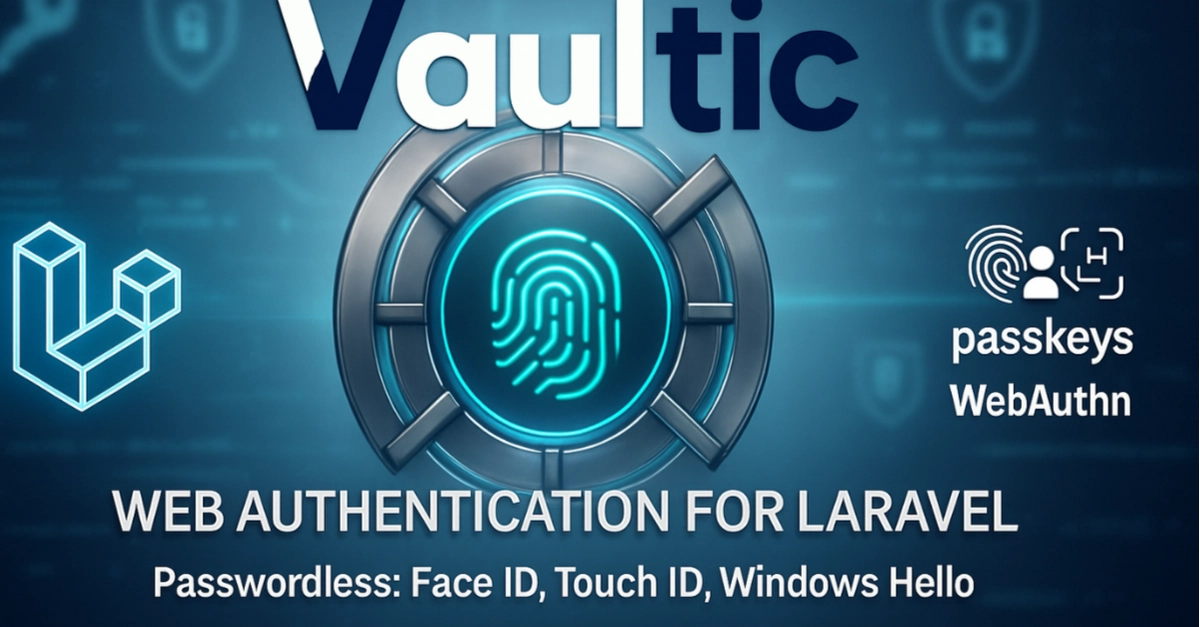
Enter Vaultic. This isn’t just another library; it’s positioned as the Rails framework for passkeys within the Laravel ecosystem. Think zero configuration needed, a simple composer require and a few artisan commands, and suddenly your Laravel app is speaking fluent WebAuthn. It abstracts away the nitty-gritty of challenges, assertions, and public-key cryptography, allowing developers to focus on shipping.
Why Now? The Shifting Sands of Authentication
We’ve been talking about passwordless for years, but the underlying technology has finally matured to a point where practical, widespread adoption is not just possible, but imminent. Browsers are on board, hardware security keys are more common, and the user base is increasingly frustrated with the old guard. The real innovation here isn’t inventing new cryptography; it’s making the existing, powerful, and secure cryptography accessible. Vaultic’s architectural approach, described as a clean, layered system—HTTP, Service, Repository, and Eloquent Models—suggests a deliberate effort to disentangle complexity. This separation of concerns is crucial for maintainability and extensibility, hallmarks of well-designed software.
The Vaultic Architecture: Deciphering the ‘How’
At its core, Vaultic orchestrates the WebAuthn flow. When a user initiates a login or registration, the package handles the communication with the browser and the user’s authenticator (their phone, YubiKey, etc.). It manages the generation of challenges, verifies the responses, and crucially, stores the resulting public keys securely. The beauty, as highlighted in the documentation, lies in its ability to handle both web UI interactions via Blade components and API endpoints using Laravel Sanctum. This dual support means a single passkey database can serve both your SPA and your mobile app, a significant simplification.
Consider the user experience flow: A web user clicks a passkey button, their authenticator prompts them, a quick tap, and they’re logged in. A mobile client calling your API sends its public key, receives a Sanctum token, and is authenticated. Both paths use the same underlying security infrastructure. This unification is where the real developer value lies – less code, fewer moving parts, and a more consistent security posture.
Your users can now register and log in with: Face ID, Touch ID, Windows Hello, Security Keys. That’s it. No WebAuthn knowledge required.
The package offers pre-built Blade components like <x-vaultic::passkey-button /> and <x-vaultic::passkey-panel />, meaning front-end integration is about dropping in a component, not wrestling with JavaScript WebAuthn APIs. The passkey panel, in particular, offers users transparency—a list of their linked authenticators, last used timestamps, and IP addresses—which builds trust. Transparency, after all, is a powerful defense against user confusion and potential fraud.
Beyond the Basics: Fallbacks and Security Events
But what about edge cases? Lost devices, browser compatibility issues, or users who aren’t quite ready to ditch passwords entirely? Vaultic addresses this with a configurable fallback driver. You can easily set it to default back to password authentication or even an OTP system. This phased approach to adoption is critical for real-world deployment. It acknowledges that the transition to passwordless won’t be instantaneous for every user.
Furthermore, the package provides hooks into security events: PasskeyRegistered, PasskeyAuthenticated, and AuthenticationFailed. This allows developers to integrate with logging, monitoring, or even immediate alerting systems. Imagine automatically flagging suspicious login attempts or triggering enhanced security protocols if an unusual IP address or device is detected. This event-driven architecture amplifies the security benefits, turning a simple login mechanism into an observable security surface.
Security also involves defense in depth. Vaultic includes rate limiting for failed attempts – 10 attempts within 60 seconds locks a user out, a sensible safeguard against brute-force attacks that might try to abuse the system even with cryptographic keys. This layered security approach is precisely what’s needed to build truly resilient authentication systems.
The Big Picture: Is This the End of Passwords for Laravel?
Vaultic’s emergence is more than just another library; it’s a signal flare. It demonstrates a commitment from developers to bridge the gap between cutting-edge security standards and practical application development. The underlying architecture appears sound, the feature set is comprehensive, and the focus on developer experience is palpable. If Vaultic can deliver on its promise of effortless WebAuthn integration, it could very well accelerate the demise of password-based authentication within the vast Laravel community. This isn’t just about convenience; it’s about significantly elevating the security posture for millions of applications and users. The era of password hashes, once thought to be the bedrock of online security, is finally facing its expiration date.
🧬 Related Insights
- Read more: Higress: AI Speeds Ingress NGINX Migration 60+ Resources
- Read more: FCC Router Ban Hits Manufacturers, Spares FOSS Users Entirely
Frequently Asked Questions
What does Vaultic do? Vaultic is a production-ready package for the Laravel PHP framework that simplifies the implementation of WebAuthn and Passkey authentication. It allows developers to integrate biometric logins (like Face ID, Touch ID) and hardware security keys into their applications without deep cryptographic expertise.
Will Vaultic replace my Laravel app’s existing authentication? Vaultic aims to replace or augment your existing password-based authentication with more secure and user-friendly WebAuthn/Passkey methods. It provides fallback mechanisms, so you can transition gradually or offer both options.