Did you ever stop to think if that autocomplete whisper in your IDE was just the first step, the quiet hum before the symphony of autonomous AI agents? Because at Google I/O 2026, that whisper roared into a declaration: the era of basic inline code completion is definitively, spectacularly over.
This isn’t just another incremental update; it’s a fundamental platform shift. We’re talking about moving from AI as a sophisticated keyboard extension—a helpful sidekick for boilerplate or debugging—to AI as a coordinated, multi-agent workforce. Google’s Gemini 3.5 Flash and Antigravity 2.0 aren’t just new tools; they’re the architects of a new development paradigm.
The core idea? Developers are no longer the primary scribes of syntax. We’re becoming the conductors, the directors of distributed AI teams. The title? Agent Architect.
The Engine Roars: Gemini 3.5 Flash
The magic behind this new era hinges on speed and efficiency. Imagine trying to build a complex structure with a crew where each worker waits 30 seconds after every single hammer swing to get the next instruction. Absurd, right? That’s precisely the problem Gemini 3.5 Flash, with its astonishing 289 output tokens per second, aims to obliterate. It’s built for the recursive loops of agentic development—where an AI writes, compiles, detects an error, reasons about that error, and iterates. Fast, fluid, and crucially, affordable.
This isn’t about brute-force intelligence; it’s about optimized intelligence for a specific, demanding task. Google’s benchmarks show this leaner, meaner engine outperforming massive models on real-world terminal environments. It’s like swapping a bulky, fuel-guzzling limousine for a finely tuned race car when you need to navigate a tight track.
The Command Center: Antigravity 2.0 Takes Flight
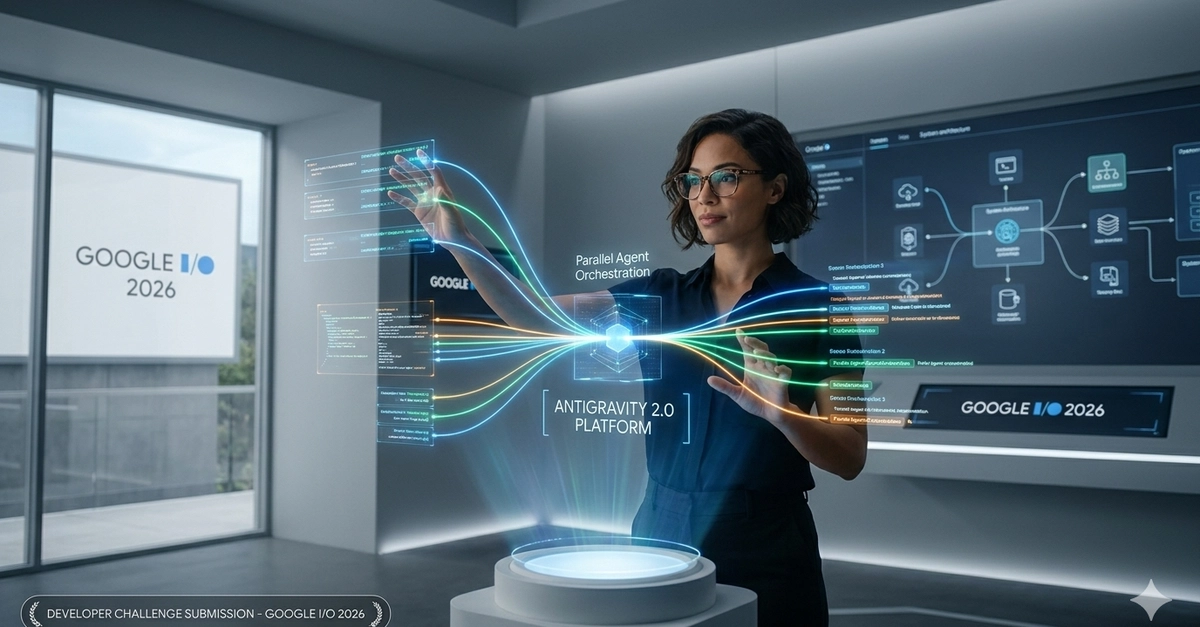
If Gemini 3.5 Flash is the engine, then Google Antigravity 2.0 is the chassis, the entire operational framework. It’s evolved from a simple IDE plugin into a standalone orchestrator designed for the wild dance of parallel agents. Forget asking a single chat window to build your backend, then your frontend. Now, you can dispatch specialist agents concurrently. Think of your Code Agent furiously building a new feature branch while your Asset Agent is simultaneously churning out matching UI elements and styling tokens. All of this happens within a unified project context, allowing agents to trace issues across disparate repositories and infrastructure directories without stepping on each other’s toes. It’s a distributed, intelligent construction crew.
Because Antigravity 2.0 decouples agent conversations from a single repository, they operate within a unified project context.
The Orchestration Strategy: Mindset Over Code
The shift requires a mental recalibration. We’re moving from crafting lines of code to defining guardrails and conceptually dispatching tasks. It’s about setting up the sandbox and then telling your AI fleet its mission.
First, you establish the rules: what directories are off-limits, how many agents can run at once, what permissions they have. This is your security perimeter, keeping your agents focused and safe. Then comes the conceptual dispatching. A simple /*goal*/ command lets an agent run autonomously until completion, handling its own code, compile, and linting cycles. Need alignment before any code is written? /*grill*/-me forces the agent to ask clarifying questions, ensuring human oversight at critical junctures.
The New Bottlenecks: Friction in the Future
But let’s pump the brakes on the utopian vision for a second. The key takeaway here, and it’s a glaring one, is that while Google is building incredible tools, the real bottleneck is us, the humans. This paradigm shift doesn’t magically eliminate complexity; it refracts it. We’re not writing code, but we are now responsible for the high-level architecture of how AI agents collaborate. This is where the true challenge lies – in articulating those abstract goals and guardrails with absolute precision. Get them wrong, and your autonomous agents will happily, efficiently, build you something entirely useless.
My unique insight here is that this mirrors the transition from individual craftsmen to factory assembly lines in the industrial revolution. Initially, skilled artisans resisted the machine, fearing obsolescence. But eventually, the skilled artisans became the engineers and foremen, designing and managing the machines. We’re at that cusp again, with AI as the new machinery. The demand for deep understanding of system design, abstract problem-solving, and effective communication with non-human intelligence will skyrocket.
This isn’t about AI replacing developers; it’s about AI augmenting developers into a new kind of architect. The skills in demand will shift from pure coding proficiency to systems thinking, strategic planning, and masterful prompt engineering—an art form in itself.
Will This Replace My Job?
Not directly, but it will fundamentally change it. The skills required are shifting from syntax generation to the orchestration and strategic direction of AI agents. Developers will need to become “Agent Architects,