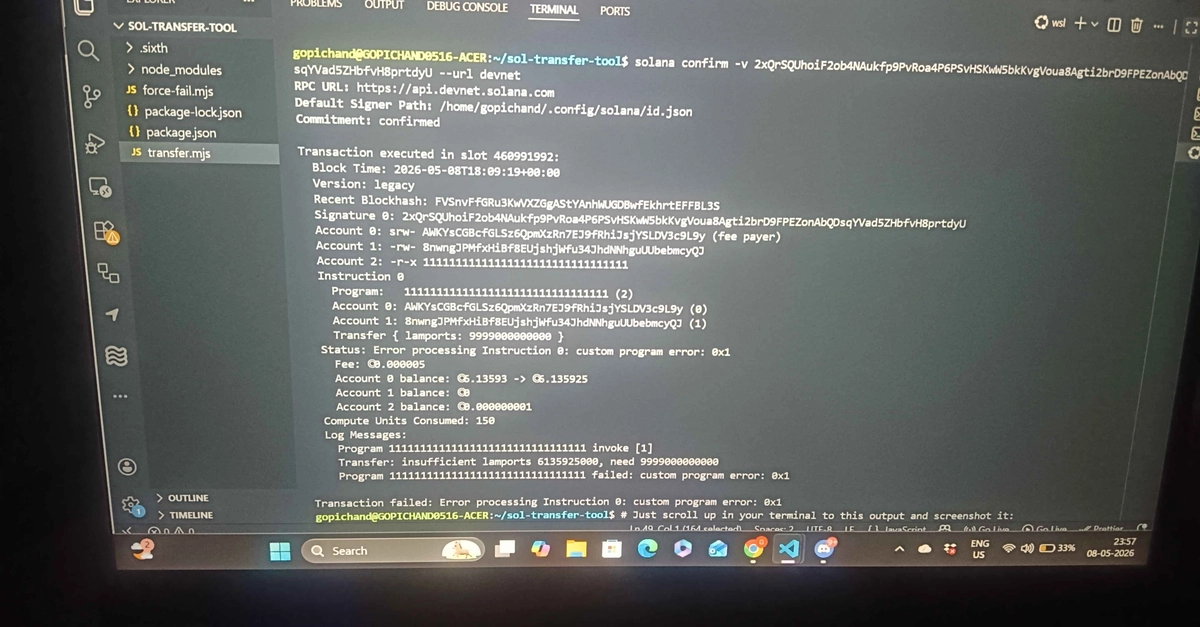
Less than 0.000005 SOL. That’s the cost of a failed Solana transaction, as I discovered by deliberately attempting to send 9,999 SOL with only 6.14 SOL in my wallet.
This isn’t a minor footnote; it’s a foundational difference between how backend developers typically think about HTTP requests and database commits, and the stark reality of blockchain execution. For those accustomed to the stateless, ephemeral nature of API calls—where a failure is merely a prompt for a quick retry without penalty—Solana introduces a paradigm shift that demands attention.
The Unforgiving Nature of On-Chain Logic
Every Solana transaction is a contract written in code, broadcast to a distributed network of validators. Unlike a POST request that hits a server and either gets a 200 OK or a 500 Internal Server Error with no lasting consequence, a Solana transaction is destined for permanence. It’s cryptographically signed, permanently recorded on-chain whether it succeeds or, crucially, fails, and it has a built-in expiration date tethered to recent blockhashes. And yes, that last part—the fee for failure—is precisely where the traditional Web2 mental model breaks down.
Here’s a glimpse into the anatomy of a Solana transaction, which looks remarkably different from a simple API payload:
Signature 0: 2xQrSQU… Account 0: srw- AWKYsCGB… (fee payer) Account 1: -rw- 8nwngJPM… Account 2: -r-x 11111111… (System Program) Instruction 0 Program: 11111111… (System Program) Transfer { lamports: 9999000000000 } Recent Blockhash: FVSnvFfG…
Each component plays a role: the Signature is the digital fingerprint of authorization, the Accounts list every piece of state the transaction will touch (read or write), the Instructions are the specific actions to be performed, and the Recent Blockhash acts as both a timestamp and a guard against replay attacks, ensuring transactions don’t linger indefinitely.
The account permission flags—srw-, -rw-, -r-x—are granular controls: signer, readable, writable, executable. This level of explicit access control is far beyond what you’d typically define in a REST API specification.
Confirmation Stages: Beyond the 200 OK
Confirmation isn’t a single event. Solana transactions move through distinct stages, a process analogous to, but far more strong than, a simple HTTP request reaching a server.
Processed: The validator includes your transaction in a proposed block. Think of this as the POST request hitting the server’s load balancer.
Confirmed: A supermajority of validators have voted on that block. This is akin to a 200 OK being returned, indicating the request was received and processed by the backend.
Finalized: The block has been cemented into the blockchain, with subsequent blocks built upon it. This is the blockchain equivalent of a database commit that’s flushed and replicated across your cluster.
I built a live tracker to observe these stages in real-time. On devnet, getting from Processed to Confirmed typically takes around 400 milliseconds. The jump from Confirmed to Finalized, however, can be significantly longer, anywhere from 6 to 12 seconds in production environments. These latency figures are critical for designing user experiences that feel responsive.
The Price of Failure: A Real-World Example
When I deliberately triggered a failure—skipping preflight checks and attempting an impossible transfer—the on-chain output was stark.
Status: Error processing Instruction 0: custom program error: 0x1 Fee: ◎0.000005 Account 0 balance: ◎6.13593 -> ◎6.135925 Account 1 balance: ◎0 Compute Units Consumed: 150 Log Messages: Program 11111111111111111111111111111111 invoke Transfer: insufficient lamports 6135925000, need 9999000000000 Program 11111111111111111111111111111111 failed: custom program error: 0x1
Several key points emerge:
- The Fee is Charged: The account balance dropped by precisely the transaction fee. The network expended resources validating the signature and attempting execution, and that effort is billable.
- Structured Errors: The
custom program error: 0x1from the System Program isn’t arbitrary. These error codes function as on-chain HTTP status codes, invaluable for debugging custom programs. - Log Messages as Stack Traces: The
Log Messagesprovide the granular detail, akin to a server-side stack trace, pinpointing the exact instruction and the reason for failure—in this case, a classic case of insufficient funds. This is how you debug production issues on the blockchain.
Not all failures are equal, and crucially, not all failures incur a fee. A failure caught by the CLI’s preflight simulation (like checking for sufficient funds before broadcasting) stops the transaction dead in its tracks, no fee incurred. But once a transaction is signed and sent, and the skipPreflight flag is set to true—as it was in my test—execution begins, and any subsequent on-chain failure incurs the network fee.
This highlights why production applications robustly use simulateTransaction. Simulation offers a free, local dry-run. Every unsimulated on-chain failure represents real, albeit often minuscule, financial cost.
The Paradigm Shift: State Change vs. Request
The fundamental divergence from Web2 lies here: Web2 is request-response. You ask the server to do something, and it tells you what happened. Solana, however, is about signed state changes. You broadcast your intent, validators execute it atomically, and the outcome—success or failure—is immutably recorded. You pay for the computation, regardless of the outcome.
Furthermore, the blockhash expiry (~60-90 seconds) forces a different approach to retries. You can’t simply re-broadcast the same signed transaction. The stale blockhash invalidates it. Instead, you must construct, sign, and broadcast a new transaction, incorporating a fresh blockhash.
This is a complex shift for developers steeped in Web2 paradigms. The distributed ledger’s immutable nature means that even errors have a permanent, auditable history, and network resources are never truly free.
Solana Transaction Anatomy: A Deep Dive
- Day 15: Inspected transaction anatomy: signatures, accounts, instructions, compute units.
- Day 16: Sent first SOL transfer on devnet (<1s settlement).
- Day 17: Built a reusable Node.js CLI transfer tool with balance checks and Explorer links.
- Day 18: Addressed transaction failures and confirmed costs.
Why This Matters for Backend Developers
Building on Solana means embracing a transactional model where every operation, successful or otherwise, has a tangible cost and a permanent on-chain record. Backend developers must shift their thinking from stateless API calls to stateful, cryptographically secured, and computationally priced transactions. The notion of a “free retry” is obsolete. Understanding the lifecycle of a Solana transaction—from signing and broadcasting through processed, confirmed, and finalized states—and accounting for potential failures and their associated fees are non-negotiable skills for anyone venturing into this ecosystem. The low fees on Solana are a significant advantage, but they do not equate to zero cost for errors or wasted computation. Backend applications will need to meticulously manage transaction lifecycles, potentially employing sophisticated retry strategies that account for blockhash staleness and dynamically reconstruct transactions when necessary. This is not just about sending money; it’s about managing distributed state with economic implications.
🧬 Related Insights
- Read more: Python Teaching Assistant v1.0.3: The Refactor That Could Actually Last
- Read more: KubeCon: Platform Engineering Gets Human
Frequently Asked Questions
What does skipPreflight: true do on Solana?
Setting skipPreflight: true tells the Solana client not to perform a local simulation of the transaction before broadcasting it to the network. This can speed up transaction submission but bypasses checks for common errors like insufficient funds or invalid instructions, meaning the transaction might be rejected by validators later, incurring a network fee for the failed attempt.
Are Solana transaction failures truly permanent?
Yes, the record of a transaction, including its failure and the reason for it, is permanently stored on the Solana blockchain. This provides an auditable trail of activity, but it also means that failed transactions, if broadcast and processed by validators, incur a network fee and consume computational resources that are accounted for on-chain.
How does Solana’s transaction model differ from traditional web services?
Traditional web services (like REST APIs) operate on a request-response model where failures are typically transient, handled server-side, and generally don’t incur direct costs for the client. Solana transactions, however, involve a cryptographically signed intent to change state, broadcast to a network of validators. Even failures are processed, recorded, and incur network fees, making them a permanent, auditable part of the ledger with economic implications.