You see these shiny new tech announcements, right? All dressed up in marketing speak, promising to solve every problem known to humankind. Then you dig a little deeper, and you start asking the uncomfortable questions: Who’s really making money here? And is this just another emperor with no clothes situation?
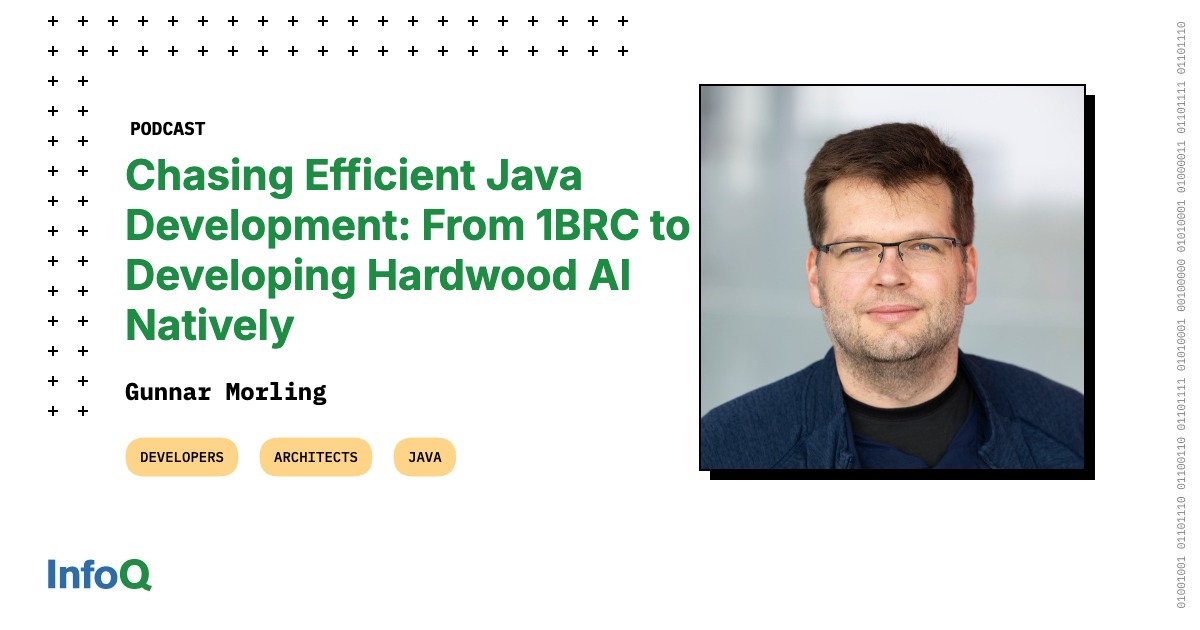
Well, sometimes, you find folks like Gunnar Morling, who’s been kicking the tires on Java for a good while now. He’s the kind of guy who doesn’t just talk the talk; he builds the darn thing. And he’s been digging into Java’s performance, not just for the sake of it, but to tackle some seriously gnarly data problems.
And here’s the thing about Morling: he’s not one for blowing smoke. He was instrumental in the One Billion Row Challenge, that wild experiment that basically screamed, “Hey, Java can actually be fast!” Now, almost three years later, the echoes of that challenge are still ringing, and he’s clearly not resting on his laurels.
Beyond the Rowdy Challenge: What’s Next for High-Performance Java?
Morling’s current gig involves a mix of the strategic and the hands-on. At Confluent, he’s the guy investigating potential tech investments and fielding those “explain X to the execs” requests. But his real passion lies in tinkering, blogging, and, yes, building open-source projects. He’s still involved with Debezium, a change data capture tool that’s practically the plumbing for modern data pipelines. But the buzz right now is around Hardwood.
Hardwood, you ask? It’s Morling’s take on a minimal-dependency Java parser for Apache Parquet. And before you yawn and think “another parser,” hear him out. Existing parsers? They often come with a truckload of dependencies, opening the door to supply chain nightmares and classpath conflicts that’d make your head spin. Morling’s approach is different: zero dependencies, maximum speed.
Unlike existing Java parsers, which introduce a large dependency footprint and liabilities like supply chain attack risks and class path conflicts, Hardwood was built as a fast, zero-dependency project to minimise these issues.
This isn’t just about trimming fat; it’s about building resilience and agility. In the chaotic world of software development, reducing your attack surface and avoiding dependency hell are not just nice-to-haves; they’re essential survival tactics. And who’s footing the bill for this kind of innovation? Ultimately, it’s the companies that need to process vast amounts of data quickly and reliably. Confluent, for one, is certainly interested in high-performance data solutions.
Making Java Fly: Virtual Threads and AI Natively
So, how is Hardwood achieving this feat of performance? It’s all about clever use of modern Java features. We’re talking highly granular page-level parallelization, and — get this — Java’s own Virtual Threads. Think of Virtual Threads as lightweight, super-efficient concurrency helpers that allow you to max out those CPU cores without the usual overhead. It’s like giving your Java application a turbo boost without the fuel guzzling.
And then there’s the AI-native development aspect. Morling claims it was a smooth ride, largely thanks to Parquet’s extensive documentation. But the kicker? He emphasizes that human oversight is still critical. You can’t just hand the reins to an AI and expect perfection. Code quality, adherence to design, keeping that public API minimal — these are all areas where human judgment reigns supreme. This is where the real value is created, not just in automating the grunt work.
This whole endeavor brings to mind the early days of database tuning. Back then, it was all about knowing your hardware, understanding the database internals, and meticulously crafting queries. Morling is doing something similar but on a higher level, squeezing every ounce of performance out of the Java ecosystem for the data-hungry world. It’s a stark contrast to the abstract, often detached, development cycles we see elsewhere.
Will Java Dominate AI Development?
The implications here are significant, particularly for the open-source community and for companies trying to stay ahead in the data game. If Java can truly become a first-class citizen for native AI development, especially in performance-sensitive areas like data parsing, it could disrupt the current landscape. We’re not talking about replacing Python for every ML model, but for the heavy-duty data processing that underpins AI, Java’s strengths are becoming undeniable.
Morling’s work with Hardwood suggests a future where Java isn’t just for strong enterprise backends but also for the cutting edge of data infrastructure and AI tooling. It’s a pragmatic approach, leveraging existing, powerful language features rather than chasing every shiny new framework. And for those of us who’ve seen trends come and go, that grounded, performance-first mindset is exactly what we need to see more of.
So, while others are busy chasing the latest buzzwords, Morling is quietly building tools that matter, pushing the boundaries of what Java can do. And that, in my book, is far more interesting than any overhyped announcement.