The hum in the conference hall at Google I/O 2026 felt different this year. It wasn’t just the usual murmur of a thousand developers anticipating the next big thing. There was an undercurrent, a palpable shift, that spoke of something more profound than just another iteration of a model or framework. For those of us steeped in the often-arcane world of AI development, the most resonant message wasn’t about the sheer power of Gemini or the Firebase wizardry. It was about accessibility. It was about making the complex, the cutting-edge, the frankly intimidating, suddenly graspable by students and independent creators.
This isn’t just marketing fluff. Think about it: for years, the promise of AI has been potent, an engine for innovation. Yet, the practical hurdles for many—from setting up complex environments to wrangling massive datasets and understanding complex deployment pipelines—remained formidable. This year, Google seemed to be dismantling those barriers, piece by painstaking piece.
The Great Unlocking of AI Development?
It’s an exciting time to be alive, and certainly to be developing software. AI’s growth is exponential, a daily deluge of new models, libraries, and esoteric algorithms. But for many bright minds, particularly students, the journey from abstract concept to a tangible, working project has been a rocky one. Resources are often scarce, the learning curve steep, and the sheer overhead of infrastructure can feel like an insurmountable wall. Google I/O 2026, if you peel back the layers of polished demos and confident pronouncements, offered a compelling vision of an ecosystem that’s actively smoothing those rough edges.
Instead of wrestling with server configurations or debugging obscure library incompatibilities for days, the narrative is shifting. Developers are being nudged—or perhaps, more accurately, handed a roadmap—to focus on what truly matters: solving problems. This is the architectural shift I’m talking about: moving the bottleneck from infrastructure plumbing to pure, unadulterated problem-solving creativity.
AI as a Collaborator, Not a Replacement
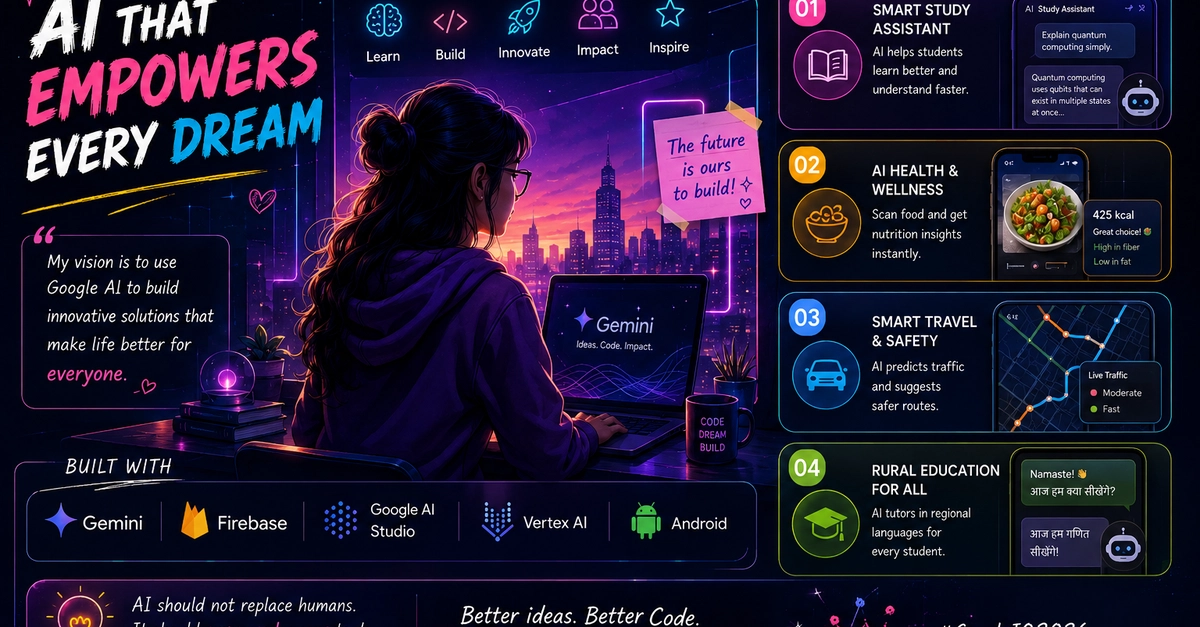
My own journey through the AI landscape has hammered home a simple truth: technology, no matter how advanced, finds its ultimate value when it serves a human purpose. This is the bedrock of the vision that feels increasingly attainable: ‘AI That Empowers Every Dream.’ It’s a far cry from the dystopian narratives that often dominate the AI conversation. Instead, it frames AI not as a silicon usurper, but as an intelligent co-pilot. Imagine it augmenting education, streamlining daily routines, and forging new avenues for opportunity for a broader swathe of humanity. The sessions at I/O 2026, especially those focusing on practical applications, amplified this motivation.
Building Beyond the Demo
The ideas bubbling up are less about abstract proofs-of-concept and more about direct, impactful interventions. Take, for instance, the concept of a ‘Smart Study Assistant.’ Students drowning in notes and complex subjects could benefit immensely from AI that intelligently summarizes, explains difficult concepts, and crafts personalized quizzes. This isn’t just about efficiency; it’s about democratizing learning itself, making it more adaptive and accessible. The implications for personalized education are staggering.
Then there’s the health and wellness angle. A simple app that scans food items, providing instant nutritional breakdowns and calorie counts, could be a game-changer for individuals seeking healthier lifestyles. It’s this kind of accessible, everyday utility that truly demonstrates AI’s potential to integrate into our lives beneficially, rather than disruptively. We’re talking about practical solutions, not theoretical marvels.
Even complex urban challenges like traffic and safety could see AI-driven improvements. Systems that analyze real-time traffic, reroute vehicles for optimal flow, and enhance safety could fundamentally alter the urban experience. It’s a powerful reminder that AI isn’t confined to screens; it can interact with and improve the physical world.
Perhaps the most compelling vision is AI for rural education. In regions where access to quality learning resources is a daily struggle, AI that functions in local languages and adapts to limited infrastructure could unlock educational opportunities for millions. If AI can truly level the playing field in education, its power to transform lives is almost immeasurable.
Google AI Studio: The Developer’s New Playground
The evolution of Google AI Studio and the broader Gemini ecosystem was a standout announcement for me. What strikes me is the deliberate focus on accelerating the development cycle. Faster experimentation, more intuitive workflows, and a clear path for beginners — these aren’t just buzzwords; they’re critical enablers. For students and solo developers who often operate with constrained budgets and limited computational power, these reductions in complexity are not minor conveniences; they are fundamental to making ambitious projects feel achievable.
Addressing the Beginner’s Paradox
Despite the impressive strides, there’s a lingering challenge: the sheer velocity of AI development can still be overwhelming for newcomers. The landscape is crowded with a dizzying array of models, APIs, frameworks, and tools. To truly solidify this push towards accessibility, integrating more structured, beginner-focused learning paths, pre-built templates, and guided project experiences within platforms like AI Studio would be a significant step. Imagine a guided journey from a basic idea to a functional prototype – that would empower a new generation of developers to build with confidence, not trepidation.
This moment, marked by Google I/O 2026, feels like a turning point. It’s not just about the impressive technological leaps, but about the architectural decision to make those leaps accessible. The future of AI development is rapidly becoming more open, and that’s a prospect that deserves our keenest attention.
🧬 Related Insights
- Read more: RPS Benchmarks 2026: Where DTC Brands Actually Stand
- Read more: Adobe Creative Cloud Pro Hits 50% Off: What’s Driving the Deal?
Frequently Asked Questions
What did Google I/O 2026 announce about AI? Google I/O 2026 showcased advancements in AI, including updates to Gemini and the Google AI Studio, with a notable emphasis on making AI development tools more accessible to students and independent developers.
Will these new AI tools actually make development easier for beginners? While the announcements suggest a significant push towards simplification and accessibility, the true test will be in the ongoing refinement of these tools and the availability of comprehensive learning resources. Early indications are positive.
Can I use these new AI tools for my own projects without a big team? The focus on platforms like Google AI Studio and streamlined workflows aims to enable individual developers and smaller teams to build AI-powered applications more readily than before.