The cursor blinks, expectant. You sit down, ready to summon that perfectly tuned Claude prompt, that brilliant little skill you whipped up last Tuesday. But it’s not there. Not on this machine, anyway. It’s back on the laptop, which is currently, cruelly, at home. This fragmentation, this digital schizophrenia across your developer toolkit – it’s enough to make you want to throw your keyboard out the window.
Branko, you built another tool? Yes. Yes, he did. And before you roll your eyes — hear me out, because this one scratched an itch that was driving him genuinely crazy.
My laptop. My desktop. My work box. And every single one of them had its own little personality. A CLAUDE.md from two weeks ago on one. A skill I wrote on Tuesday that simply did not exist on the other two. A plugin installed here but not there.
You know the feeling. You sit down at the other machine, go to use that clever little skill you made, and… nothing. It’s not there. It’s on the laptop. The laptop that is currently at home. On your desk. Mocking you.
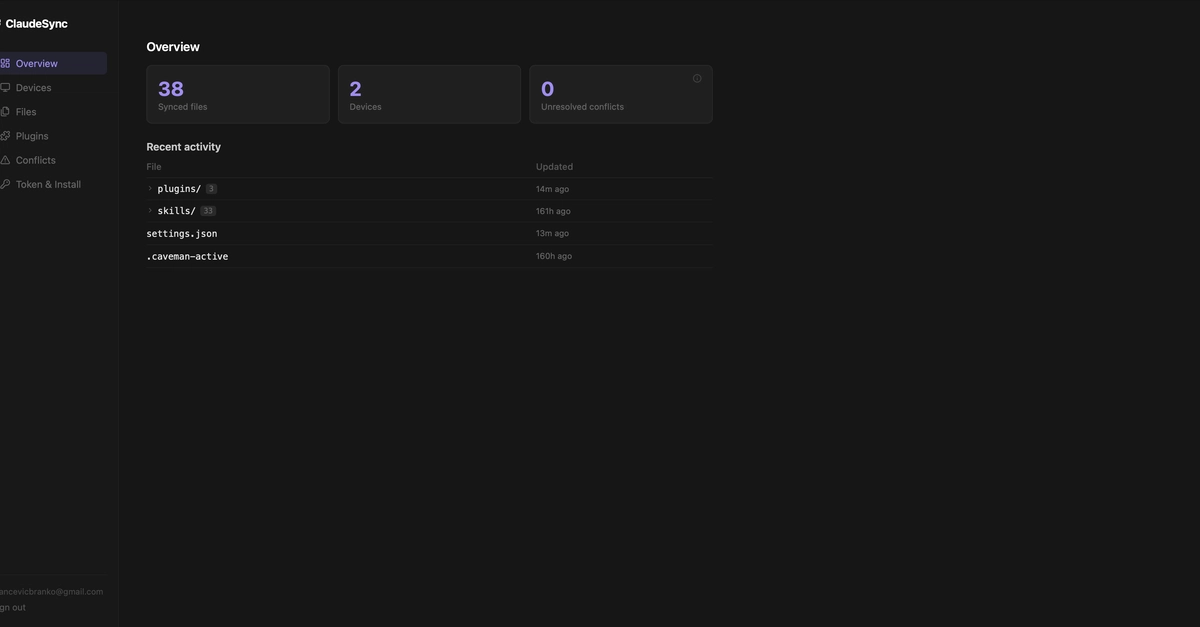
So he built ClaudeSync.
I know what you’re thinking, because I thought it too. Put ~/.claude in a git repo and be done with it. And sure. That works. Until you forget to commit. Until you forget to pull. Until a plugin file has /Users/branko/... baked into it and breaks the moment it lands on a machine where you are not, in fact, branko. And then there’s the part nobody mentions: git diff on a folder full of JSON and markdown is not what I’d call a pleasant afternoon. I wanted to see what was different before I synced it. Like a normal person.
Generic dotfile tools? Same story. They don’t know what Claude Code is. They see files. They don’t see ‘oh, this is a plugin manifest, that means somebody should run claude plugin install.’ He wanted something that actually gets it.
The ‘No Auto-Sync’ Philosophy: A Breath of Fresh Air?
No background file watcher. Let me say that again because it sounds like a missing feature and it absolutely is not: ClaudeSync does not watch your files and sync them automatically.
Here’s why. Auto-sync sounds lovely right up until you’re halfway through editing a file, the watcher wakes up, and a half-written mess gets pushed everywhere. Or two machines touch the same file and one silently eats the other. For your AI coding setup — the thing that shapes how Claude behaves for you — I did not want surprises.
So every sync is a decision you make. You open the dashboard, hit ‘Discover,’ and you get a nice file tree showing what changed — new files, modified files, badges and all. You tick the ones you want. You push. Nothing moves unless you told it to. Boring? Maybe. Predictable? Absolutely. I’ll take predictable.
Under the Hood: A Supabase Symphony
Three pieces. Stay with me.
One — a little Node agent that lives on each machine. It does not sit there polling or watching. It connects to Supabase Realtime and just… waits. Listens for orders.
Two — Supabase doing the heavy lifting. Postgres for the metadata, Storage for the actual file contents, Realtime for the command channel, Edge Functions for the API. The free tier carries all of it.
Three — a React dashboard on Netlify. This is the cockpit. Your devices show up here, and this is where you press the buttons.
The little trick I like: the dashboard never talks to the agent directly. It shouts into a Supabase Realtime channel, and the agent — subscribed to that channel — hears it. Which means the agent needs zero inbound network access. It’s behind your home router, behind your office firewall, doesn’t matter. It’s not listening for the world. It’s listening for one channel.
Dashboard  Supabase  Agent
|          |         |
|-- 'Discover!' ---->|---- broadcast ---->| scans ~/.claude
|          |<--- here's the diff |
|<-- file tree -------|          |
|          |         |
|-- 'Sync these' ---->|---- broadcast ---->| reads + pushes files
|          |         |
|-- 'Send to box' --->|---- broadcast ---->| writes ~/.claude
|          |         | auto-installs plugins
Path Placeholders: The Secret Sauce
Here’s the bit that actually took thinking.
A plugin file or a settings file loves to contain a full, absolute path. Something like /Users/branko/.claude/skills/my-skill. Beautiful. On my machine. Send that exact line to your machine and it’s nonsense — you’re not branko, and your Claude folder might live somewhere else entirely.
So before a file gets stored, ClaudeSync swaps the known path bits for placeholders — {{USER_HOME}}, {{CLAUDE_PATH}}, that kind of thing. Think of it as the file going into storage wearing a disguise. When it lands on another machine and gets pulled, the agent rips the disguise off and fills in that machine’s real values. You never see any of it. The file just works. Different username, different home directory, different install location — it just works. That’s the whole point.
Security: Because Your AI Knows Your Secrets
Good. You should ask that. Anything touching ~/.claude should make you a little suspicious.
So — Row Level Security on every single table. Every query Postgres runs is locked to the user who made it. There is no clever path where your files and my files end up in the same bucket. It’s enforced down in the database, not up in some application code where one lazy bug leaks everything.
File contents sit in private storage. Downloads happen through short-lived signed URLs. The agent authenticates with a per-user token you can rotate or kill from the dashboard whenever you like. And the whole thing is built on Supabase, which has a pretty decent track record.
This isn’t just a QoL upgrade; it’s about building an AI platform that works. The chaotic, multi-machine setup for AI development is an emergent property of early adoption, a sign that the tools themselves haven’t quite caught up to the paradigm shift. ClaudeSync is an early signal that we’re moving beyond duct-taping personal setups and towards strong, manageable AI workflows. It’s a glimpse into the future where your AI collaborator is as consistent as your IDE, no matter which terminal you open.
Frequent Questions Answered
-
What does ClaudeSync do? ClaudeSync synchronizes your Claude Code configurations, skills, and plugins across multiple machines, ensuring consistency and preventing data loss or outdated setups.
-
Is ClaudeSync open source? While the original article doesn’t explicitly state it, the architecture described (Node agent, Supabase, React dashboard) strongly suggests a potential for an open-source or at least self-hostable model. The author’s emphasis on Supabase’s free tier and the desire for control points towards community-friendly development.
-
Will this replace my job? Tools like ClaudeSync are designed to enhance developer productivity by automating tedious synchronization tasks, allowing you to focus on more complex problem-solving and creative work, not replace your role.