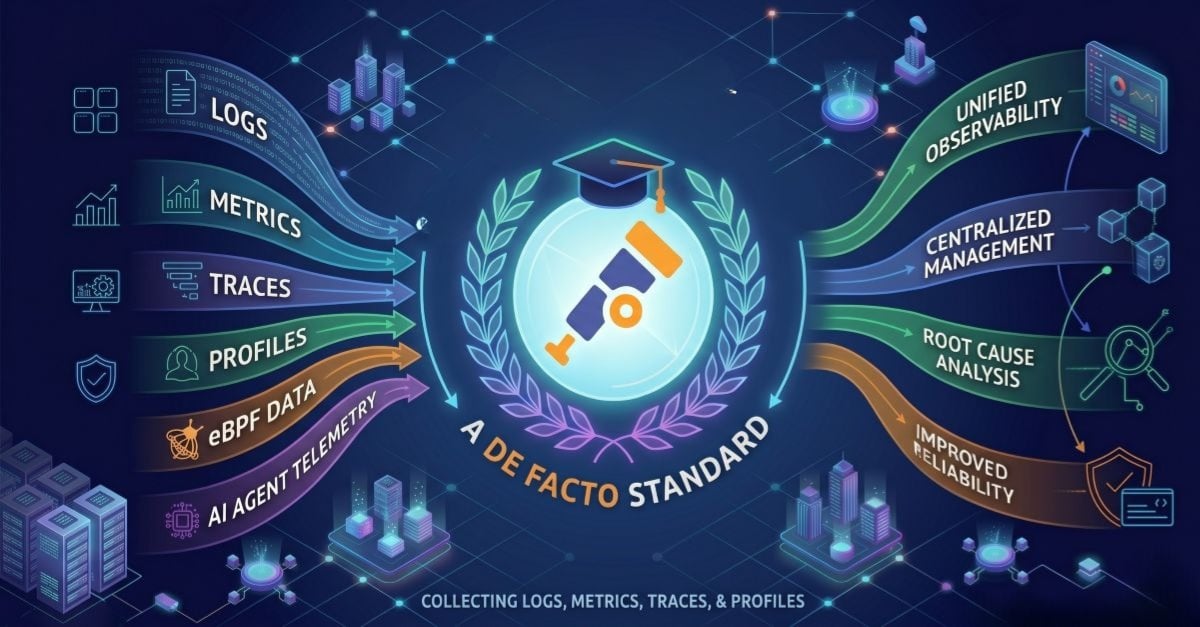
So, OpenTelemetry is now a ‘graduated’ project from the Cloud Native Computing Foundation. Big deal. Seven years in the making. Seven years. It’s a merger baby, born from the ashes of OpenTracing and OpenCensus, both noble attempts to tame the chaos of instrumenting code. Now it collects logs, metrics, traces, and — wait for it — profiles. Because apparently, we don’t have enough data points to drown in already.
This isn’t just about applications anymore. Oh no. OTel is slurping up data from your infrastructure, your security tools, anything that can spit out a signal. CNCF CTO Chris Aniszczyk declares it a ‘de facto standard.’ That’s the corporate hype machine kicking into high gear. A de facto standard is what happens when the alternative is so bad, or so fragmented, that everyone just shrugs and accepts the current imperfect solution. Does that mean it’s good? Not necessarily.
Aniszczyk also muses about OTel playing a ‘major role’ in instrumenting AI agents. Great. More data. More noise. Because AI definitely needs more telemetry to churn through. And eBPF? Oh yes, the Linux kernel’s magic tool is getting a shiny OTel wrapper. Because more formats are exactly what we need to simplify things.
He admits there’s ‘work to be done to make OTel simpler to deploy.’ Ya think? If it were simple, would we even be talking about it? Thankfully, the burden falls on ‘providers of OTel distributions.’ Bless their hearts.
Is This the Observability Holy Grail?
Mitch Ashley from Futurum Group chimes in, waxing poetic about OTel preventing ‘fragmentation’ as AI cranks out ‘orders of magnitude more signal.’ A noble goal, I suppose. But let’s be real. We’re still a long way from unifying all this data. Most orgs are still fumbling in the dark, drowning in alerts generated by tools that barely speak to each other. The idea of a central management system for all telemetry data feels like science fiction.
Futurum’s own survey shows a third of companies planning to spend over a million bucks on observability in 2026. A million dollars. For what? To finally figure out why their app is sluggish this time. Because existing monitoring tools? Ancient history. Utterly useless when your application is a sprawling, microservice-laden beast with dependencies that would make a spider web look organized. If you don’t know what connects what, you’re just waiting for the next outage. preventable, of course.
‘While most organizations are still a long way from unifying the management of all that telemetry data, OTel has created a unique opportunity to further centralize the management of IT operations.’
This quote, from Aniszczyk, is pure PR spin. A ‘unique opportunity’ to ‘further centralize.’ What we have is a common format for data. Centralization? That’s a whole other beast, and OTel doesn’t magically solve it. It just gives you a slightly more organized way to collect the pieces of the puzzle you might eventually assemble. If you have the patience. And the budget. And the sheer willpower.
Why Does This Matter for Developers?
For developers, OpenTelemetry represents a potential end to vendor lock-in for the instrumentation layer. That’s the promise, anyway. You instrument once, with OTel standards, and theoretically, you can plug in different backends for analysis. This is the dream: write code, emit telemetry in a standard format, and then choose your preferred analysis tool without a massive re-instrumentation effort. It’s about flexibility. It’s about not being beholden to a single vendor’s proprietary agents and APIs.
However, the complexity of deploying OTel itself remains a significant hurdle. Setting up collectors, configuring exporters, and ensuring consistent data collection across diverse environments (cloud, on-prem, Kubernetes, bare metal) is no trivial task. It often requires dedicated expertise, or relying on managed distributions that, while simpler, still involve understanding the underlying OTel architecture.
The move to graduate status means the project has proven its maturity and adoption. It’s likely to see continued investment and wider integration into tools and platforms. Developers can expect to see more SDKs, more libraries, and more support for OTel within their favorite frameworks. The hope is that this standardization will eventually lead to a more streamlined observability story, reducing the burden of manual instrumentation and allowing teams to focus on building features rather than chasing down elusive bugs.
But let’s not get carried away. The ‘de facto standard’ label is aspirational as much as it is factual. It’s a signal that the community has coalesced around this project, but the hard work of making observability truly easy — from collection to analysis — is far from over. The million-dollar question remains: Will OpenTelemetry genuinely simplify the chaos, or just provide a more standardized way to generate even more of it?
🧬 Related Insights
- Read more: AI Code Speed vs. Delivery: The Real Bottleneck Revealed
- Read more: Apache Turns Anthropic’s $1.5M Check into ‘Responsible AI’ – Smells Like Spin
Frequently Asked Questions
What is OpenTelemetry? OpenTelemetry (OTel) is an open-source observability framework for collecting telemetry data like logs, metrics, traces, and profiles from software and infrastructure.
Why is CNCF project graduation important? Graduation signifies that a CNCF project has achieved significant maturity, widespread adoption, and a strong governance model, indicating stability and community support.
Will OpenTelemetry replace my current monitoring tools? OpenTelemetry aims to standardize telemetry collection, potentially integrating with or providing data to existing and future monitoring and observability tools, rather than being a direct replacement for all functionalities.