Wiring up eight AI agents sounds like progress. For most users, it probably means getting more done. For one unlucky tech journalist, it meant a quiet, insidious data heist. His work, meant for GitHub, landed in a client’s Linear project. Issues meant for his local Obsidian vault were searched for on the web, fruitlessly. This isn’t a glitch; it’s a design flaw baked into how these AI agents communicate.
We’re talking about the Model Context Protocol, or MCP. It’s the backbone for some of these advanced AI setups. The problem? It doesn’t handle naming conflicts. At all. Think of it like a shared whiteboard where everyone can write ‘meeting notes’ without any indication of whose notes they are. The last person to write it wins, and everyone else’s just vanishes. No errors. No warnings. Just… gone.
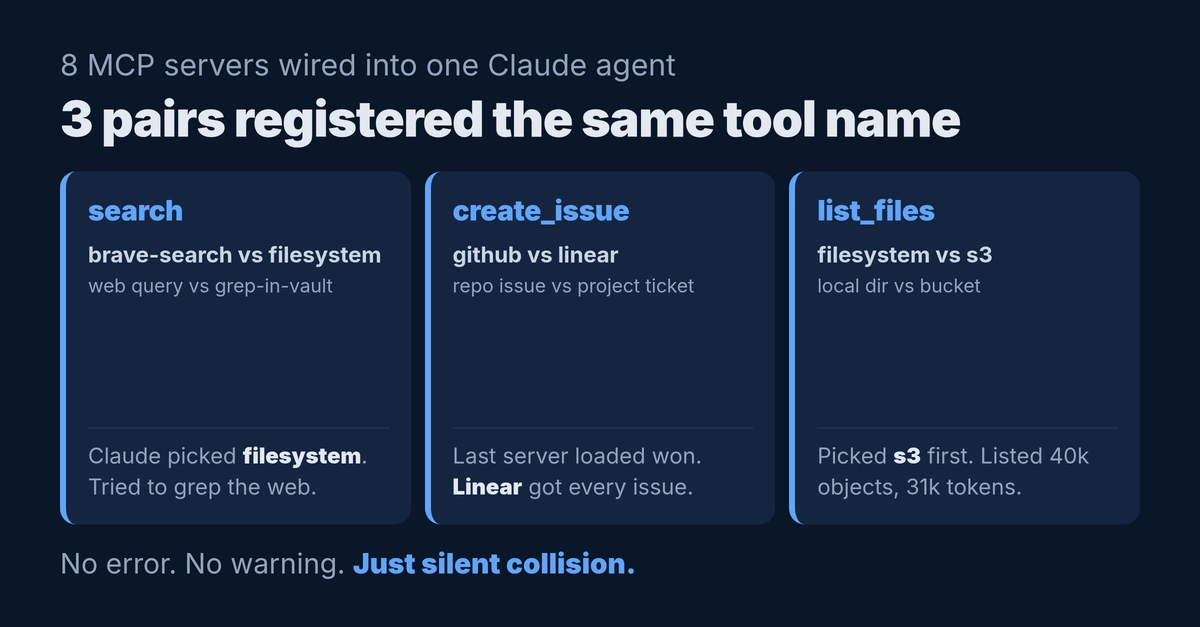
This isn’t a hypothetical. Our journalist friend wired up eight distinct MCP servers for real, everyday tasks: web searching with Brave, managing Obsidian notes, handling GitHub issues, project ops on Linear, accessing S3 buckets, doing Japanese accounting with Freee, summarizing Slack channels, and querying a PostgreSQL database. Eighty-seven tools in total. Claude, the AI model, then had to juggle all of them. The results were, to put it mildly, disastrous.
Why Does This Matter for Real People?
Here’s the kicker: no errors were thrown. None. Claude saw a tool named search. Which search? The web one or the file system one? It didn’t know. It picked whichever definition it encountered last during its boot process. The filesystem one won. So when the journalist asked for the latest Anthropic safety paper, he got a regex search of his personal notes. Useful.
Then there’s create_issue. Two servers registered this. One for GitHub, one for Linear. The request for an issue about a asyncpg regression went to Linear. The body of that issue, meant for a client project, included details about his private Postgres schema. Imagine that detail landing in the wrong hands. It’s a privacy nightmare waiting to happen. The metadata dump from the s3 server alone — 31,000 tokens — effectively burned the entire conversation session. The agent was useless until restarted. These aren’t minor hiccups; they’re fundamental breakdowns in trust and data integrity.
The MCP client (Claude Desktop / Claude Code) sees a flat tool registry. Last write wins. Period.
This isn’t some exotic, edge-case scenario. The names that collide are precisely the ones you’d expect: search, list, get, create, delete. They’re the verbs of digital interaction. The Model Context Protocol specification, in its current form (March 2026 revision), simply doesn’t account for them. It assumes a clean slate, a world where developers meticulously avoid duplicate tool names. That’s a quaint idea, isn’t it? A proposal exists to add namespace prefixes, but it’s languishing. So this “last write wins” chaos is here to stay, for now.
Is There a Fix for This Mess?
Our intrepid reporter found a workaround. It’s not pretty, but it’s effective. He prefixed all his tool commands. Instead of search, it’s now brave_search. Instead of create_issue, it’s gh_create_issue or linear_create_issue. This little three-line configuration tweak prevents the collisions. It forces Claude to distinguish between the identical names by prepending the server’s identifier. It’s a band-aid on a gaping wound, but it works.
This incident reveals a critical oversight in the current AI agent architecture. The ability to dynamically integrate multiple specialized tools is a powerful leap forward. But if the underlying communication protocols are so fragile that common actions can lead to silent data corruption or misdirection, then we’re building on quicksand. The onus is on the protocol designers and the client implementations to build in safeguards, not push the burden onto the end-user to become a de facto namespace manager. Until then, approach your multi-agent setups with extreme caution. And always, always back up your data.