Have you ever stopped to consider that your carefully curated browser bookmarks are a goldmine of untapped learning potential, currently languishing in digital purgatory?
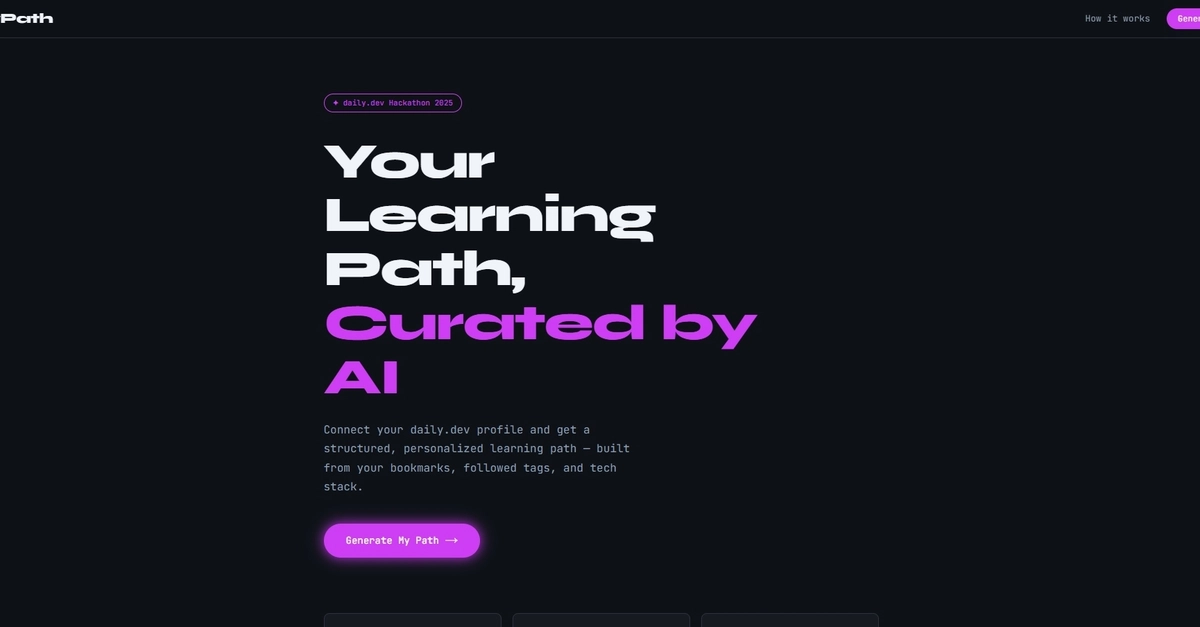
It’s a question few developers likely ponder while hitting that ‘save’ button, yet it lies at the heart of DevPath, a new tool that promises to excavate value from our often chaotic online information diets. Built on the foundation of daily.dev and supercharged by OpenAI’s GPT-4o, DevPath isn’t just another bookmark organizer; it’s a nascent AI-powered curriculum generator that turns your reading history into a structured, stage-based learning path.
The Problem of the Digital Hoard
For many, daily.dev serves as an indispensable aggregation point for the web’s technical discourse. You follow tags, bookmark articles, and build a history—a digital breadcrumb trail of your interests and perceived knowledge gaps. Yet, the inherent flaw, as the DevPath creator laments, is the lack of actionable structure. Bookmarks pile up. Articles are consumed helter-skelter. The signal gets lost in the overwhelming noise of a million-and-one saved links.
DevPath directly confronts this. By integrating with your daily.dev account and employing GPT-4o, it aims to impose order on this digital entropy. The premise is straightforward: analyze your reading habits, identify core themes, and then, critically, organize this information into a logical, progressive learning sequence.
Is This the Future of Self-Directed Learning?
The technical underpinnings are surprisingly lean, a proof to modern web development paradigms. Built with Next.js 16 (App Router) and TypeScript, DevPath operates entirely client-side, storing your generated learning paths in localStorage. This “no backend, no database” approach isn’t just a technical choice; it’s a philosophical one, emphasizing privacy and simplicity. Users provide their own OpenAI API keys, meaning costs are directly controlled, and sensitive data—beyond what’s already public on your daily.dev profile—never traverses any server other than OpenAI’s own.
Sharing is handled ingeniously via URL encoding. Your compressed learning path is embedded as a ?d= parameter. Open the link elsewhere, and the path is reconstructed. It’s a clever workaround for the inherent limitations of localStorage across devices, all without the need for a server infrastructure.
DevPath pulls your bookmarks, followed tags, and tech stack via the daily.dev API. GPT-4o selects 12–18 relevant articles and organizes them into 3–5 stages—from foundational to advanced—with a clear reason for each.
This ability to use a rich data signal from daily.dev—combining bookmarks, tags, and even stated tech stacks—alongside the sophisticated understanding of GPT-4o, is where DevPath’s potential truly shines. The prompt personalization, fueled by user-provided background questions about experience, role, and goals, allows for a nuanced curriculum tailored to individual needs, moving beyond generic recommendations.
The use of GPT-4o’s JSON mode (response_format: { type: "json_object" }) is a smart move. It guarantees structured, parseable output, sidestepping the common pitfall of brittle AI parsing logic. This ensures the curriculum structure remains consistent and reliable, a vital aspect for any educational tool.
The Data Signals: What Makes DevPath Work?
There are a few key insights here that signal a broader trend.
First, the daily.dev API proves to be a more potent signal of developer intent than one might initially assume. Aggregated data points—bookmarks, tags, and even declared tech stacks—paint a surprisingly detailed picture of a developer’s current learning trajectory and aspirations.
Second, GPT-4o’s demonstrated capability in curriculum design is significant. When provided with structured context and clear objectives, its ability to synthesize information and present it logically is, frankly, impressive. This moves AI from a mere content generator to a pedagogical assistant.
Finally, the technical elegance of lz-string for URL-based state sharing is worth noting. Compressing JSON by 60-70% and embedding it directly into a URL is an efficient, serverless method for persistent, shareable state—a pattern that could be adopted for many client-side applications.
A Skeptic’s View: Can AI Truly Curate Knowledge?
While DevPath’s ambition is laudable and its execution technically sound, it’s important to maintain a degree of critical distance. The tool relies heavily on the quality and breadth of your daily.dev activity. If your bookmarks are eclectic or superficial, the AI’s output will naturally reflect that.
Furthermore, the inherent bias of AI models, even advanced ones like GPT-4o, means that the generated path will reflect the data it was trained on. While personalization attempts to mitigate this, a truly novel or counter-intuitive learning direction might be harder to surface. The “clear reason for each stage” generated by GPT-4o will be a fascinating data point to scrutinize for potential AI-driven blind spots or emergent pedagogical philosophies.
Still, as a 72-hour hackathon project, DevPath is a remarkable demonstration of what’s possible when you combine curated user data with powerful LLMs in a serverless architecture. It hints at a future where our digital interactions provide not just information, but personalized, actionable learning frameworks.