At turn four of a multi-turn cancellation scenario, the conversation is already stalled. Priya asked to cancel an order and get a refund. The agent, following its control loop, checked the order status – shipped. Now, it’s offering Priya a choice: start a return or escalate to a human. The agent’s state is paused, waiting on a human decision, highlighting the critical engineering problems of state management, stopping conditions, and context handling that plague real-world AI agents.
This isn’t theoretical. This is production AI. And the stark reality is that for all the hype around autonomous agents, getting the fundamental control loop right is proving to be the sticky wicket.
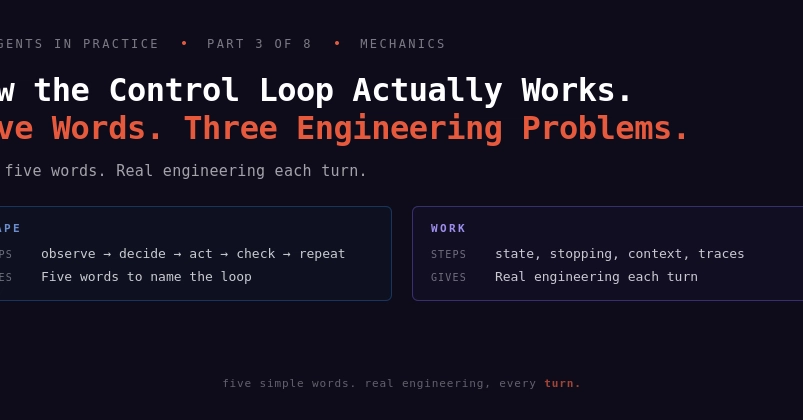
AI Agents in Practice — Part 3 dive into the engine room, dissecting that five-word mantra: observe → decide → act → check → repeat. It’s a mantra that, while conceptually elegant, hides a labyrinth of practical challenges when you try to deploy it beyond a simple demo.
The Devil in the Details: What Each Loop Step Actually Does
The core idea of the control loop is straightforward: gather information, make a choice, execute that choice, see the outcome, and start over. But the original article makes it clear that each step is far from trivial.
Observe, for instance, isn’t just grabbing raw data. It’s a curation step, sifting through the user’s latest input, the current task status, prior tool outputs, and any active skill constraints to pull out what’s relevant for this specific turn. This isn’t passive consumption; it’s active filtering.
Then comes Decide. This is where the model chooses the next action. Crucially, its decision-making interface isn’t a deep dive into source code. Instead, it’s presented with the concise descriptions the application exposes for its tools. This means the quality of those descriptions—especially regarding failure modes and when-to-use guidance—is paramount. Omit failure behavior, and you risk the agent retrying on permanent errors. Miss when-to-use guidance, and it confidently picks the wrong tool.
Act is where the rubber meets the road. Whatever was decided happens – a tool fires, a message goes out, a skill is invoked. This is the step that changes the external world, and it’s often the source of the most visible failures. A misstep here can have real-world consequences.
Check is the feedback mechanism. What actually came back? Did the tool do what was expected, or did it falter? This step is about processing the reality of the outcome, not the intention behind the action.
Repeat, then, simply restarts the cycle with the updated state, continuing until the agent determines it’s done, escalates, or is halted externally.
Why Production Agents Fail: The Three Engineering Hurdles
As the example illustrates, by turn four, three critical engineering problems are in play:
- State: The agent has a paused task. It can’t proceed without a human’s input or a system-level decision about how to handle the current situation. This requires sophisticated state management that can hold complex, ongoing processes.
- Stopping: When does a conversation or task truly end? Defining completion criteria is surprisingly difficult, especially when human intervention is required. The original task remains incomplete, and the agent needs a clear understanding of what constitutes resolution.
- Context: The active context window is a jumbled mix of tool outputs, retrieved information, internal planning notes, and in-progress decisions. Effectively managing this context—knowing what’s essential for the next step and what’s just noise—is vital for efficient and accurate operation.
These aren’t minor bugs; they are fundamental challenges to building agents that are reliable and safe in production. A control loop that doesn’t rigorously handle these issues isn’t just inefficient; it’s a potential liability.
A control loop that observes after deciding is just a script with hallucination.
This statement from the original piece cuts to the core of the problem. The order of operations in the control loop matters immensely. Pre-checks before potentially destructive actions, clear escalation paths before irreversible commitments, and thorough observation before re-decision are not optional niceties; they are the bedrock of production-grade AI behavior.
The Myth of the Up-Front Plan
A common misconception is that agents first create a comprehensive plan and then execute it. The reality, especially with patterns like ReAct (Reasoning → Action → Observation), is far more dynamic. Planning isn’t a one-time, upfront affair. Instead, reasoning and decision-making occur on each turn within the loop. The agent assesses the current situation, decides on the next best action, observes the result, and then re-evaluates. This continuous reassessment is what allows agents to adapt to changing circumstances—like a shipped order—and pivot away from potentially unsafe actions based on stale plans.
This iterative approach ensures that the agent’s actions remain relevant and safe, even as the external world responds in unexpected ways. The dynamism inherent in the control loop is its strength, but also the source of its complexity. Mastering this dynamic interplay is key to unlocking the true potential of AI agents in practical, real-world applications.
🧬 Related Insights
- Read more: Daily Briefing: April 24, 2026
- Read more: Swift 6.3 Cracks Android Open – C Interop Gets Teeth
Frequently Asked Questions
What does the ‘observe → decide → act → check → repeat’ loop for AI agents actually entail? This loop describes the fundamental cycle of an AI agent’s operation: gathering information (observe), choosing an action (decide), executing that action (act), reviewing the outcome (check), and then starting the process again (repeat). It’s the mechanism that allows agents to interact with their environment dynamically.
Why are production AI agents often complex to build and debug? Production agents face challenges like managing complex states, defining clear stopping conditions for tasks, and effectively handling vast amounts of context information. These issues go beyond simple code and require sophisticated engineering to ensure reliable and safe operation.
How does the ReAct pattern differ from a traditional planning approach for AI agents? The ReAct pattern integrates reasoning and decision-making into each turn of the control loop, allowing the agent to continuously reassess its situation and adapt its actions. This contrasts with traditional planning, which often involves creating a static sequence of steps upfront, a method less suited to dynamic, real-world interactions.