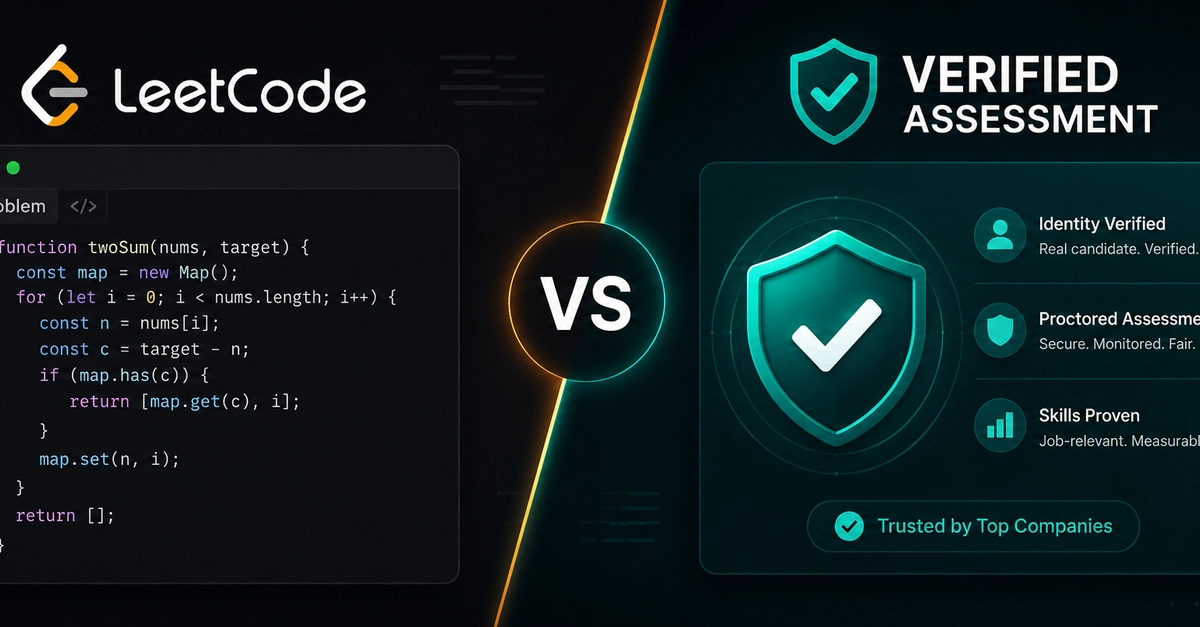
Is your LeetCode profile actually helping you land that dream job anymore?
Because here’s the dirty secret: spending countless hours battling dynamic programming problems at 2 AM, or being able to reverse a linked list in your sleep, might be producing a lot of sweat but not necessarily a job offer. A growing legion of developers, especially those fresh out of school, are discovering that a dazzling LeetCode leaderboard just isn’t cutting it in today’s hiring pipelines. And it’s not that the skills are irrelevant. It’s that nobody can definitively prove they’re truly yours.
This whole ‘self-reported skills are a gamble’ thing isn’t exactly a new concept. Resumes are rife with claims of expertise. GitHub profiles boast commit histories. LeetCode leaderboards display impressive streaks. But here’s the kicker: none of that truly tells a hiring team whether you actually solved those problems, whether you can replicate that magic under actual pressure, or more importantly, whether those skills can translate into the messy reality of day-to-day job tasks.
The Noise Just Got Louder: AI’s Role
This problem has been festering for a while, but things have reached a deafening crescendo by 2026, thanks to AI tools. Suddenly, appearing skilled is as easy as clicking a button. A candidate can employ a Copilot to breeze through a take-home assignment, or have their GitHub profile padded with AI-assisted contributions. The signal-to-noise ratio in technical hiring has plummeted to an all-time low. Consequently, companies are, understandably, losing faith in the old evaluation methods. And that, my friends, is forcing a seismic shift in how they scout talent.
Proof, Not Just Performance
There’s a yawning chasm between demonstrating a skill and proving you possess it. Demonstration is simply showing: ‘Here’s a solution I whipped up.’ Proof, however, is far more rigorous: ‘Here’s a solution I created, under strict observation, without any outside help, within a set timeframe – and yes, we even have a recording of the whole ordeal to confirm it.’
This is precisely where AI-proctored skill assessments are stepping into the void. Enterprise companies, particularly those drowning in applications, are increasingly adopting platforms that marry hands-on technical tasks with strong proctoring layers. We’re talking webcam monitoring, a hawk’s eye on tab switching, AI-driven behavioral analysis, and comprehensive session recordings. The objective isn’t to make candidates squirm; it’s to imbue the resulting credential with genuine meaning.
Think of it this way: it’s the difference between a self-taught driver proudly declaring ‘I can drive’ versus actually sitting for a test with a stern examiner in the passenger seat. Both might possess the ability, but only one provides irrefutable, verified assurance.
Why Experienced Devs Have an Edge (And How Grads Can Level Up)
If you’ve got five years of professional experience under your belt, your work history acts as a natural form of verification. Previous employers, successful product launches, glowing team references – these all lend a significant amount of credibility to your skill claims. Fresh graduates, unfortunately, lack this buffer. They’re asking companies to take a substantial leap of faith based on a degree, a handful of personal projects, and a score from an online assessment.
Proctored skill validation flips that dynamic on its head. It offers graduates something even seasoned professionals often struggle to present: a tamper-proof, independently verified stamp of competency. It’s a score that unequivocally declares, ‘This individual demonstrated this specific skill under controlled, verifiable conditions.’ For organizations genuinely committed to fair, unbiased hiring practices – and that number is growing rapidly post-AI – a verified assessment badge carries far more weight than a thousand-problem LeetCode streak.
Beyond the Algorithm: Real-World Tasks Matter
Here’s where the traditional LeetCode model falters, particularly for enterprise hiring: algorithmic puzzles rarely mirror the actual demands of the job. Most developers aren’t spending their days implementing Dijkstra’s algorithm from scratch. Their reality involves debugging infuriating integration failures, diligently reviewing pull requests, and building features under vague requirements with woefully incomplete documentation. Hands-on labs and scenario-based assessments are designed to probe these applied skills. Instead of the abstract ‘solve this problem,’ they pose challenges like: ‘Here’s a broken piece of code, find and fix the bug,’ or ‘Given this feature specification, build this component within 45 minutes.’
When these realistic tasks are coupled with proctoring, you achieve the best of both worlds: a practical challenge that mirrors actual job performance, verified under conditions that guarantee the outcome’s trustworthiness.
Practical Advice for the Aspiring Developer
So, if you’re a fresh graduate navigating the treacherous waters of the job market, here’s a tangible takeaway: actively seek out employers and platforms that offer proctored assessments. And when you find them, complete them. Some platforms even allow you to independently take verified skill assessments and then share those results as a verifiable credential. Imagine presenting a hiring manager with a proctored Python assessment, a validated SQL test, or a monitored hands-on lab result. That’s a differentiator that can eliminate doubt before the interview even kicks off.
It’s also wise to understand what employers are truly testing for. A well-designed skills assessment framework goes beyond mere syntax knowledge; it dive into problem decomposition strategies, code quality standards, effective documentation habits, and crucial time management under pressure. Understanding these nuances will help you prepare more strategically – not just by ‘practicing more LeetCode,’ but by honing your skills in environments that closely simulate real assessment scenarios.
The Era of Verified Credentials
The entire hiring industry is undergoing a much-needed trust reset. AI tools have effectively disrupted the traditional signals recruiters relied upon. Resumes, portfolios, and self-assessments have rapidly eroded in credibility. What’s emerging from the ashes is a model built on verified credentials – much like the certifications seen in medicine or law, but ingeniously adapted for the tech world. For developers, this development is actually a net positive. If you’ve got the skills and can prove them under duress, this new system offers a more equitable path forward. It’s a move towards substantiating capability, not just claiming it.
This isn’t a new problem. But it’s gotten louder in 2026 because AI tools have made it trivially easier to appear more skilled than you are. A candidate can use a Copilot to sail through a take-home assignment. A profile can be padded with AI-assisted contributions. The signal-to-noise ratio in technical hiring is at an all-time low.
The Future of Developer Assessment
Companies are no longer content with a candidate’s word. The ease with which AI can generate code, write essays, and simulate expertise has rendered traditional methods unreliable. This has forced a pivot towards demonstrating competence in a way that’s difficult to fake. Think of it as a technological arms race where the validators are now forced to adopt more sophisticated, verifiable methods because the simulators have become so advanced. The ‘open book’ test, in many ways, has been compromised. What’s left is the ‘closed-book, under supervision’ exam for technical aptitude.
This trend is particularly impactful for entry-level developers. Without a strong professional track record, their self-made portfolios and LeetCode scores are all they have. When those signals are devalued, their pathways to entry become significantly narrower. Proctored assessments, therefore, become not just a tool for employers to verify skills, but for candidates to prove they possess them, leveling the playing field somewhat. It’s about creating verifiable digital badges that genuinely represent acquired competencies, moving beyond abstract algorithmic challenges to concrete, observable tasks.
Will this replace my job?
No, proctored assessments are unlikely to replace developers’ jobs. Instead, they are becoming a new hurdle in the hiring process to verify skills. For developers who genuinely possess the required competencies, these assessments can be a way to prove their worth, especially when traditional signals are becoming less reliable due to AI.
Will LeetCode Be Obsolete for Hiring?
LeetCode and similar algorithmic puzzle platforms aren’t entirely obsolete, but their singular importance in the hiring process is diminishing. Companies are moving beyond these abstract problem-solving exercises to evaluate real-world coding skills in practical, scenario-based assessments. Algorithmic knowledge remains valuable, but it’s no longer sufficient on its own to impress employers, especially for roles demanding applied software engineering skills rather than pure competitive programming prowess.
What does this mean for developers?
For developers, this shift means adapting their preparation strategies. The focus needs to move from mastering theoretical algorithms to demonstrating practical coding ability, debugging skills, and the capacity to work under pressure in realistic scenarios. Building a portfolio of hands-on projects and actively seeking out proctored assessment opportunities will become increasingly crucial for showcasing genuine competence in a verifiable manner. It’s about bridging the gap between theoretical knowledge and practical application, ensuring that your skills are not just listed on a resume but demonstrably proven.