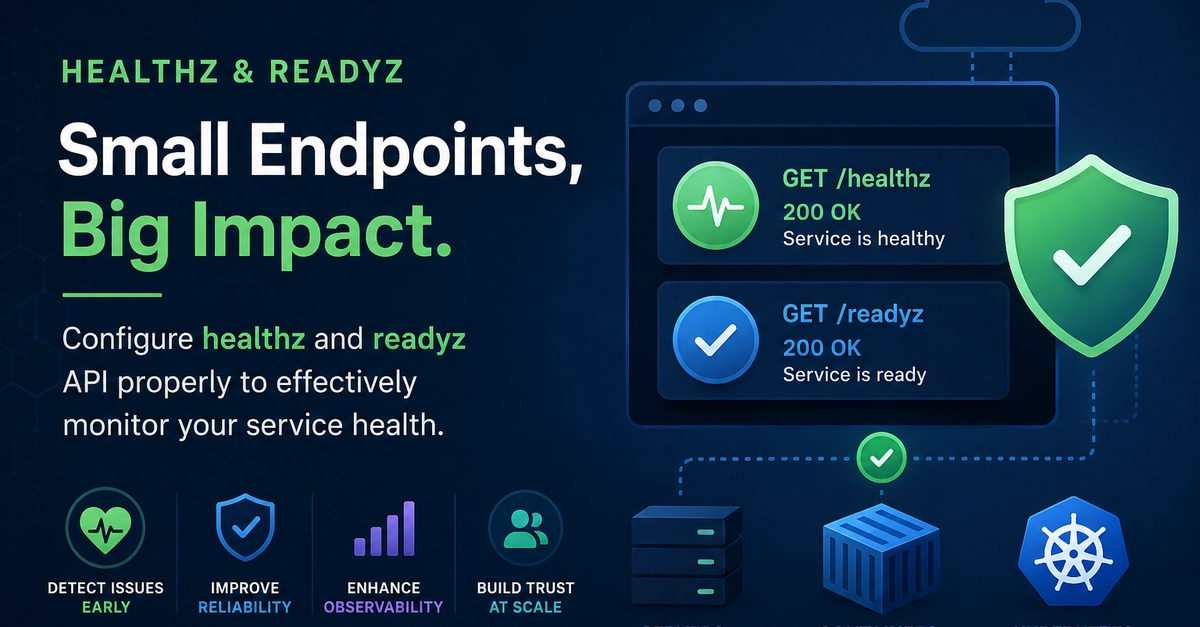
When your service is a digital workhorse, churning through requests at a dizzying pace, those seemingly minor health probe configurations aren’t just details; they’re the bedrock of your reliability strategy. Kubernetes, bless its distributed heart, uses these probes to answer two fundamentally different questions. First, is the container still breathing, capable of making forward progress? That’s the liveness probe, the livez endpoint. Second, is the pod actually ready, prepped and polished to accept production traffic right now? That’s the readiness probe, the readyz endpoint. Missing this distinction, even for a minute, can translate to thousands of lost requests, and in sensitive systems like audit trails, logging, or financial services, lost requests don’t just vanish; they can become permanent, gaping holes in your data.
The Core Distinction: Alive or Ready?
At their heart, these probes solve different problems. Liveness is the binary question: should Kubernetes scrap this container and give it a fresh start? If the process is a frozen statue, deadlocked, or stuck in an infinite loop of futility, the liveness probe should scream failure, prompting Kubernetes to spin up a new pod. Readiness, on the other hand, asks: should this pod be added to the traffic rotation? It’s about availability for service, not just the process’s existence. A pod can be alive—the process is running—but temporarily incapable of safely serving requests. In such cases, the readiness probe should signal temporary incapacitation, allowing Kubernetes to gracefully shunt traffic away without killing the still-living process.
This separation is a lifesaver in distributed systems. Not every hiccup with a dependency warrants a full-blown pod restart. Some failures are fleeting. Constantly restarting services can exacerbate problems, leading to churn, reconnection storms, or the dreaded cold start penalty, where a fresh instance needs time to warm up before it’s effective.
And a critical, often overlooked, detail for automated decision-making: HTTP status codes are king. While human-readable messages within a probe response are gold for debugging, machines rely solely on the status code. Don’t make them parse text.
Dependencies: The Great Differentiator
Consider a typical production service tethered to a constellation of external infrastructure: Kafka for messaging, OpenSearch for search, databases for persistence, Redis for caching. If any of these vital organs are unreachable, your service might falter, unable to accept, process, store, or retrieve requests as intended. But here’s the rub: not all dependencies are created equal. Some are critical enablers of core functionality; others are mere performance boosters. This is precisely where deliberate probe design becomes paramount.
- If every transient Redis blip triggers a
500from your readiness probe, you’ll be caught in a vicious cycle of pods flapping in and out of service. It’s an operational nightmare. - Conversely, if a dependency is absolutely essential for data integrity, masking its failure—pretending everything’s fine by returning a
200—can lead to serving corrupt or incomplete responses. That’s a different kind of disaster. - What if a dependency, like a Redis cache, is purely an optimization? In that scenario, keeping the pod marked as ready might be the pragmatic choice, allowing the service to gracefully degrade and fall back to a slower, but still functional, pathway.
- And if a dependency failure causes the entire process to seize up, becoming unresponsive? That’s a clear signal for the liveness probe to fail, initiating a restart.
There’s no one-size-fits-all answer for every dependency. Your health checks must be a faithful reflection of that dependency’s role in the request’s journey.
Crafting Deliberate Probes
A practical, effective strategy often involves keeping livez and readyz intentionally distinct in their checks. A well-designed livez endpoint should focus squarely on forward progress. For read-heavy applications, this might mean verifying the critical read path is operational. For write-heavy services, it could involve confirming the process remains responsive and hasn’t succumbed to repeated Kafka publish failures that push it into an unrecoverable state.
The readyz endpoint, however, has a singular, laser-focused question: Can this pod safely receive traffic right now? If a critical dependency, say Kafka, is down or not yet synced up, readyz must fail. This ensures Kubernetes stops routing traffic to the struggling pod without the drastic, and often unnecessary, step of a restart.
Here’s a glimpse into how these probes might be configured:
livenessProbe:
  httpGet:
    path: /livez
    port: app-port
  initialDelaySeconds: 15
  failureThreshold: 3
  periodSeconds: 60
  timeoutSeconds: 30
readinessProbe:
  httpGet:
    path: /readyz
    port: app-port
  initialDelaySeconds: 5
  periodSeconds: 30
  timeoutSeconds: 30
These parameters dictate the cadence of your health checks: when they kick off, how often they run, how long Kubernetes waits for a response, and crucially, how many consecutive failures it tolerates before taking action. It’s common to see readiness probes configured to run more frequently than liveness probes. This allows for rapid traffic draining from an unresponsive pod without immediately resorting to a full restart.
The Reality of Distributed Systems: Failures Are Normal
Failures aren’t some obscure edge case in distributed systems; they are the warp and weft of normal operating conditions. Network partitions, DNS lookup errors, broker node failures in distributed systems like Kafka, leader elections, intermittent packet loss, TLS handshake snags, connection pool exhaustion, CPU starvation, event loop stalls, storage latency spikes—the list of potential disruptions is long and varied. Even seemingly minor issues like OpenSearch cluster pressure or shard unavailability, or expiring authentication tokens, can have cascading effects. The intelligence of your probe design dictates how gracefully your system navigates these inevitable storms.