Is your Node.js backend building up more cruft than code? It’s a familiar story. You start with the bare metal—Express, that trusty, decades-old workhorse—and the project blossoms. Then, as teams grow and requirements multiply, the elegant simplicity you once cherished starts to fray at the edges, morphing into a tangled mess of inconsistent patterns and hidden dependencies. This is where the compelling, almost architectural debate between Express and NestJS truly ignites.
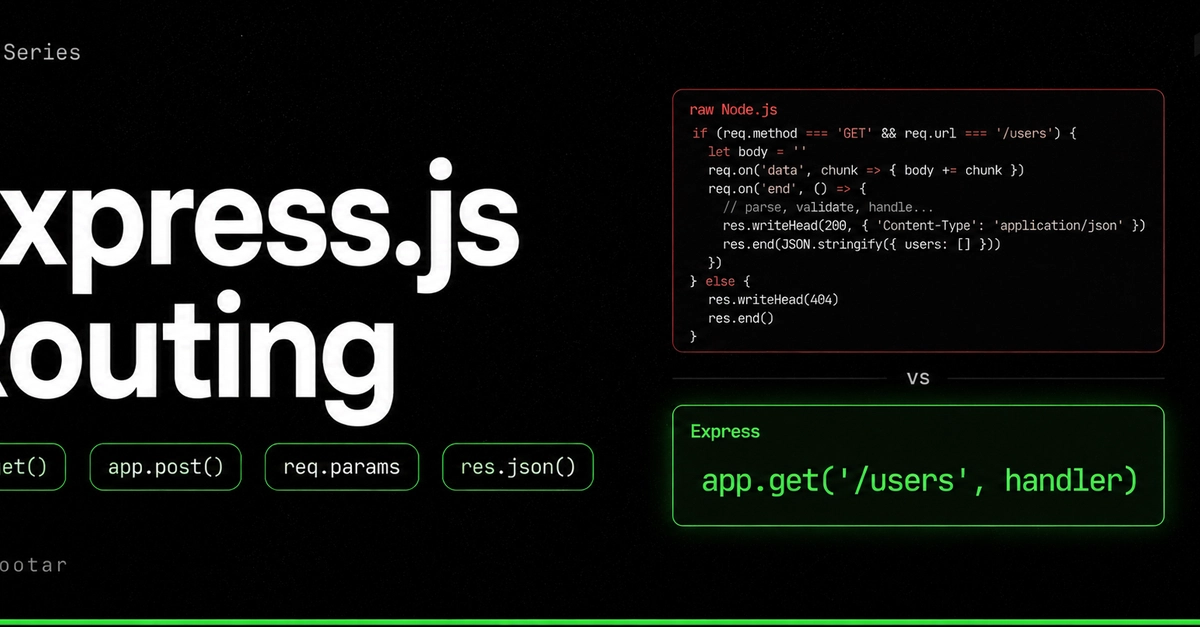
At first glance, the contrast couldn’t be starker. Express, born in 2010, offers the kind of unadulterated freedom that’s both its greatest strength and its most insidious weakness. It hands you routing and middleware, then steps back, allowing you to build with pure, unadulterated JavaScript (or TypeScript, if you’re feeling adventurous). The appeal is obvious: minimal overhead, maximum control. A small, agile team can whip up an API with startling speed, the code a reflection of their immediate needs and shared understanding.
// server.js
const express = require('express');
const app = express();
app.use(express.json());
app.get('/users', (req, res) => {
  res.json([{ id: 1, name: 'Alice' }]);
});
app.listen(3000, () => console.log('Server running on port 3000'));
But what happens when that team expands? Or when a new developer joins, inheriting a codebase that’s a proof to a dozen different architectural decisions made in isolation? Suddenly, that freedom becomes chaos. Folder structures diverge, error handling strategies clash, and the once-predictable flow of requests becomes a labyrinth.
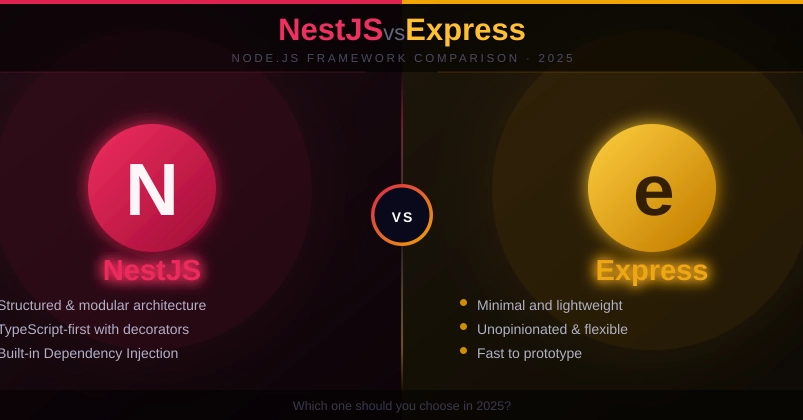
Enter NestJS. It’s not just another Node.js framework; it’s a deliberate architectural statement. Built on top of Express (or Fastify, for the performance-obsessed), NestJS brings a structured, opinionated approach to backend development, heavily influenced by Angular’s modularity and dependency injection patterns. It’s written from the ground up in TypeScript, embracing decorators and enforcing a consistent, scalable structure.
// users.controller.ts
import { Controller, Get } from '@nestjs/common';
import { UsersService } from './users.service';

@Controller('users')
export class UsersController {
  constructor(private readonly usersService: UsersService) {}

  @Get()
  findAll() {
    return this.usersService.findAll();
  }
}
NestJS’s core value proposition is making decisions for you, smoothing the path to maintainable, scalable applications, especially in larger team environments.
The Unseen Architecture: How NestJS Builds for Scale
The table-stakes features are there for both, but the underlying philosophies diverge dramatically. Express offers a blank canvas. Your architecture, your rules. This is liberating for quick prototypes, but for long-term projects, it’s a ticking time bomb of inconsistency. Imagine a large team contributing to an Express project; you’ll inevitably see a spectrum of patterns emerge—different ways of handling middleware, varied approaches to organizing business logic, and a wild west of dependency management.
NestJS, on the other hand, imposes structure. Its module-based system, a direct nod to Angular’s architecture, enforces encapsulation. Every feature lives within its own neatly defined module, containing controllers for handling requests, services for business logic, and repositories for data access. This enforced pattern is a boon for onboarding new developers and maintaining consistency across a growing codebase.
src/
  app.module.ts ← root module
  users/
    users.module.ts ← feature module
    users.controller.ts ← handles HTTP
    users.service.ts ← business logic
    users.repository.ts ← data access
This disciplined approach directly addresses a common pain point in large Express applications: manual dependency wiring. In Express, you’re the conductor, orchestrating the creation and connection of every component. You instantiate your database client, pass it to your repository, pass that to your service, and so on. It works, but it’s verbose and error-prone.
NestJS abstracts this entirely with its built-in Inversion of Control (IoC) container. You simply declare your dependencies, and NestJS handles the instantiation and injection. This not only cleans up your code but makes unit testing remarkably straightforward. Mocking dependencies becomes a trivial configuration within the testing module, a far cry from the often-convoluted setup required in pure Express.
// NestJS — DI container wires everything
@Injectable()
export class UserService {
  constructor(private userRepository: UserRepository) {}
}
TypeScript First, Not an Afterthought
While Express can certainly be used with TypeScript—requiring the installation of type definitions (@types/express) and careful configuration—it often feels like a bolted-on feature. You’re constantly fighting the type system at the edges, trying to coax clarity from a framework designed for JavaScript’s dynamic nature. NestJS, however, is a TypeScript-native beast. Decorators, interfaces, and generics aren’t optional additions; they’re fundamental to how the framework operates. This deep integration means your IDE’s autocomplete actually knows what’s going on, leading to a more productive and less error-prone development experience.
Abstractions That Matter
Both frameworks handle middleware, but NestJS elevates common concerns with higher-level abstractions. Authentication checks become declarative Guards, input validation is streamlined with Pipes (often paired with class-validator), and response transformations are handled by Interceptors. Error handling, a notorious black hole in many Express apps, is managed through dedicated Exception Filters.
Take authentication. In Express, you might nest multiple middleware functions, hoping they execute in the correct order to secure your endpoint. NestJS offers a cleaner, declarative approach.
// NestJS guard — clean and declarative
@UseGuards(JwtAuthGuard)
@Get('profile')
getProfile(@Request() req) {
  return req.user;
}
This is a far cry from the often-nested, callback-heavy middleware chains you might encounter in Express. Similarly, NestJS’s validation pipeline, leveraging class-validator decorators within Data Transfer Objects (DTOs), automates input validation. Define your expected data structure with validation rules, and NestJS automatically handles malformed requests, returning structured errors without manual if checks.
// create-user.dto.ts
import { IsEmail, IsString, MinLength } from 'class-validator';

export class CreateUserDto {
  @IsString()
  name: string;
  @IsEmail()
  email: string;
  @IsString()
  @MinLength(8)
  password: string;
}
// users.controller.ts
@Post()
create(@Body() dto: CreateUserDto) {
  return this.usersService.create(dto);
}
Performance: A False Dichotomy?
When it comes to raw performance, the comparison often leans heavily on benchmarks. The truth is, both frameworks perform remarkably similarly in typical real-world scenarios. NestJS, by default, uses Express under the hood. The performance bottlenecks are far more likely to stem from your application logic, database queries, or inefficient algorithms than from the framework itself. While Fastify can offer marginal gains over Express, it’s rarely the deciding factor for most projects.
The choice isn’t about which framework is faster in a micro-benchmark. It’s about the architectural patterns, the developer experience, and the long-term maintainability and scalability of your application. If you’re building a quick API for a small, stable team, the unopinionated nature of Express might be perfectly adequate, even preferable. But if you’re anticipating growth, onboarding new developers, or simply want a more structured, maintainable foundation for a complex application, NestJS offers compelling advantages.
It’s a matter of architectural debt. Express lets you accrue it quickly, while NestJS makes you pay upfront for structure, saving you exponentially down the line. For organizations that value consistency, testability, and scalability above all else, NestJS is shaping up to be the pragmatic choice for building the next generation of Node.js applications.
**
🧬 Related Insights
- Read more: SafeText: The Flutter Profanity Filter That Just Got Multilingual Muscle and Needs Your Help
- Read more: GitHub’s Secret Scanner Just Got 37 Times Smarter—and It’s Watching Your AI Agents
Frequently Asked Questions**
What does NestJS actually do? NestJS is a progressive Node.js framework for building efficient, reliable, and scalable server-side applications. It provides a strong architectural foundation, leveraging TypeScript and concepts like modules, dependency injection, and decorators to promote maintainability and testability.
Will NestJS replace Express? Not directly. NestJS is built on top of Express (or Fastify), using it as its underlying HTTP server. NestJS provides a higher-level abstraction and architectural pattern, not a replacement for the core HTTP server capabilities.
Is NestJS harder to learn than Express? Generally, yes. Express has a very low barrier to entry due to its minimal nature. NestJS has a steeper learning curve due to its opinionated architecture, reliance on TypeScript decorators, and concepts like dependency injection, but this investment pays off in terms of application structure and long-term maintainability.