Ever inherited a dusty old codebase and spent more time spelunking through package.json files than actually coding? Yeah, me too. You run npm outdated and get a laundry list of version bumps, then npm audit flags a CVE or two. But what about the real killer: the libraries that have been quietly bricked, the ones nobody’s touched in years, leaving you stranded when you finally need that obscure function?
Well, someone finally built a tool for that. It’s called stack-rot, it’s written in Python (a bit of a curveball for a Node.js project scanner, but hey, we’re talking about code rot, not ecosystem purity here), and it’s now floating around on PyPI. The promise? To tell you which dependencies are actively crumbling around you.
Beyond Outdated and Insecure
Look, the existing tooling does its job. npm outdated tells you if there’s a shinier version available. npm audit screams bloody murder about security holes. Dependabot merrily bumps versions. Snyk watches your back for security and licensing. Socket.dev gets fancy with supply-chain risks. They’re all fine. But none of them directly answer the question that keeps seasoned devs up at night when they’re staring down a legacy project: “Which of these libraries should I just rip out now before it bites me?”
That’s the gap stack-rot claims to fill. It’s not about the latest versions or even gaping security flaws. It’s about community migration intelligence. Is the project still alive? Has the maintainer thrown in the towel? Is there a clear, modern alternative that won’t send you down a rabbit hole of forgotten commit logs?
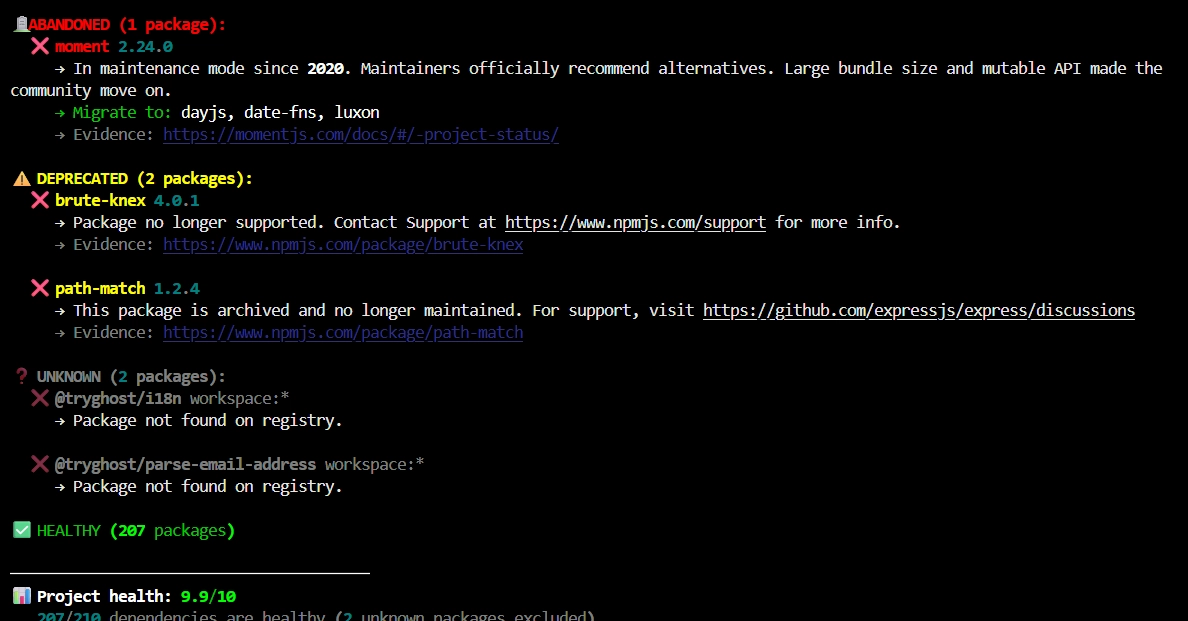
Here’s a peek at what it spits out, using Ghost as an example:
🪦 ABANDONED (1 package): ❌ moment 2.24.0 → In maintenance mode since 2020. → Migrate to: dayjs, date-fns, luxon ⚠️ DEPRECATED (2 packages): ❌ brute-knex 4.0.1 — Package no longer supported ❌ path-match 1.2.4 — Archived and no longer maintained ✅ HEALTHY (207 packages) 📊 Project health: 9.9/10
See? It’s direct. It flags “Abandoned” and “Deprecated” with clear reasons and alternatives. No corporate fluff. It’s the kind of info you used to spend hours digging for yourself, cross-referencing GitHub issues, Stack Overflow threads, and maintainer blog posts.
The Power of a Tiny, Verified Database
Now, here’s where things get interesting, and frankly, where this project shows a surprising amount of maturity for something built in a day. The creator, Akshay Varala, initially planned to ship with 50 curated entries of known dead packages. He ended up shipping with eight. Why? Because he actually bothered to check.
He had giants like gulp and grunt in his mental Rolodex of “totally dead” tech. Turns out, Gulp just dropped a 5.0.0 release in March 2024. Grunt is under the OpenJS Foundation, pushing out 1.6.2 releases, and pulling in millions of weekly downloads. If stack-rot had prematurely declared those dead, its credibility would’ve evaporated faster than a VC’s promise of profitability.
The lesson? A dataset of eight meticulously verified entries is infinitely more valuable than fifty half-baked guesses. It’s the difference between a reliable assistant and that intern who confidently tells you the sky is plaid.
So, the curated database is the core here. It’s a rot-db.json file that’s growing slowly but surely, each entry backed by public evidence. The rest of the data? That’s scraped live from the npm registry, leveraging their official deprecation flags. But the real magic, the stuff that separates the wheat from the chaff, is in those human-verified entries.
The Human Element vs. Automation’s Siren Song
This is the real insight, isn’t it? In a world obsessed with AI-driven analysis and automated everything, the most valuable part of this tool is its human curation. It’s a stark reminder that sometimes, the best data comes from someone actually looking at the source, not just crunching numbers.
Who is making money here? Right now, likely the creator, through recognition and potential future adoption. The long-term sustainability, however, hinges on community contributions. The roadmap is ambitious, aiming for Python, Go, Rust support, and eventually a web dashboard. But the key to all of it is that CONTRIBUTING.md file – ensuring every community-submitted entry is as rigorously vetted as the initial eight.
It’s a bet on the open-source community itself to maintain the integrity of this curated knowledge. A bold move. If it pays off, stack-rot could become an indispensable part of the developer toolkit for anyone dealing with aging JavaScript projects.
stack-rot is available now via pip install stack-rot. It requires Python 3.10 or newer.
Source code is on GitHub: https://github.com/varalaakshay-arch/stack-rot
PyPI page: https://pypi.org/project/stack-rot/