And then there were six agents. That’s the number that autonomously executed to produce a Windows installer, complete with localization and dark mode, for a desktop application. All from a single Claude Code session, apparently. This is the promise of AgentKit, a new command-line interface tool aiming to inject some much-needed order into the chaotic world of large language model-powered development.
Let’s face it. Most developers wrestling with tools like Claude Code currently operate in a state of digital disarray. It’s one continuous, ever-expanding conversation. You’re manually nudging the AI between tasks. Context balloons until the model probably forgets its own name, let alone what it was supposed to be building. It’s a workflow that works, sure. But it certainly doesn’t scale.
AgentKit, developed by Patrick Sardinha, aims to be the mop and bucket for this mess. It’s a CLI, pure and simple, that generates the scaffolding. The stuff that tells Claude Code what to do, who to be, and how to hand off work between specialized agents. Automatically. The theory is you provide a plain-language blueprint, run a command, and magic happens.
The Blueprint Blues
Here’s how it’s supposed to work. You write a blueprint. Something like this:
# Todo App — Blueprint
## Goal
A simple web todo app with task creation, completion, and filtering.
## Tech constraints
- Next.js 14 + TypeScript + Tailwind
- localStorage for persistence, no backend
Then you feed it to the CLI:
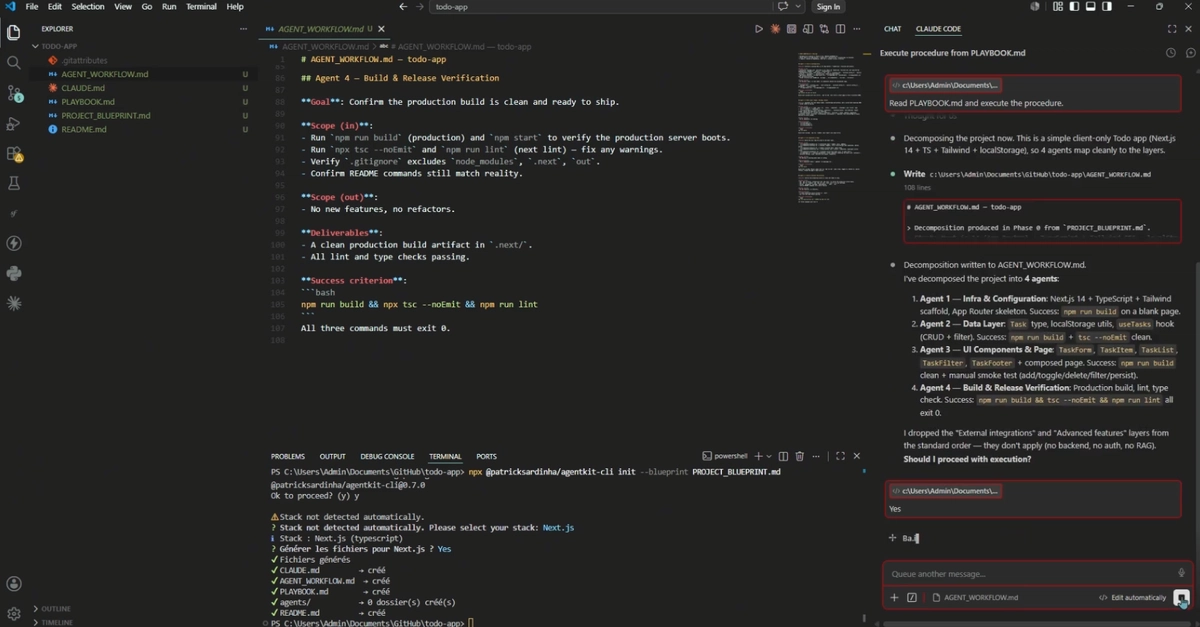
npx @patricksardinha/agentkit-cli init --blueprint PROJECT_BLUEPRINT.md
What emerges from the digital ether? Four files. CLAUDE.md (the standing brief), AGENT_WORKFLOW.md (a placeholder), PLAYBOOK.md (the autonomous engine), and README.md (documentation). You then tell Claude Code to read the playbook and execute. Simple. Almost insultingly so.
Phases of AI Execution
Claude Code then supposedly chugs through three phases. Phase 0 is decomposition, where it looks at your blueprint and spits out a list of agents. You nod. Then there’s a pause for “skills enrichment” – you can, apparently, drop in API docs or schemas. Finally, Phase 1: execution. Agents run, validate, retry, and only bother you if they’re truly stuck. The end result, for the DevLog Desktop app example, was six agents, 68 tests passing, an installer, and full internationalization.
What’s notable here is the claim: No AI inside the tool. AgentKit itself is just a structural generator. The “intelligence” resides entirely within Claude Code. This means no API keys, no added costs, and—importantly for cynics—no vendor lock-in baked into the scaffolding itself. The structure is yours, the execution is Claude’s. This is a crucial distinction.
Is This Just More Hype?
Look, the promise is alluring. Ditching the endless scroll of a single AI chat for a structured, multi-agent workflow sounds like a sensible evolution. But let’s not get ahead of ourselves. The system relies on Claude Code’s ability to decompose tasks effectively and manage agent handoffs. We’ve all seen LLMs get confused. We’ve all seen context windows betray their creators. The real test will be how strong this is when the blueprints get complex, when the dependencies multiply, and when the AI inevitably hits a snag.
AgentKit’s insistence on running Phase 0 every time is a smart move. Most users—myself included—aren’t AI architects. Delegating the split-work-into-agents decision back to the LLM is pragmatic. It acknowledges the current limitations of human prompt engineering. And its ability to detect existing project stacks or prompt interactively for new ones seems sensible enough. It’s trying to be helpful without being intrusive.
But the real innovation here isn’t in AgentKit itself. It’s in the idea of standardized, scaffolded agentic workflows for LLM development. If this catches on, it’s not about Patrick Sardinha’s CLI; it’s about a new paradigm for building software with AI assistance. It’s about turning a sprawling conversation into a series of discrete, manageable steps. The kind of steps even a tired developer can follow without losing their mind.
This isn’t a magic wand. It’s a blueprint. And blueprints, as anyone who’s built anything knows, are just the starting point. The construction is where the real work happens. And with LLMs, that construction phase is still… evolving.
The core takeaway? AgentKit provides a framework. It’s an attempt to put the cart before the horse in the best possible way—setting up the infrastructure before the AI starts building. If it succeeds, it could significantly reduce the friction of using advanced LLMs for software development.
🧬 Related Insights
- Read more: Atlassian’s AI Data Grab: Opt-Out by Default Raises Alarms
- Read more: TracKeee: South African Invoicing SaaS Builds Multi-Tenancy from Scratch
Frequently Asked Questions
What does AgentKit actually do? AgentKit is a CLI tool that automatically generates project scaffolding and configuration files to create structured, multi-agent workflows for AI models like Claude Code, based on a plain-language blueprint.
Do I need an AI model running to use AgentKit? No, AgentKit itself is purely a structural generator. It creates markdown files and code structure. The AI model (like Claude Code) is what interprets and executes the generated workflows.
Will AgentKit replace developers? No. AgentKit aims to enhance developer productivity by streamlining the process of using AI for development tasks, allowing developers to focus on higher-level design and problem-solving rather than manual AI prompting and context management.