AI Agent Bottleneck Solved?
It’s 11 PM. The API endpoint you asked the AI to build two hours ago is done. Tests pass, structure looks clean, nothing obviously broken. You’re about to merge it.
Then you notice: no rate limiting. No structured logging. The caching is a single line that will crumble under real load. The security check is a comment that says // TODO: add auth here.
The agent didn’t forget. It just didn’t know those things mattered. It built the median version of what you asked for and handed it back like everything was fine.
This gnawing frustration—the gap between what an AI model can generate and what constitutes production-ready code—is the AI developer bottleneck. And /letsgo was built to close it.
Master Agent Orchestration for Claude Code
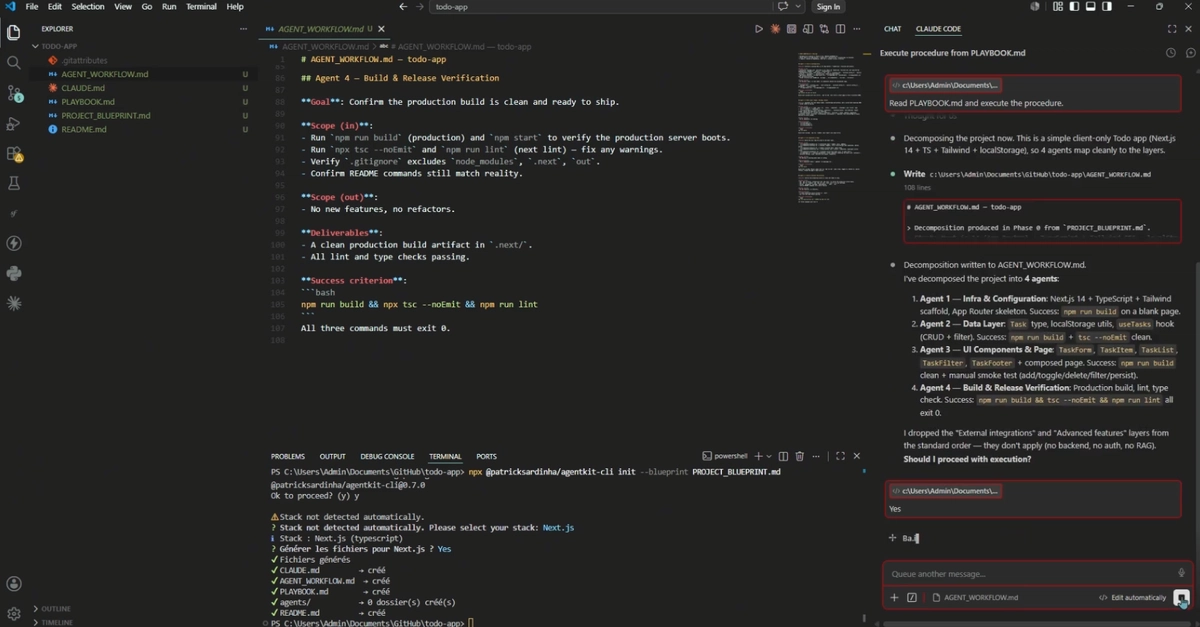
/letsgo is a master agent orchestrator designed specifically for Claude Code. It’s not another loose-knit agent that guesses your intent. Instead, it takes over the entire development process, guided by a structured 15-step blueprint. This system use 78 core skills, wired directly into its workflow, and can tap into the broader Claude Code skill ecosystem when your project demands it. The key here isn’t more AI; it’s a better system around the AI.
It doesn’t guess. It doesn’t freestyle. It follows a deliberate sequence, applies the right knowledge at the right moment, and produces work that reflects real production standards, not just the statistical average of everything the model has ever seen.
Asking the Right Questions First
The first thing /letsgo does isn’t write code. It asks a question: “Is this a personal project or a client project?” This single answer profoundly changes the downstream assumptions, standards, and subsequent questions. A personal side project and a client deliverable have fundamentally different requirements, and /letsgo respects that from the outset.
Before touching a single line of code, it surfaces a structured list of context questions:
- What is the core goal of this project?
- What stack or existing infrastructure is involved?
- Are there performance, security, or compliance requirements?
- What does ‘done’ actually look like?
Most agents skip this entirely, inferring what they can and guessing the rest. /letsgo refuses to start without a clear picture. The few minutes spent answering these questions can prevent hours of untangling later.
Planning and Discovery: The Unseen Foundation
/letsgo operates on a clean separation of concerns that many agent workflows collapse into one. Planning and Discovery comes first. Before a single file is touched, /letsgo reads the task, audits the existing codebase, identifies relevant patterns, and locks the architectural direction. This layer concludes with a concrete, sequenced plan featuring defined outputs at every step.
This is where most agents fail silently. They jump straight to implementation, making numerous small decisions that compound into a codebase that’s expensive to change and painful to debug. It’s an architectural debt accrual problem, and it’s a familiar midnight realization for many developers.
Implementation Follows the Blueprint
Implementation is the second phase. It executes precisely against the locked plan. Each step has a clear input, a defined output, and specific skills applied to it. Nothing is improvised. The orchestration moves through three distinct phases:
- Discovery and Design Lock: Scope the task, audit existing patterns, resolve open questions, and commit to the architecture. This phase ends with a locked plan that every subsequent step executes against, preventing mid-build surprises.
- Infrastructure Scaffolding: File structure, dependency wiring, environment configuration, data layer, and foundational components. Generic agents often make their worst calls here;
/letsgoapplies targeted skills to ensure every structural decision is intentional. - Security Gates and Deploy: Input validation, auth checks, rate limiting, error handling, structured logging, and deployment verification. Nothing moves forward without passing through this mandatory final phase, ensuring security isn’t an afterthought.
Each step hands a clean artifact to the next, making the entire sequence reproducible. The 78 skills wired into this orchestration aren’t arbitrary; each is a focused, opinionated document encoding a specific pattern or decision. When /letsgo needs to handle rate limiting, it pulls api-rate-limiting. For caching, it’s redis-patterns. For observability, logging-best-practices.
These aren’t just code snippets; they’re best practices encoded. For example, redis-patterns covers cache-aside versus write-through, expiry strategies, when to use sorted sets versus hashes, and the failure modes that only appear under load. Similarly, api-rate-limiting accounts for various algorithms and edge cases.
This structured approach represents a significant architectural shift in how we might integrate AI into the software development lifecycle. It’s less about letting the AI ‘write code’ and more about having a highly disciplined AI assistant follow a production-hardened playbook. The implications for developer productivity, code quality, and the reduction of technical debt are substantial, provided the underlying skills library and orchestration logic remain strong and up-to-date.
Is this the future of AI-assisted development? It’s certainly a compelling argument for moving beyond simple prompt-to-code generation towards intelligent, process-aware orchestration.
Why Does This Matter for Developers?
It matters because the AI developer bottleneck is fundamentally about trust and reliability. When an AI agent generates code, but the output consistently lacks essential production-grade features like strong error handling, security considerations, or scalable caching, developers are forced into a manual audit and correction cycle. This negates much of the promised efficiency gain. /letsgo directly addresses this by embedding production best practices into the AI’s workflow. It’s an attempt to raise the baseline quality of AI-generated code, reducing the need for developers to act as post-processing editors and allowing them to focus on higher-level architectural and problem-solving tasks.
A New Blueprint for AI Code Generation?
The core innovation here isn’t a new AI model, but a meta-system—an orchestrator that imposes discipline. This contrasts sharply with the often-unstructured, prompt-response loop typical of many AI coding tools. By breaking down the development process into distinct phases (Discovery, Scaffolding, Security Gates) and associating specific, pre-defined skills with each step, /letsgo enforces a level of rigor. This is akin to building an assembly line for AI-generated code, where each station performs a specialized, validated task before passing the work to the next. The success of /letsgo will hinge on the quality and breadth of its 78 skills and its ability to intelligently select and sequence them based on project context.
🧬 Related Insights
- Read more: Windows App Automates Webpage-to-PowerPoint Workflow
- Read more: LLM Bills Skyrocket: Spring Boot Gateway Halts Cost Chaos
Frequently Asked Questions
What is the AI developer bottleneck? It’s the gap between an AI model’s ability to generate code and its understanding of real-world production requirements such as security, scalability, and maintainability.
Will /letsgo replace human developers?
No, /letsgo is designed as an orchestrator to assist developers by improving the quality and reliability of AI-generated code, reducing manual correction cycles. It aims to augment, not replace.
How does /letsgo ensure code quality? It follows a structured 15-step blueprint, asks clarifying questions before coding, separates planning from implementation, and uses 78 specialized skills that encode best practices for various development tasks like security, logging, and caching.