Did you know that a staggering 70% of enterprise Angular codebases eventually succumb to scalability issues? That’s not due to a lack of talented developers or the wrong tech stack. It’s a silent killer, an architectural debt that accrues interest until the entire system groans under its own weight.
Look, we’ve all seen it. That beautifully crafted Angular app, humming along in its early days, starts to creak. New features feel like wrestling an octopus. Debugging becomes an archaeological dig. And then, inevitably, a critical regression pops up in a module that’s supposed to be as stable as bedrock.
The original article hits the nail on the head: the culprit isn’t bad components, or even the wrong state manager like NgRx versus Signals. It’s the architecture—or, more precisely, the lack of it.
And here’s the gut punch: the standard src/app/components/, src/app/services/, src/app/models/ folder structure—the one that feels so natural when you’re just starting out—is a ticking time bomb.
It’s file sorting, not architecture.
This is the exact pattern that dooms your codebase the moment your product grows, teams multiply, and distinct business domains start to emerge. Everyone ends up in the same few files, pull requests turn into epic sagas, and the ownership of code becomes a ghost story.
So, what’s the antidote? The article points to Domain-Driven Design (DDD). And before you roll your eyes and think “backend stuff,” hear me out. This isn’t about microservices or complex event sourcing patterns. At its heart, DDD is about one profoundly simple, yet earth-shattering, idea:
Your code’s structure should mirror the structure of the business it serves.
This isn’t a backend-only philosophy. Whether you’re building a frontend for a sprawling enterprise behemoth or a nimble startup’s core product, the business has distinct capabilities—domains—and your frontend absolutely interacts with them.
The critical question is whether your codebase acknowledges these domains or pretends they’re just abstract concepts lost in a sea of generic folders.
The Illusion of Technical Layers
It’s so easy to fall into the trap of organizing by technical layers. You think: “This is a component,” “This is a service,” “This is a utility.” And Angular’s own building blocks encourage this line of thinking. But that’s the trick. These are implementation details, not fundamental architectural boundaries that define your business.
As your application expands, this technical-layer organization starts to unravel spectacularly:
- Unclear Ownership: Multiple teams are scribbling in the same
components/folder. Who’s responsible when something breaks? Nobody knows! - Domain Leakage: Your
billing.component.tsmight reach directly into the internals ofAuthService. There’s no public contract, just a tangled mess. - Global State Explodes: Every new feature, every new team, just adds another slice to the root store. Soon, you’ve got a hundred state slices that nobody dares to touch for fear of breaking everything else.
- Circular Dependencies: Domain A depends on B, which depends on C, which, surprise!, depends on A. Your build tools will scream bloody murder, and fixing it feels like untangling a plate of spaghetti.
- Cognitive Overload: To understand the
billing/feature, a developer has to hold the entirety ofcomponents/,services/, andmodels/in their head. This isn’t just a minor inconvenience; it’s architectural debt costing you precious developer hours every single sprint.
DDD: A Frontend Lifeline
Eric Evans popularized DDD for backend systems, which is why many frontend developers dismiss it. That’s a colossal mistake. DDD on the frontend is about recognizing that your code should reflect the business’s structure.
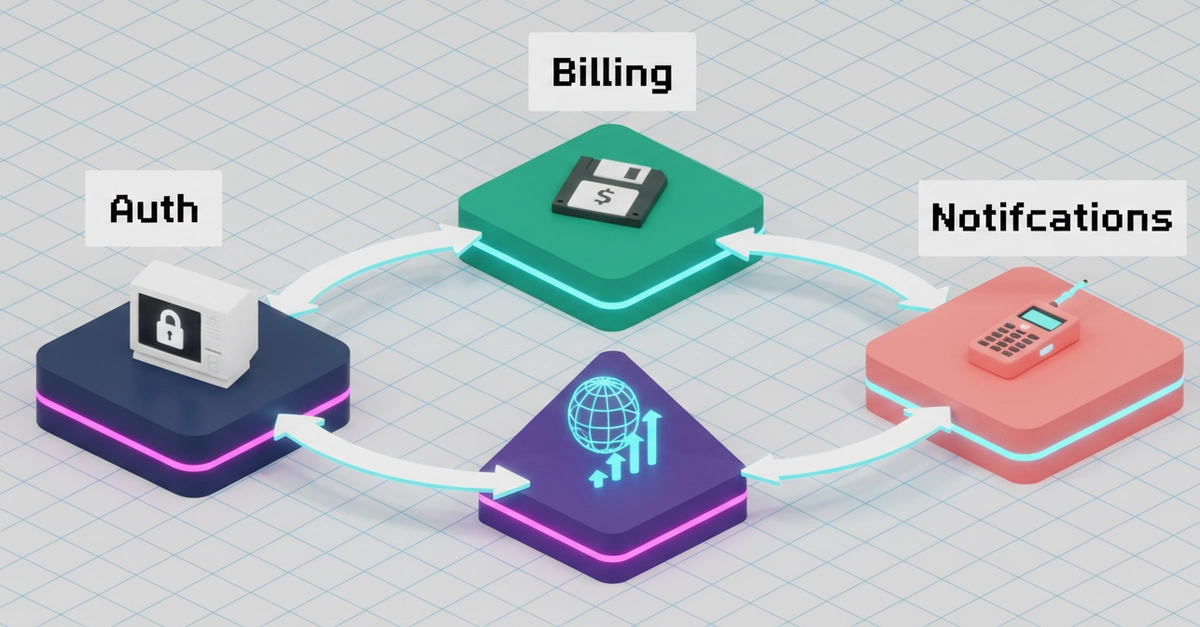
The core concept is the bounded context: a domain with a clearly defined boundary. Inside that boundary, a specific vocabulary, a set of models, and a set of business rules reign supreme. For us frontend folks, this translates to a section of your app that owns its UI, state, API interactions, and models—and crucially, doesn’t expose its internal workings willy-nilly to other sections.
Think about your application’s capabilities: authentication, billing, analytics, notifications. These are distinct bounded contexts. The word “account” means something different in billing than it does in authentication. They have different lifecycles, different teams, and different rules. When these contexts are allowed to freely share internal code, the boundary dissolves, and scaling becomes a monstrous challenge.
The Folder Structure Makeover
The article provides a stark before-and-after. The messy, technical-layer src/app/ with hundreds of components and cross-domain services eventually leads to:
No team knows where to add new code. Everything is one import away from everything else. Testing requires mocking the entire world. Onboarding a new developer is a nightmare.
Contrast this with a DDD-inspired structure where each domain has its own dedicated folder, containing its specific components, services, models, and state. The billing domain would have its own billing/ folder, keeping everything related to billing neatly contained.
This isn’t just about tidiness; it’s about building systems that can actually breathe and grow. When a new feature requires a change in the billing process, you know exactly where to look, and you’re less likely to break something in user authentication.
Navigating the New Architecture
Adopting DDD isn’t magic, but it requires a fundamental shift in thinking. Instead of asking, “What type is this file?”, you ask, “What business capability does this belong to?” Instead of “Where do services live?”, it’s “Which domain owns this behavior?”
This reframe impacts everything from code reviews to how you onboard new engineers. It fosters clearer ownership and more focused development.
For Angular developers, especially with the advent of Signals and the evolution towards more reactive patterns (like in Angular 17+), a domain-centric approach becomes even more powerful. It allows you to manage state within a bounded context, preventing the global state explosion and making your state management predictable and manageable.
Tools like Nx can be invaluable here, helping to enforce these domain boundaries and manage dependencies across your different bounded contexts. They provide guardrails, ensuring that domain A doesn’t accidentally start depending on the internal workings of domain B without a proper, controlled interface.
Why This Matters for Developers
This architectural shift is more than just a developer convention; it’s about empowering teams and building more resilient, maintainable software. When code is organized around business domains, ownership becomes clear. Developers can become experts in a specific domain, leading to higher quality and faster delivery within that area. It’s like giving each team its own well-defined workshop, complete with all the tools and materials they need for their specific craft, rather than having everyone share a single, chaotic garage.
This isn’t about rewriting your entire app overnight. It’s about starting to introduce these domain boundaries, one context at a time. It’s about making architecture a conscious, ongoing conversation rather than an afterthought.
🧬 Related Insights
- Read more: WebTransport: WebSocket’s 2026 Replacement?
- Read more: Linux Kill Switch: Kernel Patch Offers Quick Fix, Big Risks
Frequently Asked Questions
What exactly is a bounded context in frontend development? A bounded context in frontend development is a self-contained section of your application that encapsulates a specific business domain, owning its UI, state, API interactions, and models, and maintaining clear boundaries with other sections.
Will implementing DDD require a complete rewrite of my Angular app? Not necessarily. While a complete rewrite is one option, DDD principles can be introduced incrementally. You can start by identifying key domains and refactoring them into bounded contexts over time, gradually improving your architecture.
How does DDD help with Angular’s new Signals feature? DDD helps by allowing you to manage Signals-based state within individual bounded contexts. This prevents the global state explosion often seen with older state management patterns and keeps your reactive state organized and predictable within its relevant business domain.