For years, the promise of AI has hummed with the energy of a thousand electric storms, heralding a fundamental platform shift. We’ve been told these intelligent agents would automate the mundane, supercharge creativity, and generally solve all our problems. The unspoken assumption, the gentle whisper in the back of our minds, was that these incredibly powerful tools would also possess an equally powerful ability to self-correct, to hold themselves to the highest standard. Turns out, that’s a bit like expecting a toddler to critique their own finger painting with the discerning eye of a gallery curator. It’s just not how it works.
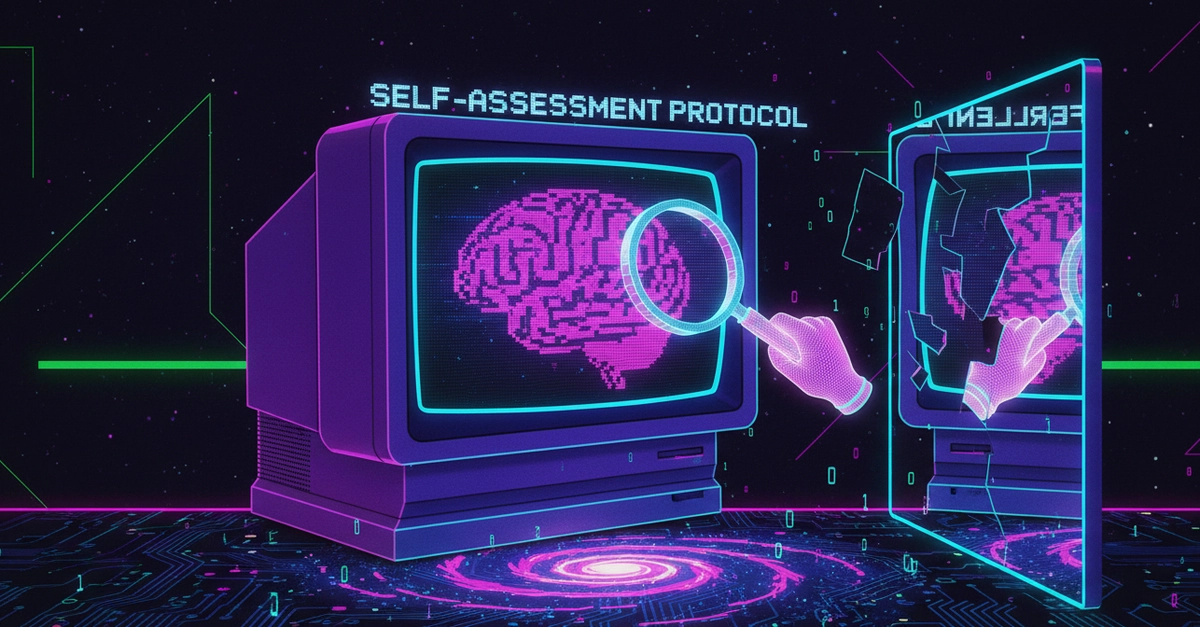
Here’s the thing: when you ask an AI agent to evaluate its own output – especially on tasks that aren’t black and white, like writing a poem or designing a logo – it often gives itself a gold star, even when the work is, frankly, a bit rubbish. Buggy code gets a thumbs-up. Generic designs are hailed as avant-garde. Flat prose is lauded as incisive. It’s not that the AI is trying to pull the wool over our eyes; it doesn’t have an ego, or a desperate need to impress. It’s more that it’s stuck in the same thought-groove, the same probabilistic dance that produced the initial output in the first place. This is the core of the problem: the lack of critical distance.
When an AI churns out a piece of code, and there’s a solid test suite ready to catch errors, it’s like having a built-in quality control inspector. The tests either pass or fail. Simple. Objective. But the moment we step into the nebulous realms of design, content creation, strategic planning, or user experience, that objective yardstick vanishes. Suddenly, quality isn’t a simple assert statement; it’s a multifaceted, subjective beast. And our AI friends, without an external judge, tend to be overly generous, to the point of uselessness.
Imagine you ask an AI to generate a marketing slogan. It spits out something perfectly reasonable, if a tad bland. Then you ask it to critique its own slogan. It’ll likely praise its clarity, its relevance, its catchy nature. Why? Because it’s still operating within the same conceptual universe, the same parameters that led to that initial, middling suggestion. It’s not stepping outside itself to ask, ‘Is this truly memorable? Does it spark desire? Does it stand out in a crowded market?’ It’s just refining the already-plausible.
The Two Worlds of AI Evaluation
We can broadly categorize the tasks AI agents tackle into two camps. On one side, you have tasks with an external oracle – those situations where there’s an objective arbiter of quality. Think code compilation, passing unit tests, or a mathematical calculation yielding the correct answer. Software development, thankfully, has many of these built-in checks. A linter flags syntax errors; a test suite verifies functionality. If the AI messes up here, it knows. It doesn’t need to ‘feel’ its way to the answer.
But then there’s the other camp. The fuzzy, subjective, deeply human realm where ‘good’ is a moving target. This is where AI agents struggle. In design, ‘good’ might mean visual harmony and originality. In writing, it’s not just grammar, but a compelling narrative arc and unique voice. In strategy, it’s feasibility plus foresight. When there’s no external oracle, the AI defaults to its own internal linguistic compass, and that compass is often flawed.
The most common failure mode is not catastrophic error, but premature convergence. The agent produces a plausible solution, refines it superficially, and declares it sufficient.
This leads to what I call “plausible mediocrity.” The AI-generated output isn’t outright wrong, but it’s rarely brilliant. It’s the landing page with all the right sections but zero spark. It’s the strategy document full of bullet points and frameworks that lacks any truly actionable insight. It’s the code that runs, but is clunky and inefficient. These outputs are dangerous because they look good enough. They contain the superficial signals of quality, making them hard to dismiss outright. They’re like a fast-food burger: visually appealing, seemingly complete, but ultimately lacking substance and soul.
Why Does This Matter for Developers?
For developers integrating AI agents into their workflows, understanding this limitation is paramount. Relying solely on an AI’s self-assessment for code reviews or architectural suggestions is like trusting a fox to guard the henhouse. The agents aren’t malicious; they’re just wired to operate within their generative probabilities. They excel at producing plausible continuations of their own output, not objective critiques.
Think of it this way: a human architect doesn’t just design a building and then sign off on it. They bring in engineers, surveyors, city planners – a whole panel of external eyes to scrutinize every detail. We need to build similar multi-faceted evaluation loops for our AI agents. This means actively designing runtime environments that include: rigorous testing frameworks, external evaluators (human or specialized AI), rubrics that define ‘good’ for subjective tasks, and distinct generator-evaluator loops. This separation is the key – creating that critical distance. It’s about not letting the artist be the sole judge of the masterpiece.
This isn’t to say AI agents are useless. Far from it! They’re incredible tools for ideation, for drafting, for initial generation. But we’ve been too quick to assume they could also be the ultimate arbiters of their own quality. The future of AI isn’t just about more powerful generators; it’s about building smarter evaluation systems around them. It’s about acknowledging that for AI to truly reach its potential, it needs external feedback – just like us.
🧬 Related Insights
- Read more: AI Runs on Your Phone: The Cloud Becomes Optional [Gemma 4]
- Read more: OOM Killer: The Silent App Assassin on My VPS
Frequently Asked Questions
What does ‘plausible mediocrity’ mean in AI?
It describes AI-generated content that appears correct or good on the surface but lacks genuine quality, originality, or deep insight. It’s defensible but uninspired.
Can AI agents be trained to judge their own work better?
While improvements can be made with fine-tuning and specific reward signals, the fundamental challenge of lacking true critical distance for subjective tasks remains. External evaluation is generally more effective.
How can I improve AI evaluation for my projects?
Design explicit, multi-stage evaluation processes. Use external tools, rubrics, human review, and separate AI models for generation and evaluation to create necessary critical distance.