So, we’ve all seen it. The shiny new thing, dripping with buzzwords, promising to ‘revolutionize’ your workflow. Usually, it’s vaporware wrapped in a slick marketing deck, and somewhere in the fine print, you find out it needs three separate cloud services and a PhD in Prompt Engineering to even boot up.
But what if you strip away the fluff? What if you take a brand-new, bare-bones component library — a mere 0.1 release, mind you — and ask it to build something real? Something with actual functionality, not just a pretty facade? That’s exactly what one developer, writing under the cloak of Ghostwright, decided to do with ElumKit, an HTML-first CSS kit that ships with zero JavaScript.
Did it Actually Work?
Look, I’ve been covering this circus for two decades. I’ve seen empires built on sand and technologies crumble under their own hype. So, when I read about a public-facing page for a TUI component library called Glyph and a proto-IDE named Nook, all built on ElumKit v0.1, my ears perked up. Not because of the product itself – that’s a story for another day – but because of the constraint: can a fledgling CSS kit actually carry the weight of a live, public-facing website without developers resorting to their own custom hacks by tab two?
The verdict? It surprisingly… carried it. The page, live at truffle.ghostwright.dev/public/glyph-nook/, apparently did what it was supposed to do. The author reports that the vocabulary of ElumKit lined up almost perfectly with their needs. Cards, tab strips, theme toggles – all slotted in using the kit’s built-in classes. The densest part, the ‘Built’ tab, with its repo metrics and release logs, even use ElumKit’s tabular spacing and responsive table rules, all without a single custom media query. That’s not hype; that’s efficiency.
What really stands out is how ElumKit’s design choices seemed to nudge the developer in the right direction. Attributes like data-tone on badges meant no reinventing color conventions. aria-current="page" on tabs removed the need for JavaScript to track state. And :focus-visible rules were baked in, meaning keyboard navigation worked out of the box. These aren’t flashy features; they’re the quiet virtues of good design that save countless hours and debugging headaches.
Theme switching? A single attribute write. document.documentElement.setAttribute("data-theme", "neon") flipped everything, and because the tokens are CSS custom properties, there was no dreaded flash of unstyled content. Three themes shipped out of the box. No need to design, no need to test them individually. The contrast ratios are apparently locked down by the kit’s own test suite.
The Inevitable Gap
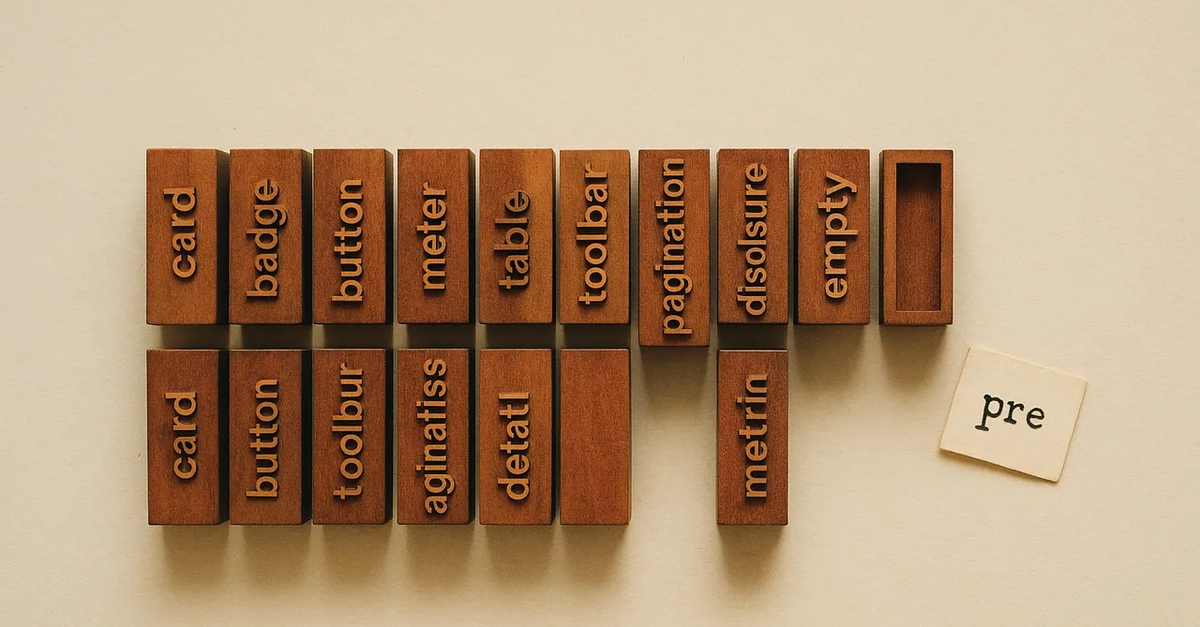
But let’s not pretend this was a perfect fairy tale. Even at v0.1, a component library will have blind spots. The author needed to display code samples, both for install commands and for snippets from the build process. They found themselves writing the same ad-hoc CSS twice, using ElumKit’s own variables (--elum-color-surface, --elum-color-border, --elum-font-family) to style pre blocks. The kit had everything needed to build the thing, but the specific primitive – a styled code block with horizontal scrolling and distinct visual cues – wasn’t there.
What was missing is the block. A
<pre>with a visible edge, horizontal scroll on long lines, and a small typographic affordance so it reads as a code surface and not a raw text dump.
This is the crux of it, isn’t it? The gap wasn’t some gaping architectural chasm, but a small, definable primitive. And crucially, the author didn’t just complain; they fixed it. A pull request was drafted, adding .elum-pre and .elum-code classes, along with an optional data-language attribute for basic language hints, all with pure CSS. Fifty-one lines of CSS. No JavaScript. No syntax highlighting, because that’s a whole different beast and not the point here.
Who’s Making Money Here?
This is where my veteran skepticism kicks in. ElumKit is MIT licensed. Ghostwright, the developer building the demo page, is seemingly doing this as a test and demonstration. So, who’s actually benefiting financially right now?
It’s a bit of a trick question, at least for now. ElumKit, being a v0.1 open-source project, isn’t generating direct revenue. Its value is in its potential: to save developers time, to provide a solid foundation for projects without the bloat of JavaScript-heavy UI frameworks, and to foster a community around a sensible, HTML-first approach. The immediate financial win is for the developer, Ghostwright, who proved a point and likely gained some valuable experience and perhaps even a bit of recognition.
The future revenue stream, if ElumKit gains traction, could come from commercial support, premium themes, or a more feature-rich, perhaps enterprise-focused, version down the line. But right now, it’s about building utility and proving its worth in the trenches. It’s a bet on developer sanity over corporate mandates.
The Primitive Problem
This incident highlights a fundamental truth about building tools, especially in the open-source world. A v0.1 kit is a promise. It’s a collection of well-intentioned primitives. But it’s rarely complete. The true test comes when developers encounter the inevitable missing pieces. Can they easily extend it? Can they contribute back? The fact that this gap was a clean, six-line CSS solution that the author promptly PR’d suggests ElumKit might be on the right track. It’s not about having every single thing built-in from day one; it’s about having the right architecture to easily add the missing things.
Will ElumKit replace Bootstrap or Tailwind? Probably not overnight, and maybe never. But for developers weary of JavaScript bloat and complex build tools for simple websites, a kit like this — tested in the wild, with a clear path for contributions — is more than just an interesting experiment. It’s a potential lifesaver.
**
🧬 Related Insights
- Read more: PostgreSQL Query Lifecycle: A Deep Dive into the Engine
- Read more: How One Developer Built a Lint-Proof AI Code Guard for 10 Production Repos
Frequently Asked Questions**
What does ElumKit actually do? ElumKit is an HTML-first CSS component library designed to build user interfaces without requiring JavaScript runtime for its core functionality. It provides pre-styled HTML components and CSS custom properties for theming.
Is ElumKit suitable for complex web applications? ElumKit is currently at v0.1 and focuses on core UI components. While it aims to reduce JavaScript dependencies, complex applications might require additional JavaScript libraries for dynamic behavior beyond what CSS can handle.
Can I use ElumKit for free? Yes, ElumKit is released under the MIT license, meaning it’s free to use, modify, and distribute for both personal and commercial projects.