Could a machine truly understand the agony of refactoring legacy UI? Probably not. But it can churn out code for a tool that aims to ease that pain. And that’s where this story begins.
Meet a full-stack developer, 10 years deep, who apparently can’t stand the tedious grunt work of migrating interfaces. Even with AI assistants like Codex, pulling pixel-perfect markup into a new codebase is apparently a bottleneck. Screenshots to AI, 80% output, then hours of editing. A familiar refrain for many.
So, what does one do? Build a Chrome extension. Simple enough, right? Except the web is a mess. Pseudo-elements, complex gradients, proprietary styling, you name it. This wasn’t just a personal tool anymore. It became something bigger. And a month later, it got paid.
AI’s Code, Human’s Coin
Here’s the developer’s breakdown: 95% of the code? AI-generated. 700+ commits. 40-ish daily. Over 400 regression tests. All in one month. Automated self-learning. Automated regression testing. Parallel processing for testing. It just keeps getting better.
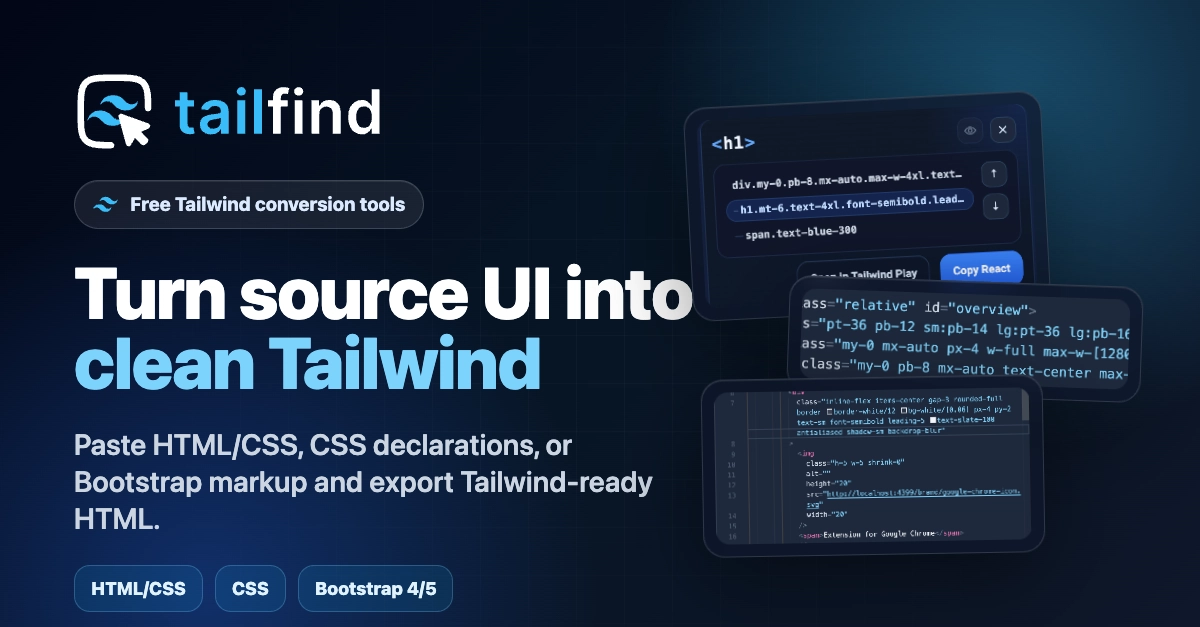
This isn’t just about code. It’s about solving a real, if niche, problem. Refactoring legacy UI without altering appearance. Snagging UI elements from anywhere. Using AI agents that understand Tailwind better than images. Turning messy inline styles into clean Tailwind CSS. Customers want that exact look? Got it. Pull, paste, done.
The developer even claims they can now pull an entire Github page—not even Tailwind-based—and convert it to clean HTML in seconds. A bold claim, but one that hints at the utility.
“Eventually, people will solve their pain as you solve yours.”
And for those who aren’t ready to buy a whole extension, there are free tools. HTML/CSS to Tailwind. CSS to Tailwind. Bootstrap to Tailwind. All with previews, fullscreen modes, responsive support. They even offer parallelism for side-window use. Generous. Or perhaps a smart funnel.
What’s next? Output configuration. Prefixes. Units. The usual suspects. The developer wants feedback. They should get it. Because this story, while small, is significant. It’s a proof to a human-defined problem, an AI-assisted solution, and the enduring possibility of commerce in the open-source adjacent world.
This isn’t just another AI tool announcement. This is about a developer finding a specific pain point, throwing a modern toolkit at it, and actually getting paid. It’s a signal. A signal that the gap between AI-generated code and tangible, commercial value might be shrinking faster than many assume. The market, it seems, still values a sharp mind identifying a problem over a thousand lines of perfectly formatted AI prose.
Why This Extension Matters
This extension, while not open-source itself, taps into a very open-source developer ethos: build what you need, share what you can. The speed at which it was developed, largely thanks to AI, is the headline grabber. But the real story is the market validation. A stranger paid for it. This isn’t a friend, not a beta tester. A genuine, paying customer. That’s the elusive unicorn for many side projects, AI-assisted or not.
It also highlights the ongoing tension between human creativity and AI efficiency. The developer identified the pain. The AI executed the code. One can’t exist without the other in this scenario. This isn’t the AI replacing developers; it’s AI augmenting them, allowing them to focus on the higher-level problem-solving that machines currently struggle with.
FAQs
Will this AI-generated extension replace my job?
Highly unlikely. This tool solves a specific task (UI refactoring to Tailwind CSS). It augments a developer’s workflow, making a tedious job faster. It doesn’t replace the need for developers to design, architect, and maintain complex applications.
Is it really 95% AI-generated code?
The developer claims so. While AI can generate a significant portion of boilerplate and functional code, human oversight is usually required for integration, optimization, and ensuring the code truly meets all edge cases and requirements.
How much did the first customer pay?
The article doesn’t specify the exact amount of the first payment. The focus is on the fact that a payment was received, validating the tool’s value.