The digital battlefield has a new front. Cybercriminals aren’t just targeting traditional systems anymore; they’re now aggressively weaponizing artificial intelligence tools and platforms used by development teams themselves. This isn’t some distant future threat—it’s happening now.
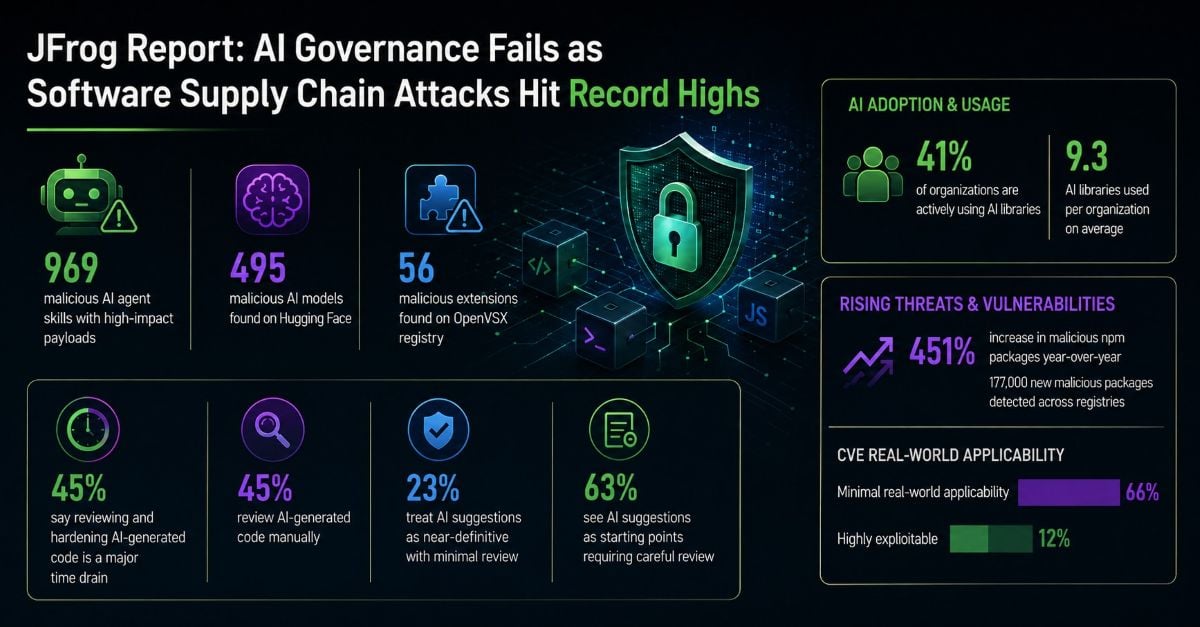
A deep dive by JFrog into 18.2 billion artifacts managed through their platform unearthed a disturbing trend: 969 AI agent skills carrying high-impact payloads and a staggering 495 malicious AI models lurking on Hugging Face, a central hub for open-source AI models. Even the OpenVSX registry, a seemingly innocuous repository for extensions, was found to harbor 56 malicious entries. We’re talking about code repositories becoming vectors for attack, disguised as helpful tools.
This influx of AI-powered threats coincides with a rapid adoption of AI in development. JFrog’s survey indicates 41% of respondents’ organizations are actively integrating AI libraries, with an average of 9.3 libraries per company. But here’s the kicker: while AI is speeding up development, it’s also creating new security headaches. Nearly half of those surveyed (45%) find reviewing and hardening AI-generated code a significant time sink, with an equal percentage resorting to manual reviews—a process that’s inherently slow and prone to error. Only a meager 23% are treating AI code suggestions as nearly gospel, highlighting a widespread, albeit cautious, acknowledgment of AI’s limitations.
Is AI Making Old Vulnerabilities New Again?
What’s particularly unnerving is JFrog’s observation that familiar, decades-old vulnerabilities like Cross-Site Scripting (XSS), SQL Injection, and general injection flaws have seen a resurgence in discovery since the widespread adoption of AI coding assistants. It suggests AI, while a powerful tool for code generation, might inadvertently be reintroducing or obscuring established security flaws, or perhaps adversaries are using AI to more efficiently find them. The tools meant to accelerate development could, paradoxically, be accelerating our exposure.
Paul Davis, Field CISO for JFrog, didn’t mince words: “fundamental changes” are needed in DevSecOps workflows. His point is valid. Current practices, often a patchwork of workstation-level security (59%), CI/CD enforcement (58%), and native platform tools (38%), are clearly insufficient. The reliance on manual processes—a staggering 48% still depend on them—and the week-long wait for compliance proof underscores a fundamental disconnect between the speed of AI-driven development and the pace of security validation. It’s like trying to secure a Formula 1 car with a horse-and-buggy inspection system.
The Illusion of Security: Overconfidence in DevSecOps
Despite this clear and present danger, a cloud of overconfidence seems to hang over many organizations. Davis points out that a whopping 97% claim to have certified model governance, yet over half (53%) are still self-hosting models from sources where malicious payloads have already been detected. An 18% vacuum of governance over IDEs or MCP servers? That’s an open invitation to disaster. This disconnect between claimed security posture and actual practice is, frankly, alarming.
Adding fuel to the fire is the sheer volume of attacks. JFrog reported a 451% year-over-year increase in malicious npm packages, with 177,000 new malicious packages identified. These aren’t isolated incidents; they’re part of a systematic, escalating assault on software supply chains. The threat landscape is only going to intensify as adversaries get better at leveraging AI to find and exploit vulnerabilities faster. While JFrog notes that many discovered CVEs have limited real-world applicability, the sheer volume is a concern, and the 12% that are highly exploitable represent a significant risk.
The reality, as Davis suggests, is that while most organizations might weather the immediate storm of isolated incidents, the cost and effort required to minimize these events are undeniably on the rise. The age of AI in development isn’t just about faster code; it’s about a fundamental re-evaluation of our security paradigms. Are we ready for it? The data, unfortunately, suggests we’re not. We’re still trying to outrun a rocket with a bicycle.
🧬 Related Insights
- Read more: MCP’s Big Tech Maintainers Plot Enterprise Security Overhaul at Dev Summit
- Read more: Linux 7.0 Flips the Switch: ASUS Armoury Crate Powers Up Three Beastly Gaming Laptops
Frequently Asked Questions
What is the main finding of the JFrog report? The JFrog report highlights a significant increase in cyberattacks targeting AI tools and platforms used in software development, exposing vulnerabilities in current DevSecOps practices and increasing the risk of supply chain attacks.
How many malicious AI models were found on Hugging Face? JFrog researchers discovered 495 malicious AI models on the Hugging Face platform.
Are organizations struggling to secure AI-generated code? Yes, nearly half of respondents (45%) reported that reviewing and hardening AI-generated code is a major time drain, with a similar percentage relying on manual reviews.