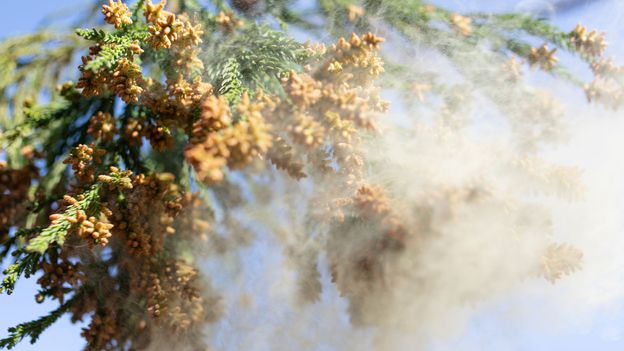
For tens of millions in Japan, spring doesn’t just signal warmer weather and blooming cherry blossoms. It’s a season of dread, marked by relentless sneezing, itchy eyes, and the ubiquitous sight of masks donned on city streets. This isn’t a new phenomenon, but it’s a crisis escalating to a national scale, with a staggering 43% of the population now suffering from hay fever. The discomfort alone is profound—sleep disruption, concentration fog—but it also dovetails into a higher incidence of asthma and food allergies. Economically, the toll is immense, estimated at a whopping $1.6 billion per day at the peak of pollen season, a direct consequence of lost workdays and reduced consumer activity.
The shocking truth? This isn’t an act of nature gone rogue. It’s a man-made problem, a direct inheritance from decisions made over 70 years ago, in the ashes of World War II.
The Green Scar of Reconstruction
After the war, Japan faced immense challenges. Fuel shortages had ravaged the country’s natural forests, leaving mountainsides bare and susceptible to catastrophic landslides and flooding. The government, in a drive to stabilize the landscape and secure future timber resources, embarked on an ambitious, large-scale afforestation project. The goal was rapid reforestation, and the chosen architects of this green recovery were two fast-growing evergreen species: the Japanese cedar (sugi) and the Japanese cypress (hinoki).
These trees were ideal for the task—they grew quickly, stabilized soil, and promised a sustainable supply of wood. Millions upon millions were planted, transforming barren hillsides into dense, uniform forests. A noble intention, to be sure. But therein lies the rub: these chosen species are also prolific pollen producers.
What was intended as a solution to environmental devastation has metastenosed into a public health emergency. The lightweight sugi and hinoki pollen, released in massive quantities each spring, easily drifts into populated areas, overwhelming the immune systems of a nation.
“Pollen allergies have become a national health issue in Japan. Addressing this problem is urgent.”
Now, as these trees mature—many reaching their peak pollen-producing age of 30 years—the problem has reached a fever pitch. Japan has officially recognized the severity, declaring allergies a national social problem and setting an ambitious target: a 50% reduction in pollen levels within three decades. The immediate plan is to reduce areas covered by high-pollen sugi by 20% in the next ten years. A daunting task, considering these plantations cover over 2% of Japan’s landmass. And it’s not as simple as just cutting them down; new, more diverse forests must be planted to prevent ecological backslides and maintain climate goals.
The Eerie Monoculture
Step into a sugi or hinoki plantation, and the difference from a natural forest is palpable, almost unsettling. The uniformity is striking—trees of identical height, a sparse undergrowth, a quieting of birdsong and insect hum. Sunlight struggles to penetrate the dense canopy, leaving the forest floor in perpetual twilight. It’s a stark contrast to the vibrant, biodiverse ecosystems that once thrived, and that still exist in pockets across this archipelago nation.
Japan’s unique geography has long made it a biodiversity hotspot, but the expansion of these monoculture forests, alongside other forms of habitat loss, has put much of its unique wildlife at risk. The very trees planted to “fix” the land have, in a way, impoverished it.
The Path Forward: Rebuilding Biodiversity
So, how does a nation reverse such a deep-seated, large-scale environmental and health problem? The scale of Japan’s forest coverage—a remarkable 68% of its land, significantly higher than many industrialized nations—presents both a challenge and an opportunity. The government’s plan to diversify its forests is a monumental undertaking, requiring careful planning and significant investment.
But this isn’t entirely a top-down solution. Even before the national declaration, local communities and non-profit organizations have been quietly working to transform these problematic monocultures back into biodiverse havens. In places like Nishiawakura village in Okayama prefecture, efforts are underway to replace sugi with a mix of native deciduous and evergreen trees, fostering a richer ecosystem that, crucially, produces less allergenic pollen. The early signs are promising, demonstrating that a return to ecological balance can yield tangible benefits, not just for wildlife, but for the health of the human population too.
This is more than just a story about trees and allergies; it’s a cautionary tale about unintended consequences, the long shadow of post-war planning, and the slow, arduous, but ultimately necessary work of ecological restoration. The nation that planted a problem is now trying to plant its way out of it, one diverse sapling at a time.
🧬 Related Insights
- Read more: Go Service Boilerplate Solves Production Headaches [Open Source]
- Read more: Jellyfin Tops Open Source Movie Trackers—Here’s Why
Frequently Asked Questions
What is the main cause of Japan’s mass allergies?
The primary cause is the excessive pollen produced by vast monoculture plantations of Japanese cedar (sugi) and Japanese cypress (hinoki), planted after World War II to reforest deforested areas.
How much of Japan’s population suffers from hay fever?
An estimated 43% of Japan’s population experiences medium to severe hay fever symptoms.
What is the Japanese government doing about the allergy crisis?
The government has declared allergies a national social problem and plans to reduce pollen levels by 50% in 30 years, starting with reducing areas of high-pollen trees by 20% in the next decade.