Coffee gone cold. Screen glows with arXiv tabs and a GitHub repo—both preaching specs-first gospel for taming rogue AI code agents.
That’s March 26, 2026, when Christo Zietsman’s paper drops, oblivious to the Swarm Orchestrator already humming in the wild. Specification-first AI code verification isn’t some lab fantasy. It’s here, converging independently, because AI code spew demands it.
Look.
Zietsman lays it out clean in his abstract:
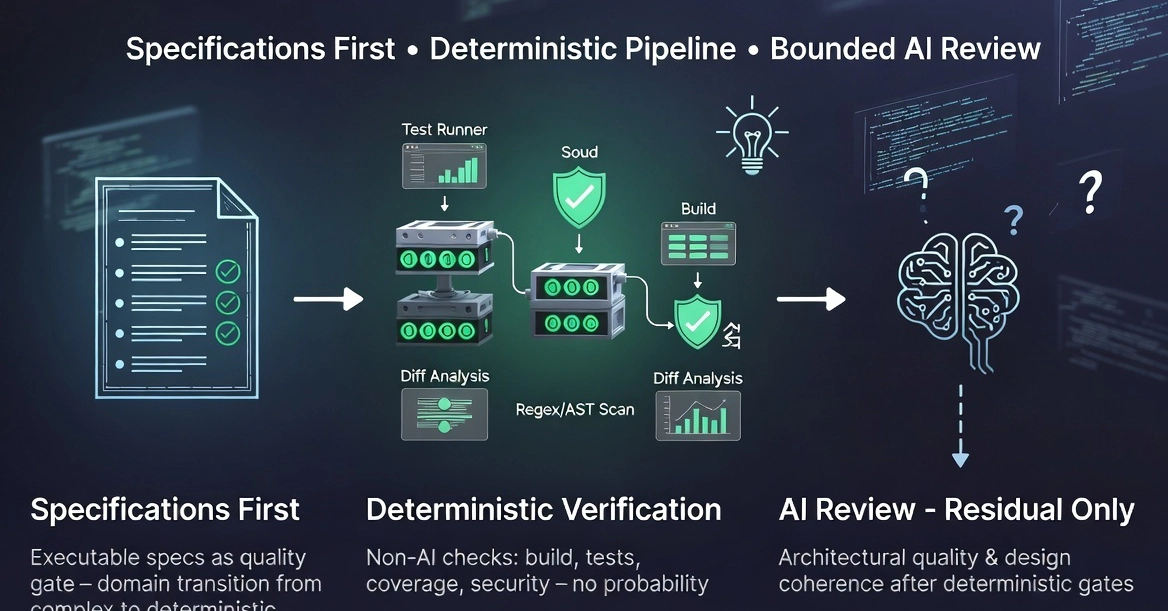
The combined argument implies an architecture: specifications first, deterministic verification pipeline second, AI review only for the structural and architectural residual.
Boom. No fluff. Specs as the unbreakable gatekeeper—before any AI touches review.
Swarm Orchestrator? Moonrunnerkc built it months earlier, from gritty battles with Copilot, Claude Code, Codex. No paper peeking. Just real pain: AI spits code fast, but it’s riddled with holes. Throughput up, stability down—DORA 2026 report nails that trap perfectly.
Why Does AI Code Need a Spec Leash?
AI agents? They’re sprinters without maps. Generate, commit, pray. Zietsman cites the stats: time saved coding floods back into audits. More AI review? Just piles hallucination on hallucination.
Swarm flips it. Orchesstrates agents on isolated branches—like kids in timeout rooms. Injects acceptance criteria into prompts. Runs them as untrusted subprocesses. Then? Deterministic hammer: git diffs, builds, tests. Evidence or bust.
Eight quality gates fire next. Regex for scaffold junk. AST scans for duplicates. Thresholds on test coverage. Hardcoded configs? Nixed. README lies? Caught. No LLM as the boss gate—that’s for amateurs.
Only after does the optional Critic wave hit, scoring the fuzzy bits for human eyes. Advisory. Not god.
And here’s my twist nobody’s saying: this echoes the 1970s formal verification push in avionics—NASA’s cleanroom software, where specs ruled before code breathed. AI’s chaos revives that old wisdom. Bold call? Big vendors like GitHub Copilot will bolt on spec layers by 2028, or watch enterprises bail for tools like Swarm.
Skeptical? Sure. But 80 stars, 50 passing tests, v4.2.0 live. Open source doesn’t lie.
Is Swarm Orchestrator Actually Better Than Solo Agents?
Try it. npm install -g swarm-orchestrator. Point at your repo: swarm bootstrap ./your-repo “Add JWT auth and role-based access control”.
Agents churn in parallel. Verification pipeline sifts winners. Merge what’s proven—no speed illusions.
Standalone Copilot? Flaky. Misses security headers, shallow tests, config bleeds. Swarm’s gates catch ‘em every time, per head-to-heads. It’s not autonomous builder hype (yawn). It’s governance for the agent swarm.
Zietsman hypothesizes the same stack: specs, deterministic checks, AI residual. Convergence without coffee chats? That’s signal, not noise.
But—plot twist—Swarm predates the paper by months. Dev.to post January 25, 2026. Patterns don’t lie. AI coding’s failure modes scream for this.
Critic in me smirks at PR spins. “AI revolution!” Nah. It’s plumbing. Essential, dull, effective.
One para wonder: Trust beats velocity.
What Changed the Game for Code Review?
DORA 2026: higher AI gen, higher instability. Audit hell.
Swarm’s born from that. Copilot-first version public early ‘26. Evolved to multi-agent. GitHub Action ready. Recipes for JWT, RBAC, whatever.
Zietsman tests hypotheses: specs as quality gate slash review costs. Evidence pipelines crush hallucinations. AI for architecture only.
Independent proof? Swarm’s benchmarks. Passing rates soar on gated flows.
Corporate spin watch: OpenAI/Anthropic tout agentic coding. Cute. But without specs-first? Toy for prototypes. Enterprises need audit-proof.
Prediction time—my unique jab: this sparks a “verifOSS” movement, forks everywhere, forcing LLM labs to expose spec APIs. Or get sidelined.
Wander a sec: remember Docker’s rise? Orchestration fixed container mess. Swarm does that for code agents.
Detailed flow? Hit the repo. Issues welcome. Contribute.
Dense dive: gates include accessibility scans (a11y diffs), runtime correctness (thresholded errors), isolation (no cross-test leaks). Configurable weights. Human pause on flags. Portable—npm global or GitHub Action.
Short punch: It’s ready. Use it.
Medium chew: No magic. Just evidence.
The Hype Trap AI Can’t Escape
Everyone chases autonomous agents. Full codebases from prompts. Dream on.
Reality: verification layers win. Specs first—always.
Swarm proves practical. Zietsman theorizes tight. Together? Roadmap for sane AI dev.
Dry laugh: if only VCs funded gates, not generators.
Fragment. Trust now.
🧬 Related Insights
- Read more: AI Subscriptions: $100 Gone in Hours for Power Users
- Read more: React View Transitions: The Browser’s Built-in Magic React Finally Taps
Frequently Asked Questions
What is Swarm Orchestrator?
Open-source layer orchestrating AI code agents with spec-based verification gates—no merges without proof.
How does specification-first AI code verification work?
Specs define criteria upfront; deterministic checks (diffs, tests, builds) gate AI output; review hits residuals only.
Will AI code agents replace human developers?
Not without specs-first plumbing—they amplify, but verification ensures sanity.
Is Swarm Orchestrator free to use?
Yes, fully open-source on GitHub—install via npm, contribute away.