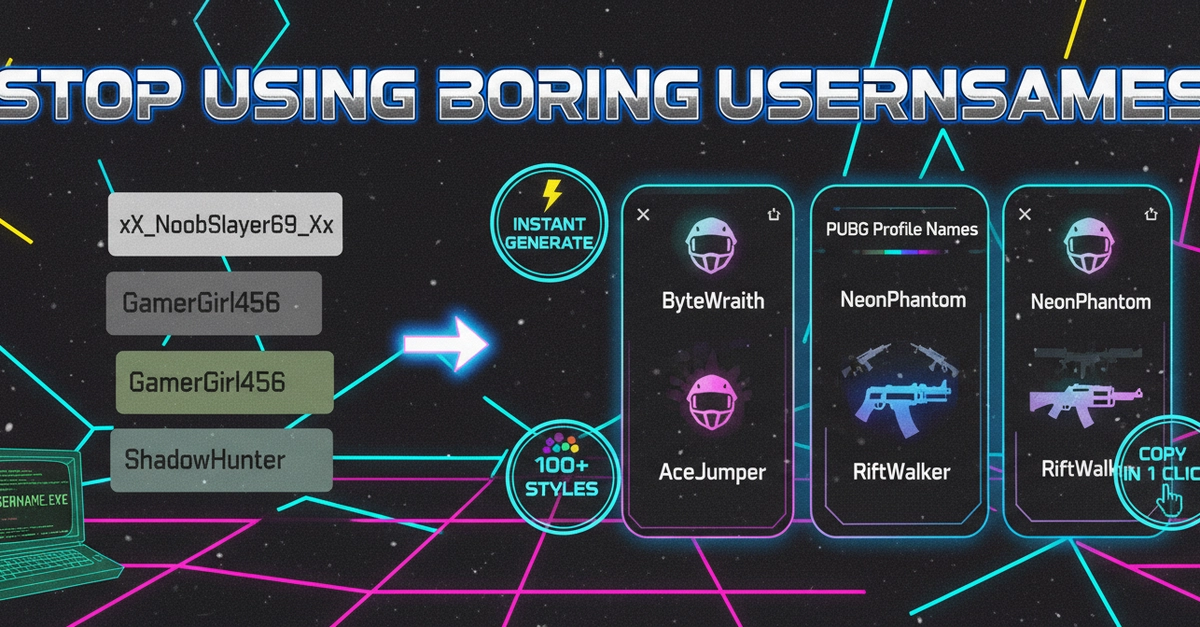
It’s just text.
Or so the prevailing wisdom goes, especially in the digital ether where quick logins and ephemeral interactions dominate. Yet, a subtle but powerful market dynamic is at play, one that reveals a deep human need for personal expression, even in the most seemingly trivial corners of online life. The humble username, often dismissed as mere metadata, is emerging as a significant artifact of digital identity, and platforms that ignore this are missing a key user engagement lever.
Consider the data points: A gamer might spend 10 minutes fine-tuning a loadout, another 30 seconds to initiate a match, and then, in a stark contrast, dedicate upwards of 30 minutes just to select a screen name. This isn’t an anomaly; it’s a pattern. It signals that for many, the username transcends its functional purpose. It becomes a digital avatar, a first impression delivered before any action, a mnemonic for friends, and, yes, even a taunt for adversaries. This qualitative shift in user behavior demands a quantitative re-evaluation of tool development.
The Identity Economy
This phenomenon isn’t confined to the gaming world. The impulse to personalize extends across platforms: social media bios, community forum handles, and general online identifiers. The original text highlights a creator’s realization that their username generator wasn’t just a novelty tool; it was an ‘expression tool’. The underlying market isn’t for random strings of characters, but for names that feel ‘cooler, cleaner, more personal, more ‘them’‘. This is the essence of the burgeoning identity economy – where digital real estate, even as small as a username, is highly valued.
It’s a simple truth: people personalize not out of necessity, but because it imbues an object, a profile, a digital space, with a sense of ownership. When users repeatedly engage in customization – testing styles, capitalization, symbols – they are signaling a demand for effortless experimentation. Providing an immediate, visual, and easily comparable experience, as the tool described does with its one-click copy feature, directly addresses this market need.
The current landscape of username generators, however, often falls short. Many are described as ‘random, hard to copy, full of ads, too many unnecessary options’. This points to a significant market gap. Users don’t want complexity; they want a curated experience that delivers on the promise of looking ‘good’. The success of a tool hinges on its ability to simplify, to be ‘instant, visual, easy to compare, one-click copy’. Naming should be fun, not an administrative chore.
A Historical Parallel
This user behavior is, in many ways, a modern echo of historical trends in branding and personal adornment. Think back to the early days of automobiles. Beyond basic transportation, buyers sought ways to distinguish their vehicles – custom paint jobs, distinct badges, interior modifications. These weren’t functional upgrades; they were statements of identity and status. The username, in its digital form, serves a similar purpose. It’s the digital equivalent of a personalized license plate or a unique ringtone, allowing individuals to carve out a small but distinct space in a crowded digital world.
Why Does This Matter for Developers?
For developers and platform creators, this trend has tangible implications. Prioritizing username customization isn’t just a feature; it’s a user retention strategy. When users invest time and effort into their digital identity, they are less likely to abandon a platform. The data suggests that users return to these tools, ‘scroll. compare. copy. go back. generate again.’ This iterative process indicates a deeper engagement than a single-use scenario. Platforms that make this process frictionless and enjoyable, rather than frustrating, will likely see higher engagement rates and stronger community building.
Ultimately, the market is speaking. People care about their usernames. They’re willing to spend time, and implicitly, money (or at least attention), to get them right. Tools that understand this nuanced need and provide elegant solutions are poised to capture significant user interest. The takeaway for creators is clear: treat the username not as an afterthought, but as a fundamental element of user experience and identity.
🧬 Related Insights
- Read more: GitHub Copilot App: IDEs No Longer Enough
- Read more: Blackwell GPUs: AI Kernel Shatters Speed Records
Frequently Asked Questions
What does a username generator tool do? A username generator tool helps users create and style unique online identifiers, often offering various fonts, symbols, and visual previews for selection.
How long do people spend choosing a username? While it varies, many users report spending considerable time, sometimes up to 30 minutes or more, selecting and refining their username.
Is a username important for online identity? Yes, especially in gaming and social platforms, a username serves as a primary identifier, a first impression, and a key component of a user’s digital persona. The more I looked at it…
And the more I realized:
People use styled names everywhere:
- Gaming profiles
- Social bios
- Usernames
- Community accounts
This became less of a gaming tool…
And more of an expression tool.
A lot of them felt:
- Random
- Hard to copy
- Full of ads
- Too many unnecessary options
But this is usually a quick decision.
People want:
“Show me names that look good.”
I kept it:
- Instant
- Visual
- Easy to compare
- One-click copy
Because naming should feel fun.
Not like filling a form.
I expected people to generate names once.
But I noticed something else.
People kept testing:
- Different styles
- Different capitalization
- Different symbols
Trying to find:
“That one name that feels right.”
People don’t personalize because they need to.
They personalize because:
It makes something feel like theirs.
If users repeatedly customize something…
👉 Make experimenting effortless.
A username isn’t just text.
Sometimes…
It’s the first thing people know about you.
Be honest
How long have you spent choosing a username?
- Under 1 minute
- 5–10 minutes
- Embarrassingly longer 👇