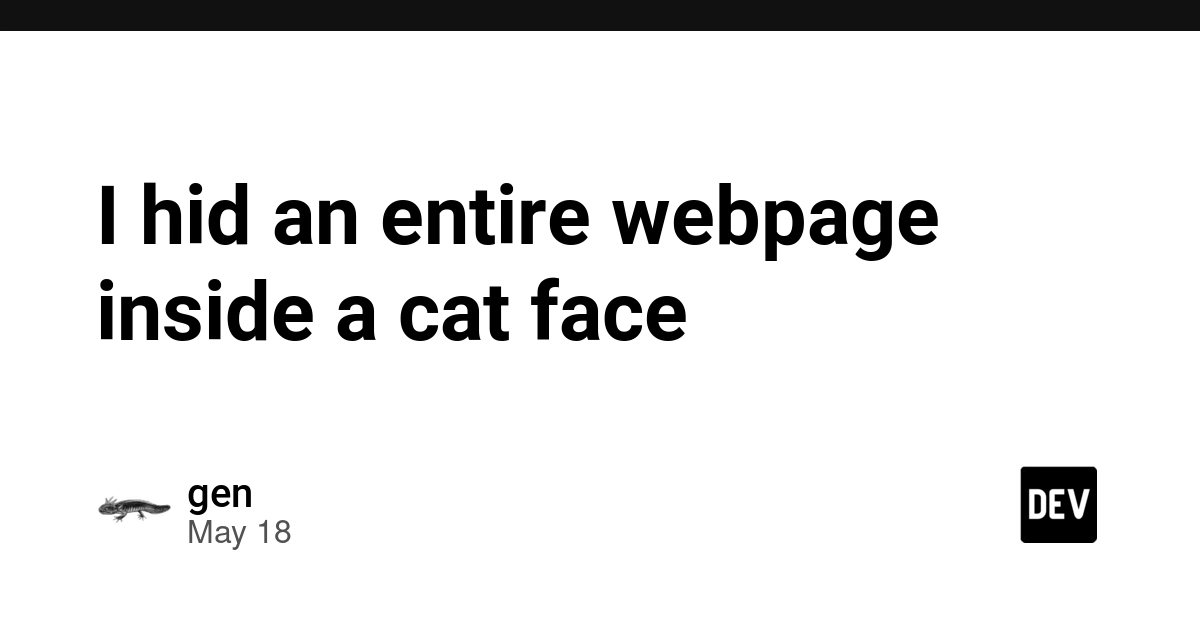
Look, for two decades now, I’ve been wading through the swamp of Silicon Valley’s endless parade of “innovations.” Most of it is vaporware, dressed up in buzzwords and aimed squarely at VCs looking for the next quick flip. So when I saw this tidbit about hiding a webpage inside a cat face, my first thought wasn’t ‘wow, clever,’ it was ‘who the hell is this for, and more importantly, who’s making money off it?’
Because, let’s be honest, the tech world thrives on making the simple complex, and then charging an arm and a leg for it. But this? This is something else entirely. We’re talking about embedding entire JavaScript programs, the kind that run animations and control layouts, into invisible Unicode Variation Selectors attached to an emoji. A cat emoji. That’s not just subtext; that’s a full-blown, hidden narrative playing out right under your nose, or rather, right next to your cat meme.
The magic, apparently, lies in Unicode’s Variation Selectors (VS), specifically U+FE00–FE0F and U+E0100–E01EF. These little digital chameleons can map precisely to 256 byte values. So, any sequence of bytes, any chunk of code, can theoretically hitch a ride on these invisible characters. It’s data transmission that bypasses the usual channels, slipping through the cracks of Slack, X, iMessage, and other platforms like a phantom limb.
So, What’s the Point? Beyond the Meme
This isn’t just a party trick for sad, lonely coders with too much time on their hands. Think about it: you can send a message, a seemingly innocuous string of text with an emoji, and have it carry a payload of actual, executable code. This code could be anything – a tiny game, a complex algorithm, or even something more sinister (though the article focuses on the ‘fun’ aspect).
And get this: it survives copy-paste. That means the invisible code isn’t lost when you share the message. It’s persistent. It’s like hiding secret instructions within a mundane grocery list, and the person reading the list automatically executes those instructions without even realizing it.
“Any byte sequence can ride inside normal text, invisible to readers, surviving copy-paste across Slack, X, LINE, iMessage. That’s subtext.”
This whole concept reminds me of early steganography techniques, where messages were hidden within images or other data formats. But this is on a whole new level. It’s digital graffiti, written in invisible ink on the walls of our everyday conversations. It’s the technological equivalent of a whispered secret in a crowded room.
Who’s Actually Making Money Here?
This is where my cynicism kicks in. Right now, it looks like a clever hack, a proof-of-concept. Nobody’s selling “Emoji-Code-as-a-Service” (yet). But that’s how it always starts, isn’t it? A cool, slightly weird demonstration of technical prowess. Then, someone figures out how to monetize it. Perhaps it’s a way to embed tracking scripts that are nearly impossible to detect, or a novel distribution method for niche software. Imagine embedding DRM-protected content that only activates when the emoji is “read” by a specific application.
Or, consider the open-source community. This could be a novel way to distribute small, self-contained libraries or tools, packaged in a way that’s incredibly accessible. Developers could share code snippets that are literally just an emoji in a chat window, but unlock powerful functionality when rendered by a compatible environment. That’s pretty neat, if you’re into that sort of thing. It feels like a quiet rebellion against the bloat of modern web development.
The Future of Invisible Data?
This is where we might be headed: a web where the visible content is just the tip of a very large, very hidden iceberg. We’re already drowning in data; this just adds another layer of obfuscation. The implications for digital rights management, content distribution, and even privacy (both for those hiding data and those potentially having data hidden on them) are significant. It’s a fascinating, slightly unsettling glimpse into what happens when cleverness meets the inherent malleability of digital communication. It’s not about the cat face; it’s about what’s behind the cat face, and the fact that it can now be anywhere, in anything.
🧬 Related Insights
- Read more: Linux’s Hidden Binary Ballet: ELF Parsing, Dynamic Linking, and Runtime Surprises
- Read more: Terminal Tantrums: Conquering Linux One Bash Blunder at a Time
Frequently Asked Questions
What does this technique actually do? This technique embeds executable JavaScript code within invisible Unicode Variation Selectors attached to an emoji, allowing a hidden webpage to function while appearing as just a simple character.
Is this safe to use? While the article focuses on the novelty, embedding arbitrary code, even disguised, carries risks. It’s essential to understand the source and purpose of any such hidden data before interacting with it.
Will this replace standard webpage development? Unlikely. This is a highly niche technique for specific use cases, not a replacement for traditional web development or content delivery methods.