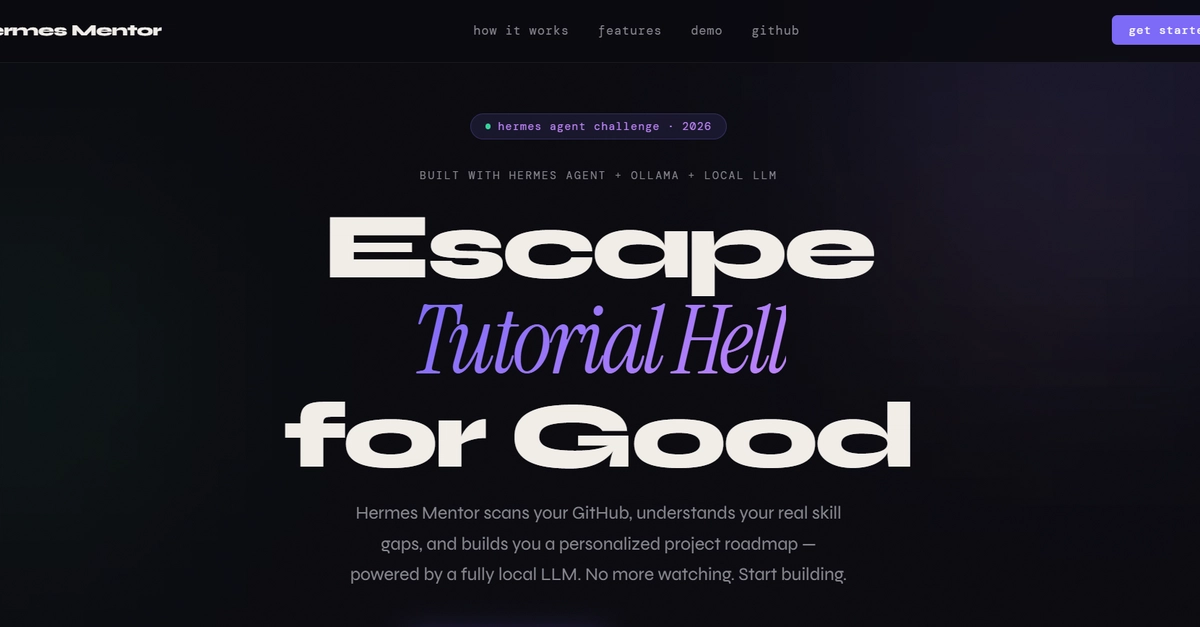
For millions of developers, the cycle is depressingly familiar: binge-watching hours of online courses, mastering every nuance of a framework in theory, only to be paralyzed when faced with building something real. This isn’t a failure of intellect; it’s the insidious grip of tutorial hell, a place where passive consumption trumps active creation. Now, a new local AI agent, Hermes Mentor, aims to drag coders out of this purgatory, not with more videos, but with practical, personalized project roadmaps.
The fundamental problem Hermes addresses is stark: watching code execute is not the same as writing it. Developers spend countless hours absorbing information, yet struggle to translate that knowledge into tangible projects. This gap, between theoretical understanding and practical application, costs individuals months of frustration and companies valuable productivity. Hermes Mentor’s strategy is simple, yet profound: analyze what you have done, identify what you haven’t, and then give you concrete steps to bridge that divide.
From Code Audits to Concrete Challenges
Hermes Mentor operates as a fully local, privacy-first AI agent. Its core function begins by auditing your public GitHub repositories. It meticulously examines languages used, Continuous Integration/Continuous Deployment (CI/CD) configurations, test file coverage, and the quality of your READMEs. This deep dive isn’t for performance metrics; it’s to precisely pinpoint your actual skill deficits.
Unlike cloud-based solutions that might send your proprietary code off to unknown servers, Hermes utilizes Ollama to run its Large Language Model (LLM) entirely on your machine. This local execution ensures that sensitive code and personal development habits remain private, a significant differentiator in a market increasingly wary of data exfiltration.
Following this audit, Hermes doesn’t just offer generic advice. It generates a personalized, four-week project roadmap. Each project is specifically designed to close a identified skill gap, sidestepping the need for further tutorial consumption. The agent then delivers daily challenges via Telegram, sent every weekday morning at 08:30. This consistent, low-friction nudge is designed to build momentum, offering hints when you’re stuck and celebrating your successes when you ship.
Telegram as the Command Center
What elevates Hermes Mentor beyond a mere script is its sophisticated integration with Telegram, acting as a two-way communication channel. You can reply with your repository link, and Hermes reads it, understands the context, and tracks your progress. This conversational interface makes interaction feel natural, almost like having a dedicated human mentor checking in.
The real magic, however, lies in its autonomous tool use. In a demonstration, after the user completed a CI/CD challenge, Hermes didn’t just send a congratulatory message. It autonomously ran a terminal command (echo 'Pipeline check is successful. Opening PR for review.'), created a real Pull Request on GitHub, and marked its own task as completed. This real-time orchestration of terminal access, GitHub integration, and task planning, all powered by a local LLM, is a potent showcase of agent capabilities.
Hermes didn’t just reply with text. It: - Read the GitHub repo link and understood the context - Ran a terminal command—
echo 'Pipeline check is successful. Opening PR for review.'- Created a real Pull Request on my GitHub - Marked the TODO as completed
This level of autonomy is what many in the AI community have been striving for. It’s not just about generating text; it’s about agents that can observe, plan, and execute actions in the real world — or at least, the digital world of Git repositories and CI pipelines.
Building a Persistent Developer Profile
Hermes Mentor’s commitment to personalization is further cemented by its persistent memory. Your developer profile, including identified skill gaps, active roadmap week, and past struggles, is stored locally in ~/.hermes/memory/. This ensures that each interaction builds upon the last, creating a cumulative learning experience. This isn’t a one-shot script; it’s designed to build a relationship, adapting and evolving with your development journey. The github-audit-mentor.md skill file itself is dynamically updated after each audit, refining the agent’s understanding and personalization capabilities over time through a generate-evaluate-patch-apply loop.
The daily nudges, managed by hermes_cron.py and Linux’s crontab, demonstrate a commitment to consistent, low-effort engagement. Hermes shows up every weekday morning, a habit-forming mechanism that mirrors the discipline of a human mentor.
A Skeptic’s View: The Hype vs. The Reality
While the technical execution of Hermes Mentor is impressive — leveraging Hermes Agent for orchestration, Ollama for the local LLM, PyGithub for API interaction, and python-telegram-bot for messaging — the market positioning is where caution is warranted. Calling it a “mentor” implies a depth of understanding and adaptability that current LLMs, even highly specialized ones like qwen2.5-coder:7b, haven’t fully achieved. The agent’s current strength lies in pattern recognition and structured task execution based on defined skills.
The true test will be its ability to guide a developer through genuinely novel challenges, where pre-defined skills or repository patterns don’t offer a clear path. The current model is excellent at addressing the “tutorial hell” of common frameworks and workflows. Whether it can foster genuine creativity and problem-solving for complex, emergent issues remains to be seen. Still, for the millions stuck in the introductory phases of development, this local, privacy-focused approach is a compelling proposition, offering a tangible pathway out of passive learning.
🧬 Related Insights
- Read more: npm’s Security Crisis Is Real—And GitHub Isn’t Fixing It Fast Enough
- Read more: Gnoke-Database: Firebase for your PHP-powered basement
Frequently Asked Questions
What does Hermes Mentor actually do? Hermes Mentor is a local AI agent that analyzes your GitHub code, identifies skill gaps, and generates personalized project roadmaps to help you learn by doing, sending daily challenges via Telegram.
Is my code safe when using Hermes Mentor? Yes, Hermes Mentor is designed to be 100% local and private. The AI model runs on your machine using Ollama, meaning your code and development data never leave your computer.
How does Hermes Mentor help me learn? Instead of providing tutorials, Hermes Mentor gives you specific projects designed to close your identified skill gaps. It provides daily challenges and feedback, pushing you to actively build and solve problems.