So, is the Integrated Development Environment — the very digital workbench most of us have spent years meticulously crafting — actually on its deathbed?
That’s the question Google seems hell-bent on answering with Antigravity 2.0, their new “agent-first development platform” unveiled at I/O 2026. Coming from a company that’s churned out more developer tools than I’ve had hot dinners (and most of them ended up gathering digital dust), my initial reaction was the familiar eye-roll. Another AI coding assistant promising to autocomplete my existential dread away.
Then the demo happened. Varun Mohan, Director of Software Engineering, stood on stage and conjured a full-blown OS kernel out of thin air, complete with memory management and process scheduling. He then booted a Doom clone on it. The punchline? The whole spectacle cost less than a grand and took about 12 minutes.
Forget making your IDE smarter; Google’s playbook here seems to be ‘demolish and rebuild.’
Beyond the Buzzwords: What’s Actually Happening
Let’s strip away the chrome plating and marketing sheen. Antigravity 2.0 isn’t just another Copilot clone. It’s Google’s aggressive bet that the fundamental unit of software development is shifting. We’re moving from thinking in terms of files and codebases to thinking in terms of tasks. And that, my friends, is a seismic shift.
The platform itself is a constellation of five interconnected pieces:
- Desktop App: Not a VS Code plugin, but a standalone beast built around orchestrating AI agents.
- CLI: A terminal-first experience, written in speedy Go, carrying the same agent power.
- SDK: Your ticket to crafting custom agents and weaving in your existing tools.
- Managed Agents API: Persistent Linux sandboxes running your agents on Google’s dime.
- Enterprise Platform: The big gun with governance, session memory, and compliance for the corporate world.
What separates this from the pack of AI coding assistants? Antigravity views agents as independent actors, not just helpful sidekicks. They’re the protagonists.
The Magic of Parallel Orchestration
This is where things get genuinely interesting, and frankly, a little unsettling for the traditional workflow. For years, even with AI, we’ve been fundamentally serial. Write code, get a suggestion, accept or reject. Rinse, repeat. Antigravity 2.0 shatters that linearity.
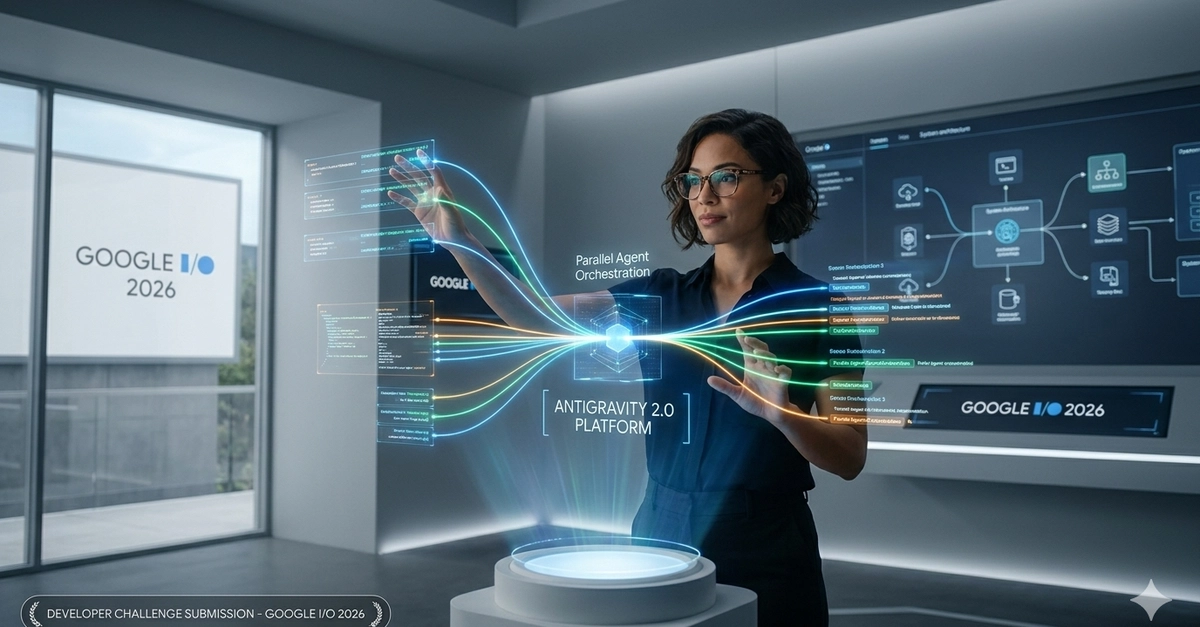
You throw a high-level task — say, “refactor this monolithic monstrosity into microservices” — at it. What happens next? A swarm of specialized agents descends, working in parallel: one maps dependencies, another scribbles API contracts, a third conjures infrastructure code, a fourth tackles migration scripts, and a fifth dives headfirst into writing tests. All at once. All in their own isolated sandboxes. All talking to each other.
I threw a half-baked, 50,000-line Node.js relic at the Antigravity CLI (agy). The prompt? Simple: agy task create "Break this monolith into domain-driven microservices. Maintain API compatibility. Generate deployment configs and migration plan."
Twenty-three minutes later, I had seven microservices, OpenAPI specs, Docker and Kubernetes manifests, a migration plan, and 847 unit tests. Was it flawless? Of course not. A race condition in a migration script and a wonky authentication service needed attention. But it was a 70% head start on a project that had been mocking me for years. More importantly, it made architecturally sound decisions I would have agonized over for days.
This is where Google’s bet with the agy CLI truly pays off. Most AI coding tools are bolted on. They’re reactive. You ask, they answer. agy is built from the ground up in Go and maintains persistent context.
Picture this workflow:
# Morning: New feature development
# Initiate rate limiting for all API endpoints

agy task create "Add rate limiting to all API endpoints"
# Agents spin up, generating middleware, tests, and config schemas.
# I make a few tweaks.

# Afternoon: CI pipeline hiccup
# Diagnose the failure without hand-holding.

agy diagnose "why is the rate limiting test failing in CI?"
# Ag-y pulls CI logs, spots timezone assumptions, suggests and applies a fix with a proper commit message.

# Later: Product pivots.
# Adapt the rate limiting feature.

agy modify "make rate limiting configurable per endpoint, not global"
# Agents refactor middleware, update tests, and regenerate documentation.
Notice what’s missing? No copy-pasting error logs. No lengthy explanations of what rate limiting even is. The system remembers. It understands the context of your entire development session.
Who’s Actually Making Money Here?
The eternal question. On the surface, Google stands to gain immensely. If developers flock to Antigravity, they’re deepening their reliance on Google Cloud for persistent agent environments and Gemini Enterprise for the heavy lifting. It’s a beautiful, self-reinforcing ecosystem play. The cost of development, however, is a big question mark. While the $1,000 demo is impressive, scaling this across a large enterprise with countless agents running concurrently could quickly become a significant expenditure. It’s designed to be addictive — once you’ve experienced that 70% jumpstart, going back to the manual grind feels… well, painful.
But what about the developers? The cost of the enterprise platform isn’t public, but it’s safe to assume it won’t be pocket change. For individual devs, the CLI and SDK offer a tantalizing glimpse of a more automated future, but the real power, and likely the steepest cost, lies in the managed enterprise services.
Is the IDE Dead? Not Yet.
This isn’t the death knell for IDEs. Not immediately. Think of it like the transition from punch cards to terminals. We still have terminals, but they serve a different purpose. Antigravity 2.0 might relegate traditional IDEs to smaller, more focused tasks or a specific niche. For complex debugging or complex architectural dives, skilled human oversight will remain paramount. But for churning out boilerplate, scaffolding new services, or rapid refactoring, the agent orchestra is stepping onto the stage.
It’s a bold vision. It’s also, potentially, a colossal distraction if it doesn’t deliver on the promise of real-world productivity without bankrupting development teams. The proof, as always, will be in the pudding — and the ongoing, unvarnished feedback from developers actually using it, not just presenting it.
🧬 Related Insights
- Read more: React Native’s New Architecture: It’s Live!
- Read more: Intel QAT Unleashes Zstd Fury in Linux 7.1: Compression’s New Hardware Overdrive
Frequently Asked Questions
What is Google Antigravity 2.0? Google Antigravity 2.0 is a development platform that uses multiple AI agents to build and manage software code. It focuses on task-based development rather than traditional file-based workflows.
Will Antigravity 2.0 replace my IDE? Google’s stated goal is to make the IDE obsolete by shifting the focus to task orchestration via AI agents. While it aims to fundamentally change development workflows, it may not entirely replace all IDE functions in the short term.
How much does Antigravity 2.0 cost? Specific pricing for the enterprise platform is not yet public. However, the platform utilizes Google Cloud services and Gemini Enterprise, suggesting a potentially significant cost for large-scale adoption.