The air in the developer community hummed with a certain expectation. We’d seen AI assistants churn out snippets, offer autocompletion, and even draft entire functions. It was helpful, a productivity boost. But the real seismic shifts? Those were still lurking, whispered about in feature requests and experimental betas. Everyone was bracing for the next step in AI’s integration into the developer workflow, but nobody quite saw this coming. Nobody expected their codebase itself to transform into a literal, playable dungeon.
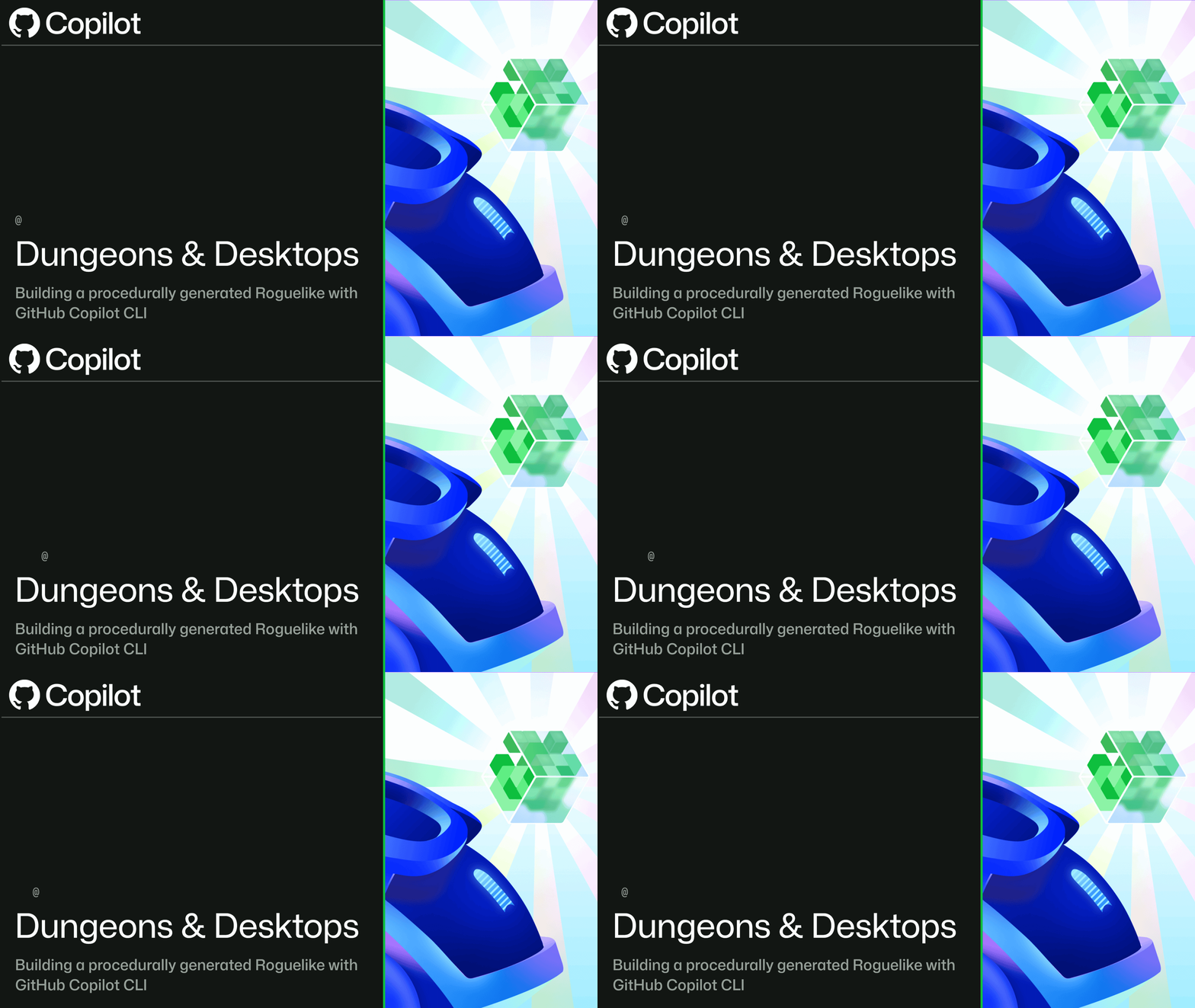
And yet, here we are. GitHub Dungeons, a project born from a seemingly offhand challenge, has turned the concept of ‘working with your code’ into a full-blown terminal-based roguelike adventure. It’s less about debugging and more about… well, dungeoneering.
This isn’t just another code generator. This is a profound architectural reimagining of what a developer tool can be. It takes the gritty, permadeath heart of classic roguelikes and grafts it directly onto the living, breathing organism of your software project. The implications for how we interact with, understand, and even play with our code are, frankly, staggering.
The Roguelike Renaissance, Reborn in the Terminal
Roguelikes, for the uninitiated, are a genre defined by procedural generation and permadeath. Think Rogue, NetHack, or Spelunky. Each play session throws you into a new, randomly generated environment, and when you die? You start from scratch. It’s a brutal but endlessly replayable loop.
The combination of procedural generation, permadeath, and text-based interfaces (later formalized in things like the “Berlin Interpretation”) makes the genre feel surprisingly modern, and a perfect fit for the command line.
This is where GitHub Dungeons finds its perfect niche. The command line, often derided as archaic, is actually the ideal canvas for this kind of deeply interactive, text-driven experience. And what better source for procedural generation than the very structure and evolution of a software project?
GitHub Dungeons uses a repository’s commit history as its seed. This means every commit, every change you make, directly reshapes the dungeon. The layout isn’t arbitrary; it’s a reflection of your code’s journey. Different repositories? Different dungeons. The same commit? The same layout. It’s a fascinating, almost meta-commentary on software development itself.
How Does Your Code Become a Dungeon, Anyway?
The magic happens through Binary Space Partitioning (BSP), a technique for recursively subdividing a 2D space. In essence, it’s a way to chop up the repository’s data into rooms and corridors. But instead of static design, the whole process is driven by the latest commit SHA. This ensures consistency: the same code state yields the same dungeon map, preserving the link between your development and the game world.
This isn’t just a neat trick; it’s a fundamental shift. We’re moving beyond tools that analyze code to tools that transform code into an interactive experience. It forces a different kind of engagement.
The Copilot CLI Effect: Delegation as the New Development
Building GitHub Dungeons wasn’t about painstakingly hand-coding every room or enemy. It was about describing the desired behavior to GitHub Copilot CLI. The /delegate command, in particular, stands out. It’s not just code generation; it’s task delegation to a cloud-based AI agent.
Think about it: you describe a feature – like making levels progressively harder with more enemies and health potions – and Copilot, via /delegate, handles the asynchronous heavy lifting. It spins up a pull request with a solid first pass, allowing you to then iterate and refine. This workflow feels less like coding and more like directing a highly skilled, albeit digital, team of developers.
This is where the real architectural shift lies. The developer becomes an architect of intent, a director of agents. The tedious work of implementation, the boilerplate, the edge cases – these are increasingly offloaded. The focus pivots entirely to the higher-level design, the player experience, the creative vision.
It’s akin to having an army of NPCs, as the project’s creator Lee Reilly put it, ready to tackle specific tasks. This frees up mental bandwidth. Instead of getting bogged down in syntax and compiler errors, you can stay immersed in the game design loop: prototyping mechanics, testing ideas, and figuring out what makes the game fun.
Beyond the Novelty: What This Means for Developers
So, is GitHub Dungeons just a fun distraction? Or does it signal something deeper? Look at the trajectory. We’ve gone from AI as a helper, to AI as a collaborator, and now, to AI as a transformer of our development environment itself.
This move toward delegating complex tasks, especially those involving creative or structural generation, opens up a Pandora’s Box of possibilities. Imagine this applied to other domains: generating documentation frameworks, creating interactive tutorials directly from code, or even simulating system load based on your codebase’s architecture. The potential for understanding and interacting with complex systems is immense.
It’s also a fascinating counterpoint to the doomsaying about AI replacing developers. This project, and the underlying technology, suggests a future where AI doesn’t just automate tasks but augments our creative capabilities in entirely new ways. It’s about building with AI, in ways we’re only beginning to comprehend.
The /yolo command, an alias for /allow-all, feels particularly apt. It’s a nod to the permadeath nature of roguelikes, but also, perhaps, a metaphor for the daring leap AI is taking into the developer workflow. We’re living on the edge of a new era, and it’s a good time to be exploring.
🧬 Related Insights
- Read more: GitHub’s Copilot Quietly Turns Your Code into AI Fuel—Opt Out or Feed the Beast?
- Read more: Google’s Scion Unlocks Parallel AI Agents — But Is It the Kubernetes Moment for Agent Orchestration?
Frequently Asked Questions
What does GitHub Dungeons do?
GitHub Dungeons uses GitHub Copilot CLI to transform a software repository into a procedurally generated roguelike dungeon that can be played in the terminal. The dungeon’s layout is seeded by the repository’s commit history, meaning changes to the code alter the game map.
How does Copilot CLI help build this?
Copilot CLI, particularly its /delegate command, allows developers to describe features in natural language and have the AI agent build them asynchronously, submitting the results via pull requests. This enables developers to focus on game design and experience rather than low-level implementation.
Is this a serious development tool or just a game?
While GitHub Dungeons is a playable game, the underlying technology and workflow demonstrate a significant advancement in how AI can be integrated into the development process. It showcases AI’s potential for complex content generation and task delegation, hinting at future applications beyond simple coding assistance.