The blinking cursor on a programmer’s screen, humming with the quiet urgency of a complex task, embodies the current state of AI’s long-context capabilities.
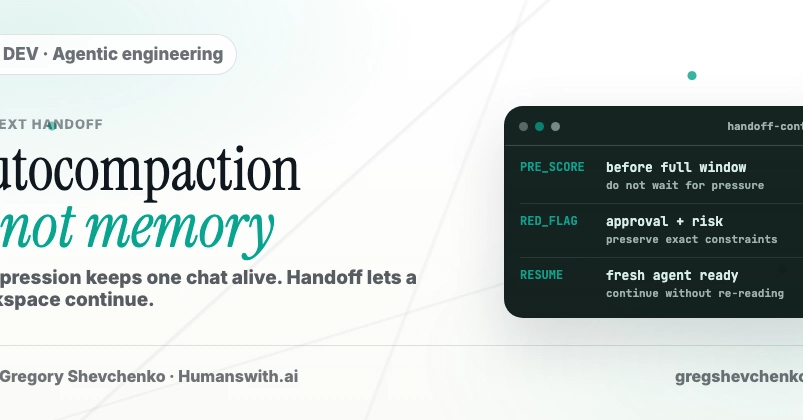
AI agents are getting better at summarizing our increasingly lengthy interactions. It’s a useful trick, no doubt. It allows tools like Claude Code, Codex, and Cursor to keep more of our ongoing session in view before the dreaded context window slams shut. But let’s be clear: this summarization, this ‘autocompaction,’ is not memory. Not in any meaningful sense for true team workflows.
What a team workflow actually demands is something far more rigorous than a politely condensed chat log. It requires portable operational state. This distinction — the difference between a summarized conversation and a transferable workspace — is the crux of the issue that keeps surfacing as I poke around local MCP token-economy stacks.
Autocompaction excels at its intended purpose: scrunching down the raw context of a product session when the memory window gets too full. For a solitary agent in a solo chat, this can indeed be a lifesaver. It preserves the general goal, compresses prior discussion, keeps the model from stalling, and mercifully spares the user the indignity of starting from square one.
That’s real value, plain and simple.
The wheels, however, start to wobble when the work transcends a single chat.
Consider a real-world repository. A single task can, and often will, ping-pong between Claude Code, Codex, Cursor, Windsurf, a remote Mac Mini, MCP tools, CI gates, and the ever-present human reviewer. In this complex dance, a narrative summary simply doesn’t cut it. It’s no substitute for an operational contract.
What truly matters in these handoffs are the granular details often deemed too messy for a neat summary:
- Which approvals were genuinely greenlit?
- Which specific files or services are explicitly off-limits?
- What precise values must absolutely not drift?
- Which sources are deemed trustworthy, semi-trusted, or entirely untrusted?
- Which errors have already been encountered and subsequently patched?
- Which commands executed successfully?
- Which verification checks are still awaiting completion?
- What exactly must the next agent refrain from redoing?
These aren’t mere ‘context’ points. They constitute control-plane state.
When this state evaporates during a compaction process, the subsequent agent might sound confident, yet it could be silently reintroducing risks that its predecessor had painstakingly resolved.
What’s needed is a local handoff MCP mechanism that meticulously crafts a structured handoff before the context window reaches its breaking point. The objective here isn’t to concoct a prettier summary. No, the real aim is to engineer a resume contract that another agent can safely and effectively utilize.
A minimal handoff protocol ought to preserve:
- The core objective and its defined completion state.
- All loaded instructions and critical constraints.
- The current approval status.
- Exact values that are non-negotiable.
- Identified risks and red flags.
- A clear log of actions already taken.
- Records of errors encountered and their resolutions.
- Pending verification items.
- A clear directive for the next recommended step.
- Explicit instructions on what not to redo.
This contract must reside within the workspace itself, not confined solely to the product’s proprietary chat memory.
The timing of these operations is critical. Autocompaction often kicks in only when context pressure is already high. Conversely, a well-designed handoff protocol can pre-emptively assess the session’s state earlier, determining if the next transition necessitates a standard summary, a red-flag alert, or a full-blown human intervention.
Look, a larger context window is indeed valuable. I want it, and I’ll certainly use it. It allows an agent to retain more code, logs, source material, and prior reasoning before compression becomes an immediate necessity.
However, a larger window primarily serves to delay the inevitable failure mode. It doesn’t automatically render state portable, trustworthy, auditable, or universally shareable across disparate products. A million tokens can still be a breeding ground for:
- Stale approvals that are no longer relevant.
- Buried, inadvertent secrets.
- Contradictory instructions that confuse the agent.
- Obsolete diagnostics that lead down the wrong path.
- Repeated, fruitless attempts at the same sub-task.
- Unlabeled source trust, leading to unvalidated information.
- A complete absence of a clear next step.
More room isn’t inherently better state management. It’s just more room.
Here’s the structured format that agents should ideally produce at genuine transition points:
## Objective
What we are trying to finish.
## Done Condition
The exact observable state that means this task is complete.
## Constraints
Loaded repo rules, user constraints, risk boundaries, and trust labels.
## Approval State
What the user approved, what remains unapproved, and what requires a checkpoint.
## Actions Taken
Commands, edits, deploys, external publications, or tool calls already completed.
## Verification
Checks that passed, checks that failed, and checks still pending.
## Red Flags
Secrets, live ops, destructive commands, ambiguous ownership, or same-defect loops.
## Next Step
The recommended next action for a fresh agent.
## Do Not Redo
Work already completed or paths already ruled out.
This is deliberately unglamorous. Effective handoff isn’t meant to be a dazzling display of cleverness. It’s meant to be unambiguous, to be difficult to misinterpret.
The truly valuable metric isn’t the aesthetic appeal of a summary. It’s whether the subsequent agent can pick up the thread with minimal waste and significantly fewer errors.
I’d be measuring:
- Resume success: Can a fresh agent, relying solely on the handoff, confidently execute the next step?
- Re-read rate: How often does the agent need to revisit old files or previous chat context?
- Token estimate: How much context was successfully avoided during the resume process?
- Leak rate: Did any secrets, proprietary implementation details, or forbidden facts inadvertently slip into the handoff?
- Approval preservation: Did the resumed agent correctly maintain the established permission boundaries?
- Redo rate: Did the agent fall into the trap of repeating already completed work?
This is where the MCP token-economy angle finds its practical application. The goal isn’t just token reduction. It’s about minimizing unsafe or inefficient recovery loops.
This pattern becomes indispensable when:
- a coding session nears its context limit;
- a task is transitioning through multiple specialized tools; or
- multiple developers, or AI agents, need to collaborate on the same codebase.
Larger context windows are a welcome addition, but they represent an incremental improvement, not a fundamental shift in how AI agents will truly remember and collaborate.