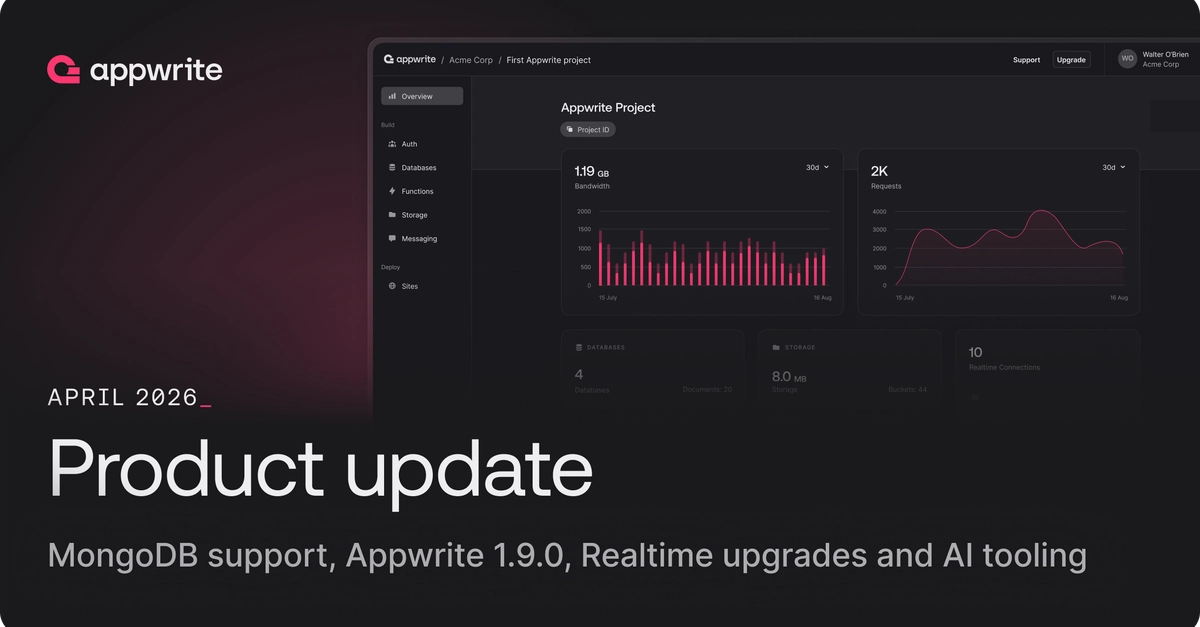
MongoDB has officially partnered with Appwrite. This isn’t just a co-marketing exercise; starting with Appwrite 1.9.0, self-hosted deployments can now run directly on MongoDB infrastructure. Forget the days of being locked into Appwrite’s default SQLite for your own servers – now you can use your existing MongoDB deployments.
This move is substantial. It means Appwrite users can utilize their established MongoDB backups, monitoring, and scaling solutions while remaining fully open-source and self-hosted. The company is touting “no breaking changes” and “no rewrites,” a critical promise for any business relying on a stable backend. Beyond the big database news, 1.9.0 also brings quality-of-life and performance boosts, including better handling of large integers, new string column types, configurable caching, and improved observability for database usage.
Is This a Strategic Pivot or Just an Upgrade?
The implications here are enormous for the open-source BaaS (Backend-as-a-Service) market. For years, Appwrite has been lauded for its ease of use and developer experience, often pitching itself as a simpler, open-source alternative to proprietary solutions. Its default SQLite database, while convenient for getting started, has always been a limiting factor for larger, more demanding applications or organizations already invested in other database ecosystems.
By officially supporting MongoDB – a heavyweight in the NoSQL space, particularly popular with web and mobile developers – Appwrite is directly addressing a significant market demand. This isn’t just about offering another database option; it’s about making Appwrite a more viable and scalable choice for serious production workloads and enterprises that have already committed to MongoDB. It’s a strategic play to capture a wider audience and deepen its integration into existing tech stacks.
But this raises an eyebrow. For years, Appwrite’s simplicity was its selling point, often built around the idea of a single, managed solution. Integrating a complex, distributed database like MongoDB could introduce new operational overhead for self-hosted users. The devil, as always, will be in the details of implementation and the ongoing support for this integration.
Infrastructure Gets a Major Overhaul
Beyond the database, April was a busy month for Appwrite’s core infrastructure. Developers can now manage their Appwrite environments using Terraform. This is a huge win for DevOps teams, allowing for declarative infrastructure-as-code for databases, storage, functions, authentication, and messaging. It’s designed to work with both Appwrite Cloud and self-hosted setups, promising consistent deployments across development, staging, and production.
Realtime has also undergone a significant rewrite. The move to a message-based protocol over a single, persistent WebSocket connection means better scalability and predictability. No more managing multiple subscriptions on separate connections, no more URL length limits for complex subscriptions. This is crucial for applications requiring high volumes of real-time data updates.
Performance also gets a boost with list response caching. By implementing in-memory caching with a configurable Time-To-Live (TTL), Appwrite can now skip database reads for repeated queries until the cache expires. This should dramatically speed up common use cases like feeds and dashboards, with the added benefit of being permission-aware, ensuring users only see what they’re supposed to.
AI Tooling Continues to Expand
Appwrite is clearly leaning into the AI wave. The addition of a Webhooks API, manageable via Server SDKs, simplifies automation for CI/CD or multi-tenant systems, a key component for integrating with AI workflows. The official Rust Server SDK is also a significant addition, catering to developers who prefer Rust for its performance and type safety, especially in backend services.
The real AI story, however, lies in the integrations with tools like Claude Code and Cursor. The new Appwrite plugin for Claude Code aims to streamline the process of connecting AI agents to a real backend, providing the right context from the start. Similarly, the Appwrite plugin for Cursor, a popular AI-first code editor, simplifies building with Appwrite by including built-in support for the CLI and SDKs. These integrations look less like afterthoughts and more like a concerted effort to embed Appwrite into the AI-assisted development toolkit.
The Appwrite MCP (Model Contextual Processing) Server 2.0 also gets a mention, touting a simpler architecture and reduced model context usage. This is important as the cost and efficiency of AI model inference become increasingly critical. Community recognition for Abid’s early work on optimizing MCP server context usage highlights the collaborative spirit and the direct impact of community contributions on the platform’s evolution.
You can now manage your Appwrite infrastructure using Terraform. Define databases, storage, functions, auth, messaging, and more using HCL, and apply changes consistently across environments.
This integration with Terraform, combined with the broadened database support, suggests Appwrite is moving beyond its early-stage developer playground image. It’s making a credible play for the enterprise developer, the kind who needs strong tooling, predictable scaling, and integration with established infrastructure management practices.
The future, as described by Appwrite, involves deeper database flexibility and more AI-assisted development tools. Given the trajectory, expect Appwrite to continue solidifying its position as a competitive open-source BaaS, particularly appealing to developers who want control and flexibility without sacrificing developer experience. The MongoDB partnership is the most compelling data point from April, signaling a new era for the platform’s ambition and reach.
🧬 Related Insights
- Read more: 47 Commits, Zero Users: The 13-Day Fix for Stalled Projects
- Read more: Archon Tops GitHub: The AI Harness That’s Everywhere—But Not Autonomous
Frequently Asked Questions
What does the MongoDB partnership mean for Appwrite? It means self-hosted Appwrite deployments can now officially use MongoDB as a database backend, allowing users to use their existing MongoDB infrastructure for backups, monitoring, and scaling.
How has Realtime been improved in Appwrite 1.9.0? Realtime now uses a message-based protocol over a single WebSocket connection, enabling multiple subscriptions on one connection, easier updates without reconnecting, and eliminating URL length limits for more predictable, scalable real-time experiences.
Are there new AI development tools in this update? Yes, Appwrite has introduced plugins for Claude Code and Cursor, and improved its MCP server, all aimed at making AI-assisted development more integrated and efficient with Appwrite projects.