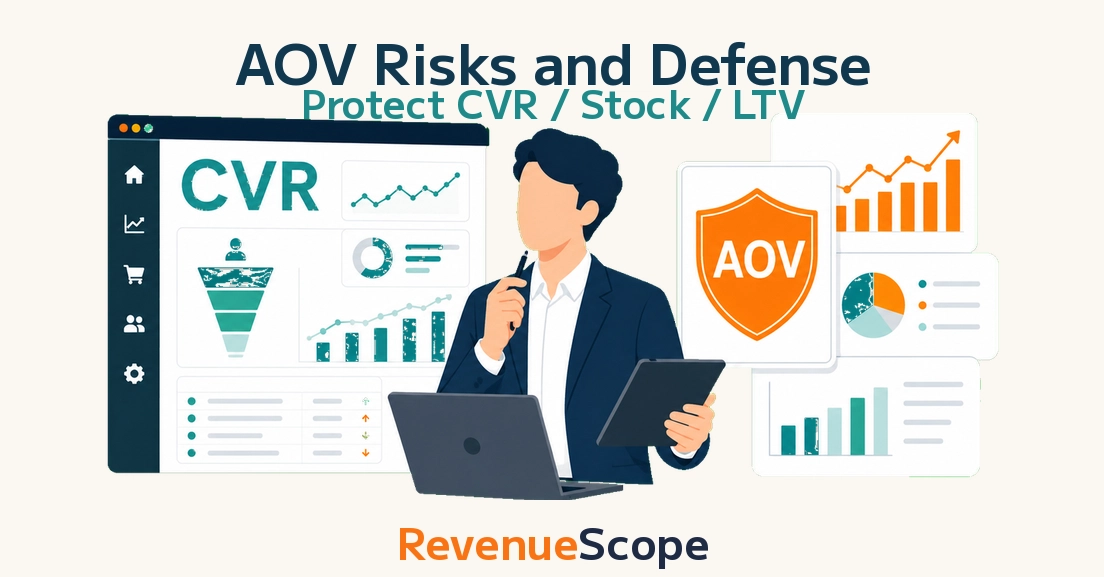
For months, the gospel preached in ecommerce boardrooms has been simple: push Average Order Value (AOV). The logic is seductive: get customers to spend more per transaction, and revenue must follow. So, the initial reports of AOV climbing 20% likely landed with a collective sigh of relief across many digital storefronts. But here’s the kicker: for many, monthly revenue is flat. Or worse, slightly down year-over-year. This isn’t just a blip; it’s a market dynamic shift nobody seems to have priced in.
When that AOV surge comes at the steep price of a 15% drop in Conversion Rate (CVR), followed by slower inventory turnover and a reversed repeat purchase rate, the revenue formula doesn’t just break — it implodes. The plays that move the needle most violently also tend to generate the loudest, most disruptive side effects. It’s a high-stakes game where the reward is often overshadowed by the unanticipated, and frankly, avoidable, fallout.
The Double-Edged Sword of AOV Uplift
Revenue, at its core, is a simple equation: sessions × CVR × AOV. You can boost AOV by 20%, but if your CVR simultaneously tanks by 20%, and traffic remains static, your total revenue actually decreases by 4%. It’s a stark reminder that these levers rarely, if ever, operate in isolation. They’re interconnected, interdependent, and often, antagonistic.
Look, most AOV uplift tactics force the customer’s hand. They push for more items, or higher-priced ones. Cross-selling on the product detail page (PDP) or in the cart, for instance, often nudges customers toward products they hadn’t considered. When this pressure crosses an unseen threshold of perceived value or necessity, two things happen: cart abandonment spikes, or post-purchase returns surge. Baymard Institute’s data is damning here: a staggering 48% of cart abandonment is attributed to unexpected costs at checkout. Think about that. Iconic AOV plays like threshold-based free shipping or last-minute cart upsells can quite literally become the primary drivers of CVR decline if they’re not meticulously designed.
And it’s not just conversion rates that suffer. Inventory management gets hammered. Bundles miss sales because one component SKU sells out faster than its partners. Subscriptions, pitched as a predictable revenue stream, can trade immediate first-order AOV for a churn rate that craters long-term Customer Lifetime Value (LTV). It’s a financial tightrope walk where missteps are costly.
Mapping the Risks: 10 Levers, 4 Core Dangers
This isn’t theoretical. We’ve cataloged ten common AOV uplift strategies and their predictable failure modes. Each lever carries one of four primary risks: a hit to CVR, undue pressure on inventory, a reverse in customer LTV, or a fundamental mismeasurement of its true impact.
- Free Shipping Threshold Raise: Primary risk is CVR drop due to sticker shock. Secondary risk? LTV reversal from customers who feel coerced into buying more than they wanted and end up unhappy.
- Cart Upsell: High CVR drop potential as customers bail at the last minute. A secondary risk is mismeasurement, particularly if forced returns mask the true cost.
- Bundle Sale: The immediate danger here is stock pressure. If one item in a bundle runs out, the whole deal sours. A subtler risk is mismeasurement, inflating unit AOV without truly increasing value.
- Cross-Sell (PDP / Cart): Classic CVR drop risk. Customers might feel overwhelmed. Secondary risk is LTV erosion if these aren’t genuine recommendations.
- Quantity Discount: Another stock pressure candidate. More importantly, it can lead to LTV reversal if customers simply stockpile and delay repeat purchases.
- Subscription: The big one is LTV reversal via early churn (the 60-day mark is often telling). Mismeasurement is also a risk if you’re not tracking true retention.
- Premium Product Line: Stock pressure is real. But more than that, price confusion can drag down CVR.
- Paid Gift Wrapping: Surprisingly, this often leads to a CVR drop. Its secondary risk? Minimal.
- Conditional Free Shipping: Puts pressure on LTV, as customers might feel obligated. Mismeasurement is also a concern.
- Next-Order Coupon: Creates an LTV reversal pattern where customers delay purchase to use the discount. Mismeasurement is a consistent theme here too.
Where to Play: A Strategic Quadrant
When selecting an AOV lever, the deciding factor shouldn’t just be potential uplift. It must be grounded in an understanding of your customer’s core motivation – are they driven by necessity or preference? Preference-driven categories are far more sensitive to CVR shifts, while necessity-driven ones have a higher LTV elasticity. Mapping these levers onto an ‘AOV Uplift vs. CVR Risk’ quadrant provides immediate clarity.
The ideal zone, bottom-right (high AOV, low CVR risk), includes levers like bundle sales, quantity discounts, conditional free shipping, and next-order coupons. These offer a better balance. The top-right, high AOV with high CVR risk, is where the real strategic thinking must happen before launch. Premium product lines and raised free shipping thresholds fall here. They demand strong defense plays. And then there’s the top-left: low AOV, high CVR risk. Paid gift wrapping, in this model, is an outlier. Is it worth the potential churn?
The Early Warning System: 5 KPIs to Watch
Monthly reviews are a relic of a slower age. In today’s environment, you need real-time or at least weekly vigilance. These five Key Performance Indicators (KPIs) are your early warning system. Set thresholds, monitor them relentlessly, and act fast:
- CVR: Flag any instance where CVR drops by 10% or more for two consecutive weeks compared to the preceding four-week average.
- Inventory Turnover Days: Watch for a 30% or greater deterioration in key SKUs. A jump from 30 days to 39 days is a flashing red light.
- 60-day Repeat Rate: A drop of 5 percentage points or more year-over-year is a serious LTV signal.
- AOV Variance (Standard Deviation): A 50% or greater expansion in the standard deviation suggests one customer segment is reacting disproportionately, often negatively.
- Return Rate: A rise of 2 percentage points or more within four weeks of a new lever’s launch points to forced upsells or misaligned expectations.
Building the Defense: Proactive, Not Reactive
Designing your defense mechanism before you roll out an AOV lever is the single most impactful way to mitigate post-launch chaos. It’s about anticipating the blowback. For instance, if you’re raising the free shipping threshold, your defense might involve clearer communication about the threshold before checkout, or offering a smaller, complementary item that pushes the customer just over the line without creating “sticker shock.” For a bundle, ensuring strong inventory management and clear communication on component availability is paramount. The goal is to move from reactive firefighting to proactive risk management, cutting down those frantic post-launch sprints by an order of magnitude.
Ultimately, the pursuit of AOV isn’t inherently flawed. But the current, often myopic, focus on it without a commensurate emphasis on its ripple effects is a recipe for suppressed revenue. It’s time for a more holistic view of the ecommerce P&L.
🧬 Related Insights
- Read more: GitLab GovRAMP: Faster Path to Secure DevSecOps
- Read more: 5 No-Signup Online Tools Developers Secretly Use
Frequently Asked Questions
What is AOV and why is it important? AOV, or Average Order Value, is the average amount a customer spends per transaction. It’s important because increasing it can directly boost revenue without necessarily increasing marketing spend on customer acquisition.
Will these AOV strategies hurt my business? Yes, they absolutely can if not implemented carefully. The original content highlights that strategies designed solely to increase AOV can negatively impact Conversion Rate (CVR), Customer Lifetime Value (LTV), and inventory turnover, potentially leading to stagnant or declining overall revenue.
How can I monitor AOV strategies effectively? The article recommends tracking five key performance indicators (KPIs) weekly or in real-time: Conversion Rate (CVR), inventory turnover days, 60-day repeat rate, AOV variance, and return rate. Setting warning thresholds for these metrics is crucial for early detection of problems.